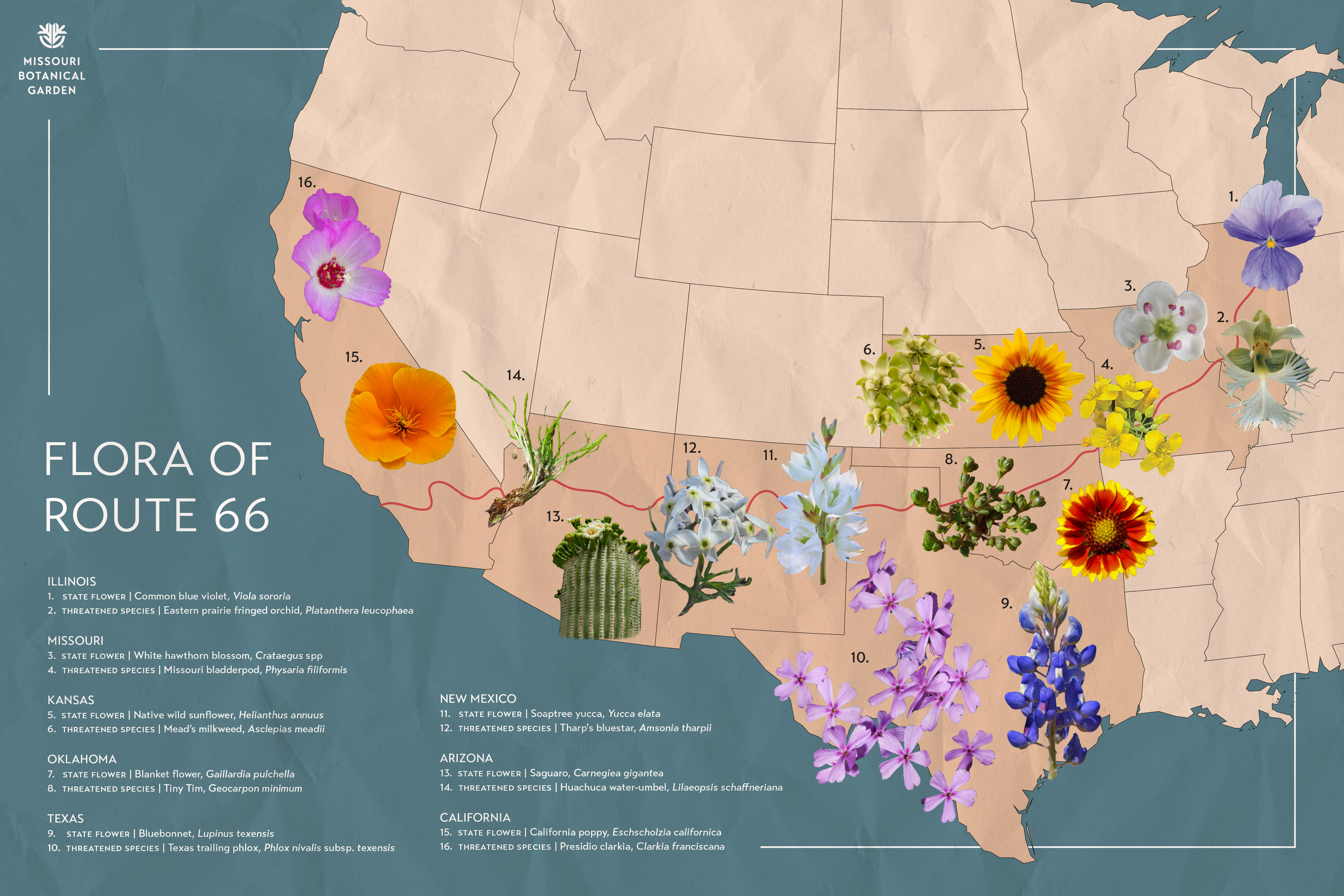
Established in 1926, Route 66 is one of America’s original highways that ran from Chicago to Santa Monica. For decades, road trips across the nearly 2,500-mile route have been an opportunity to see many unique sights of America, including its native flora.
The route includes five major ecosystems, each with endemic species that occur nowhere else in the world. But with booms in population and development over the past century, America’s landscape is vastly different from 1926. Once-prevalent plants face the threat of extinction or have already disappeared altogether.
During this special 100-year anniversary year, we invite you to learn more about the native flora of Route 66. In Part 1, we shared this native flora as represented by their state’s chosen floral emblem. Now, we explore some of the most vulnerable species along the Mother Road that the Missouri Botanical Garden is working to protect.
Changing Landscape

As Route 66 has changed over the past century, so has the flora around it. Once prominent species, like the Ozark chinquapin, have all but disappeared. Invasive species, like bush honeysuckle, Callery pears, and tree of heaven fill the landscapes. What native flora does remain faces threats from habitat destruction, changing climate, disease, invasive species, and human activity.
Saving America’s Most Threatened Species

To preserve the nation’s most threatened species of plants and animals, President Richard Nixon signed the Endangered Species Act (ESA) into law in 1973. Today, there are 941 plant species listed on the ESA. The Missouri Botanical Garden is working on conservation with 154 species on the list. This includes conservation ex situ in the Garden’s Living Collections and in the Garden’s Seed Bank, and in situ conservation projects protecting plants in their native habitats. The Garden’s Herbarium also contains specimens of hundreds of listed species. Herbarium specimens can support a variety of research projects, helping restoration and conservation efforts worldwide. Through the Revolutionizing Species Identification project, the Garden is using cutting-edge technology to make this critical data freely accessible to scientists, conservationists, and policymakers globally.
Collectively, the states along Route 66 contain 254 listed species, including several Garden scientists are helping save. Below, we highlight a species from each of the eight states on Route 66.
1. Illinois: Eastern Prairie Fringed Orchid, Platanthera leucophaea

About the species
Many people think of orchids as tropical plants, but Illinois is home to around 45 native orchid species, including the Eastern Prairie Fringed Orchid, Platanthera leucophaea.
Unlike the more familiar colorful tropical orchids that frequently grow in trees, Platanthera leucophaea, is a ground orchid with creamy white flowers. This orchid grows in eight U.S. states, including Missouri and Illinois. It is federally listed as a threatened species.
Garden Conservation Efforts
Garden scientists took three trips to northern Missouri to count and map plants in wild populations and hand-pollinate them to maximize their seed production. Scientists collected seeds to bring back to the Seed Bank and to study in the micropropagation lab.

In the lab
Scientists germinated the orchid seeds in petri dishes, experimenting with two different approaches. One mimicked how this species grows in nature (with mycorrhizal fungi) and another used nutrient-rich media alone.
A symbiotic relationship is a mutually beneficial, long-term interaction between two organisms. Nearly all orchids have a symbiotic relationship with the microscopic mycorrhizal fungi.
After the seeds sprouted, the plants advanced through multiple growth stages before the team moved them into potting mix. The young plants spent several months in a climate-controlled growth chamber to slowly acclimate them to greenhouse conditions. The plants are now growing at the Oertli Hardy Plant Nursery. The team plans to continue testing growing methods to support reintroducing this rare orchid to the wild.
In the Herbarium
The Missouri Botanical Garden has 30 Platanthera leucophaea specimens in its Herbarium. This includes 11 specimens from Illinois. The oldest specimen dates back to 1835.
2. Missouri: Missouri bladderpod, Physaria filiformis

About the species
Missouri bladderpod is an herb in the mustard family (Brassicaceae) with yellow flowers that bloom in spring. It grows mostly in limestone glades in three different soil types across three disconnected locations in Missouri and Arkansas. It is federally listed as “threatened.”
Garden Conservation Work

Given its unusual geographic distribution, Missouri Botanical Garden scientist Christy Edwards and collaborators wanted to understand if Missouri bladderpod’s genetics varied by population and soil type. In analysis, they found that populations thought to be P. filiformis in the Ouachita Mountains in Arkansas were actually a genetically distinct new species. A recently-published paper establishes this population as a new species, Physaria ouachitensis. The population in Arkansas is the only known population of this new species. Giving this unique species a name is an essential step in adequately conserving this extremely rare plant.
In the Seed Bank
The Garden’s conservation team is using the genetic analysis to guide seed collection from the most genetically diverse populations to safeguard the species in its frozen seed bank. Vice President of Conservation and Restoration Matthew Albrecht currently has a contract with Missouri Department of Conservation to expand seed collections of this threatened species.
In the Herbarium
The Garden’s Herbarium houses 63 specimens of Physaria filiformis, including 18 from Arkansas. A portion of the Arkansas specimens likely represent the new species.
3. Kansas, Mead’s milkweed, Asclepias meadii

Thanks to its relationship with the charismatic — and threatened — monarch butterfly, Mead’s milkweed, Asclepias meadii, is perhaps the most well-known threatened U.S-native plant. Mead’s milkweed’s is native to eastern tall grass prairies and is currently found in four states, including Kansas and Missouri. The plant has a long lifespan but can take many years to first flower. Once flowering, the plant produces pale green to pale yellow flowers, blooming in May and June each year.

Garden conservation efforts
Scientists studying the decline of Mead’s milkweed noted the species struggled to reproduce. Garden scientists Christy Edwards and Albrecht looked closer at the species’ genetics and found the problem wasn’t genetic diversity. Many Mead’s milkweed populations just didn’t have enough flowering plants to reproduce. They concluded the most effective conservation approach for Mead’s milkweed was to ensure a population had at least 50 flowering plants. This study informed how land managers like the Missouri Department of Conservation are managing the species.
Conservation genetics studies provide information about genetic diversity and genetic structure to inform conservation strategies. They can also help scientists understand mating systems, pollinator relationships, and seed dispersal of plant species.
Edwards is continuing this research with a study looking at 14 populations of Mead’s milkweed to see if a lack of pollinators or other resources is causing the lack of reproduction. She and colleagues are also conducting experiments to help failing populations, including hand-pollinating plants and supplementing with seedlings grown in the Garden’s Oertli Family Hardy Plant Nursery.
In the Seed Bank
One obstacle to increasing population size to reach the desired population size of 50 flowering individuals was a lack of seed, given the low reproductive success. Recent field work allowed the teams to collect a large quantity of seeds to use in restoration efforts.
In the Herbarium

The Garden’s Herbarium houses 29 specimens of Asclepias meadii, including two type specimens collected in the 1840s by Samuel Barnum Mead. Mead was the first scientist to collect the species and the species namesake.
4. Oklahoma: Tiny Tim, Geocarpon minimum

About the species
This petite plant is less than 2 inches in size, earning it the common name “Tiny Tim.” Its leaves are about .01 inches in size, and its tiny purple flowers are no larger than .02 inches.

Garden Conservation Efforts
Garden researchers analyzed genetic diversity and found Geocarpon minimum self-fertilizes, and in most cases, all individuals in a population are genetically identical. Each population, however, is genetically different from the others.
A plant population refers to all plants growing in a specific geographic area.
To conserve the species, the team recommended protecting a large proportion of the population of the species.
After successful conservation efforts, the U.S. Fish and Wildlife Service is recommending this species be removed from federal protection.
In the Herbarium
The Garden’s Herbarium holds 34 accessioned specimens of Geocarpon minimum, mostly from Missouri with two specimens from Arkansas. The plant’s range is from Missouri to Texas.
5. Texas: Texas trailing Phlox, Phlox nivalis subsp. texensis

About the Species
The trailing stems of this phlox species spread horizontally and vertically, eventually forming a small mat. It produces pink blooms from March to May. Its trailing, woody stems, and needle-like leaves make it distinct from other Texas phlox species. Growing only in the Longleaf Pine region of East Texas, this species is federally listed as endangered.
Garden Conservation Efforts

Garden scientists led by Edwards are investigating the genetic diversity, pollination, and seed germination of Texas trailing phlox. For their first study, they visited every possible location where the species historically grew in the wild and collected 261 samples from four remaining populations. The team found that this species is genetically unique from other subspecies of Phlox nivalis and that only 225 individuals of this once-widespread species remain.
In the Greenhouse
The Garden team recently collected over 100 cuttings to build a conservation collection. Scientists will use these specimens to test for reproductive issues and to generate seed to investigate seed germination biology. Ultimately, they will use the plants to help increase population size in small populations of the species.
6. Arizona: Huachuca water-umbel, Lilaeopsis schaffneriana

About the species
An aquatic plant in the carrot family, Apiaceae, this species grows in shallow waters. Its hollow, vertical leaves are sometimes mistaken for a grass. It produces tiny white flowers from March to October. There are two recognized subspecies of Huachuca Water umbel, including Lilaeopsis schaffneriana subsp. recurva that grows in southern Arizona and Mexico. It is federally listed as “endangered.”
A subspecies is a taxonomic rank below species used to describe populations of the species that grow in different locations and have unique physical or genetic traits.

Garden conservation efforts:
Another study led by Edwards looked at the relationship between the two subspecies: subsp. recurva and subsp. schaffneriana. The team found that subsp. recurva is closely related, but genetically distinct, from subsp. schaffneriana in Mexico and merits conservation. They also found that subsp. schaffneriana, which was also thought to be native to Ecuador, is genetically distinct and should be recognized as a new species. Describing a new species is the first essential step in conservation.
In the Garden’s Herbarium
The Garden’s Herbarium has three specimens specifically labeled as Lilaeopsis schaffneriana subsp. recurva, including one collected in 1881.
7. New Mexico: Tharp’s Bluestar, Amsonia tharpii

About the species
This species can grow to about 2 feet tall, with green and purple stems and blooming with pale-blue or greenish white star-shaped flowers. It is known from six sites in a small region of New Mexico and one site in Texas. Its native habitat has been under extreme drought for more than 20 years. It is a “federal candidate” species being considered for protections.
Garden conservation efforts

On a trip to the Chihuahuan Desert, a Garden team collected seed of Amsonia tharpii under a permit from the Bureau of Land Management. The goal is to safeguard the genetic diversity of the population by having it represented in the Garden’s living collection. Recently, scientists started growing this species in the micropropagation lab. Eventually, it will be displayed in the Shoenberg Arid House.
In the Herbarium
The Garden’s Herbarium holds three specimens of Amsonia tharpii, including one collected by the plant’s namesake, Benjamin C. Tharp. The Tharp specimen is from 1943, five years before it was officially described as a new species.
8. California: Presidio clarkia, Clarkia franciscana

About the species
A member of the evening primrose family, Presidio clarkia’s pink or lavender flowers bloom from May to July. The flower’s center is bright red. It is only grows in a handful of sites in the Bay Area.
Garden conservation
Although the Garden doesn’t have any active projects focused on this species, Clarkia franciscana‘s scientific beginnings are tied to the late Peter Raven, who served as Garden president for nearly 40 years. Raven, who grew up in California, first collected this species when he was just 16. The species had not been seen in the area since 1900. He and Harlan Lewis, who served as a mentor, described it as a new species in 1958.
In the Herbarium

The Garden’s Herbarium holds two species of Clarkia franciscana including one collected by Peter Raven when he was a teenager.
Catherine Martin
Senior Public Information Officer
Many thanks to Scientist Christy Edwards, Living Collections Director Becky Sucher, Vice President of Conservation and Restoration Matthew Albrecht, Shaw Nature Reserve Director Quinn Long, Horticulturist Jared Chauncey, Herbarium Director Jordan Teisher, Seed Bank Director Meg Engelhardt, and Assistant Scientist Aaron Floden for providing information for this article.
Leave a Reply