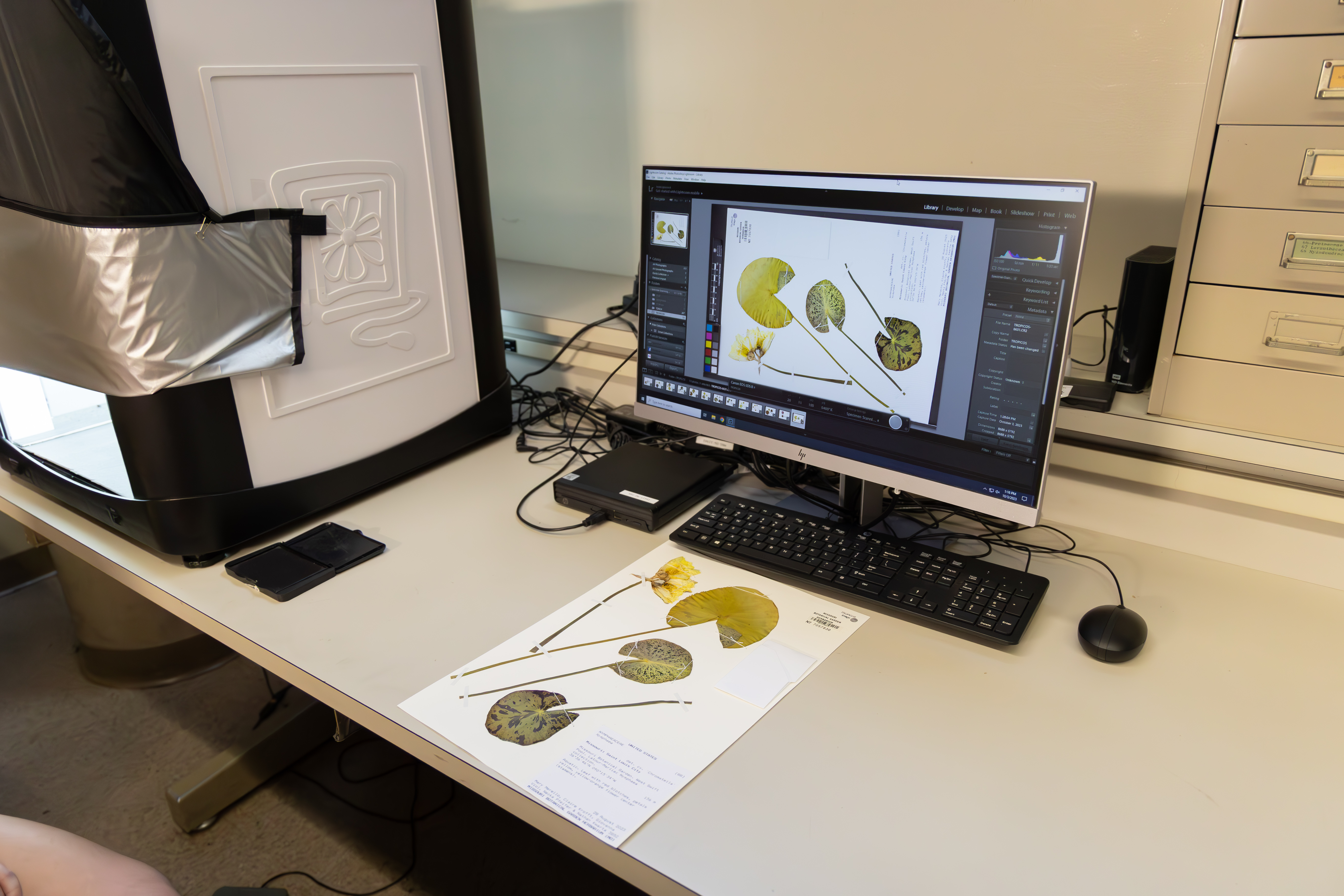
The Missouri Botanical Garden Herbarium is one of the largest in the world. Herbaria support virtually all scientific knowledge of plant diversity. Scientists around the world use herbaria for species identification, research, and conservation.
The Missouri Botanical Garden has been working for years to digitize these collections, making them instantly available to researchers anywhere. Now, a $14.4 million grant from an anonymous donor will transform that work by launching the Revolutionizing Species Identification Project.

What is the Revolutionizing Species Identification Project?
The Revolutionizing Species Identification, or RSI, project is a transformative initiative to digitize the Missouri Botanical Garden’s extensive herbarium collection. This work will inform taxonomy and plant systematics, aiding restoration and conservation efforts worldwide.

What exactly is an Herbarium?
Herbaria are the world’s libraries of preserved plant specimens, providing fundamental information on plant diversity, distribution, geography, and ecology.
The Garden’s Herbarium, which dates back to 1857, contains more than 7.8 million specimens.
Learn more about the Missouri Botanical Garden’s Herbarium, and its importance to global science, in this blog post.

What are the benefits of digitizing Herbarium Specimens?
Experts can use the rapidly digitized herbarium specimens to answer new questions about taxonomy, biogeography, evolution, ecology, ethnobotany, etc.
The ability for a researcher or student to instantaneously access a high-resolution image of a specimen thousands of miles away with only internet access creates countless opportunities for collaboration. This is especially helpful for resource-limited countries and institutions.
How long has the Garden been working to digitize its specimens?
The Garden has spent decades working to digitize its collection and 2 million are now online. The RSI grant will allow the Garden to digitize the remaining 6 million specimens in just six years.

the role of AI in the Revolutionizing Species Identification project
AI technology will automatically detect unique plant characteristics to create an online reference library of plant features. Scientists will then be able to upload images and other data from an unidentified plant to a new project website for rapid automated species identification.
This innovative project responds to the urgent global biodiversity crisis.
Did you know? One third of the world’s plants face the threat of extinction.

Growing the Garden’s Team
Human expertise is still essential for species identification and advancing the Garden’s scientific work. Through the grant, the Garden will be able to add 20 new professional positions to execute the RSI project. The Garden will also hire four post-doc researchers.

Building Up Botany
The grant for the RSI project is the largest gift to botany in recent history. The projects combination of visual scanning, hyperspectral imaging, and AI will create an unmatched biodiversity dataset of over eight million herbarium specimens.
The research and technology in this project allow us to move faster than we ever have before when it comes to identifying species, and that means we can move faster in safeguarding biodiversity before it is too late.

How could this help Conservation?
This dataset will enable rapid identification and analysis of plant traits, supporting targeted conservation efforts that prioritize species and habitats at risk.
Did you know? An estimated 40,000 plant species remain unidentified, with an estimated 77% likely threatened with extinction.
By partnering with cutting-edge technology, RSI will transform the role of herbaria in conservation science. This will inspire a new generation of plant science professionals. Science needs botanists now more than ever, as botany and plant taxonomy remain critically under-resourced.

What Could come next?
If the technology works as scientists expect, it could be used eventually to deploy drones that could scan trees in a forest and rapidly identify whether endangered species occur in the area. This could be vital in accelerating conservation work, especially in areas where deforestation threatens rare and endangered trees.
Catherine Martin
Senior Public Information Officer
Leave a Reply