Study is first to look at individual trees across decades
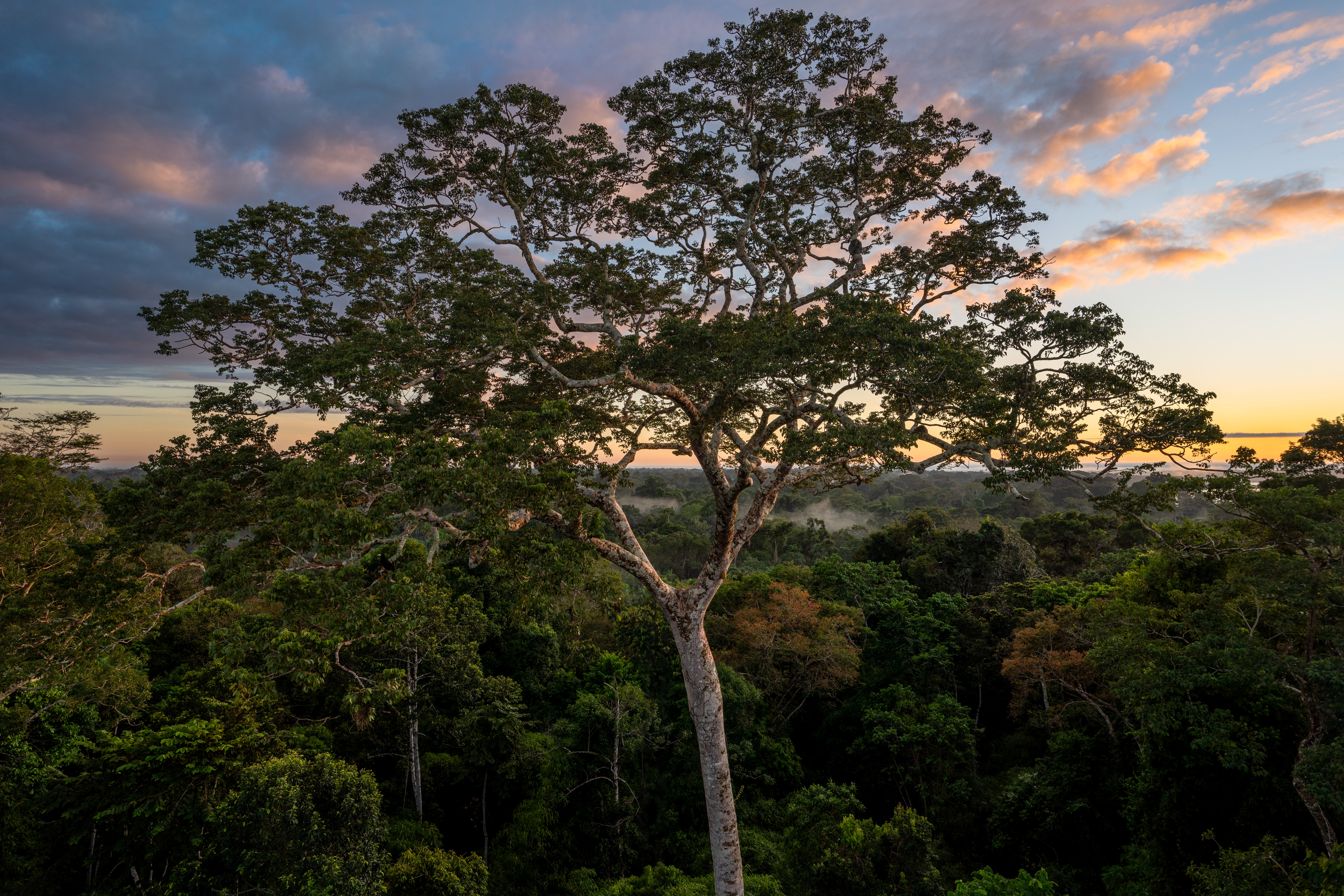
As the Amazon rainforest experiences higher temperatures and longer, more intense dry seasons, individual trees in the Peruvian Amazon are acclimating, but experiencing more stress, according to a new study by Missouri Botanical Garden scientists and collaborators.
The study, recently published in Global Change Biology, is the first to compare how individual trees are responding to a changing climate over multiple decades. The findings give scientists a more fine-tuned idea of climate change impacts on tropical forests. This can support conservation efforts, explained lead author Riley Fortier, a Postdoctoral Fellow in Biodiversity Data at the Missouri Botanical Garden.
“These trees have already experienced significant changes in climate and will certainly face more in the future,” Fortier said. “Understanding how they have responded in recent decades will help us understand their fate, which has obvious implications for the forest as a whole.”
Missouri Botanical Garden President and Director Lúcia G. Lohmann said studies like this underscore the importance of long-term biodiversity monitoring and the extraordinary power of herbarium collections, demonstrating that specimens gathered decades ago can help scientists understand the impact of our changing world in the Amazon and anticipate what may lie ahead.
“Having studied the Amazon Basin for more than three decades, this study touches my heart,” Lohmann said. “It reveals that, within my own lifetime, Amazonian trees have lost some of their ability to cool their leaves — a warning with profound implications for the future of this forest and its vital role in regulating the climate and cooling our planet. Safeguarding the Amazon has never been more urgent.”
Building on a Botanical Legacy
Early days

The Missouri Botanical Garden has conducted scientific research since its founding in 1859. International programs greatly expanded under Peter Raven’s leadership. Soon after being named director in 1971, Raven hired several key scientists, including Alwyn Gentry, to start a Latin American program.
Following in the footsteps of other scientists in Peru, Gentry and colleagues began setting up forest plots in 1983. A forest plot is a marked plot of land, usually between 1 and 50 hectares. Botanists use plots to monitor tree populations.
At the time, the main goal was to inventory and understand “the megadiversity of the richest tropical forests on the planet,” said Garden scientist Rodolfo Vásquez, who helped set up the plots.
“The priority was to record floristic composition, to understand forest structure, and to discover species new to science before deforestation advanced,” said Vásquez, who is also the Director of the Peruvian Herbario Selva Central Oxapampa.
Their findings led to the area eventually becoming the Tambopata National Reserve.
Return Visits

Vásquez has returned to the plots several times over the years. He has measure the trees’ growth, find new ones, and mourn those lost.
For this study, the team returned to the forest plots to study the same individual trees that Gentry, Vásquez, and colleagues studied years ago. This experience was scientifically fascinating and deeply nostalgic, Vásquez said.
“Seeing my diameter tape, worn from use, wrap around those trunks once more, and seeing my arms—once strong, now aged by time—reach around these old friends who are right where I left them four decades ago, fills me with emotion, because I can see the marks of time on their bark, the changes in their crowns, and I realize that they survived historic droughts and storms.”
Lasting Legacy

Important to the legacy of this work is that Vásquez didn’t return alone. He was accompanied by young researchers like Fortier, just starting their careers.
“In the 1980s, I was the one following a foreign botanist along these trails, writing down everything he said,” Vásquez said. “Today they are the ones arriving from other parts of the world to learn from our forests, and it falls to me to open the notebook, point to the tree, and explain why that bark, that fruit, that leaf mean what they mean. The circle closed, and it closed in the same place.”
Harnessing Herbarium Collections

This study wouldn’t be possible without the Garden’s legacy in Peru and its expansive Herbarium.
The Missouri Botanical Garden is home to one of the largest herbaria in the world. It holds more than 8 million specimens from across the globe. Many of these collections are from areas where the Garden has active research programs, like Peru. When Gentry and Vásquez set up the forest plots, they collected specimens to store in the Herbarium. Each specimen description includes a unique tag number. The team cross-referenced tag numbers with plot census data. This let them see which trees were still alive and find their exact location. And, since Vásquez set up the plots originally, he could confirm where the original team collected material and how they handled it to ensure accurate comparisons.
“One person’s memory ended up being part of the method. That is the legacy: not only collections and databases, but people who kept working in the same place for an entire lifetime,” he said.

Garden scientists have used herbarium specimens to study the impact of climate change on particular plant species. But this is the first time any scientists have used herbarium specimens to study the same individual trees across decades in tropical forests.
“I think one of the coolest things about it is the novel use of herbarium specimens,” Fortier said.
Tracking Changes

Backfiring Survival Strategy
To understand how the trees changed over the past four decades, the scientists measured specific leaf traits in individual trees. They compared those traits with the Herbarium specimens collected decades ago. They paired this information with temperature and precipitation data.
The team found that the leaves became thinner and structurally simpler over time. Specifically, the plant’s stomata, microscopic pores on leaves that allow plants to “breathe,” became smaller. This acclimation to climate change means trees are absorbing less water and losing their ability to cool their leaves. This is causing the trees’ leaves to heat up faster than their surrounding environment. The change makes trees vulnerable to warming temperatures.
Simply: the trees’ own survival strategy may be backfiring.
“These findings are significant because they provide evidence that tropical trees, even though they are acclimated to hot tropical climates, are getting more stressed as they are experiencing unprecedented heat and drought,“ Fortier said.

A generational Effort
Vásquez was joined in the field by his colleagues at the Herbario Selva Central Oxapampa, Rocío Rojas, Luis Valenzuela Gamarra, and Abel Monteagudo Mendoza, all co-authors on the study, along with field botanist Jaime Flores. Between them, they relocated each surviving tree. They climbed to tree crowns as high as 40 meters, and collected the leaves for analysis.
These significant findings are the result of what Vásquez called “a generational effort” of the scientists who have dedicated their lives to studying the Peruvian Amazon.
“Behind these data there are dozens of botanists, forest engineers, technicians, and local guides who nailed in the tags, carried the plant presses, climbed the trees, measured the diameters, faced down the rain, and kept the plots alive,” he said. “This study is a tribute to all of them and, above all, a call to the Peruvian State and to the international community: long-term science is expensive and requires patience, but it is the only tool that will give us the right answers to save the planet’s natural heritage. Peru’s plots are speaking to the world today; our duty is to listen to what the trees are telling us.”
Supporting Conservation

These findings are the latest additions to growing evidence that tropical forests are facing increasing stress. They need urgent conservation support. Understanding the specific response of these individual trees also shows the importance of protecting forests where these species will have a better chance of survival in the face of climate change.

These trees grow in Reserva Nacional Tambopata, which is part of a huge area of protected forest. The area also includes cooler, wetter forests closer to the Andes. Maintaining that connection will be important to let species potentially migrate, over many generations, from this forest to those wetter ones.
“These ‘climate refugia’ will become especially important as time goes on. At least for the species that are less resilient to climate change,” Fortier said. “Of course, I think we should protect all forests, but there is an especially strong case for protecting climate refugia.
Amplified Through Cutting-Edge Tech

The Garden’s Revolutionizing Species Identification, or RSI, project will take this research even further. The project aims to digitize the Garden’s entire Herbarium collection. It also supports hyperspectral scanning of key plant species for innovative research projects.
During this study, Fortier and colleagues on the RSI project scanned the herbarium specimens from the Peruvian Amazon for hyperspectral data. Fortier is now using a combination of measured traits and hyperspectral data to build AI models to amplify the research.
“Measuring traits is very time-consuming and simply isn’t feasible to scale up to thousands of specimens,” Fortier explained. “By building these models and getting hyperspectral scans from additional specimens, we can characterize trait changes and responses to climate for thousands of trees across the entire Amazon.”
About the Study
“Individual Trees Respond to 40 Years of Climate Change Through Leaf Functional Trait Acclimation” was published in Global Change Biology in 2026 and is open access: doi.org/10.1111/gcb.70978.
The authors are Riley P. Fortier (University of Miami; Missouri Botanical Garden), Rodolfo Vásquez Martínez, Rocío Del Pilar Rojas Gonzalez, Luis Valenzuela Gamarra, and Abel Monteagudo Mendoza (Herbario Selva Central Oxapampa, Peru and Missouri Botanical Garden), Rachel Collins (University of Miami), Oliver L. Phillips and Timothy R. Baker (University of Leeds), J. Sebastián Tello (Missouri Botanical Garden), and Kenneth J. Feeley (University of Miami and Fairchild Tropical Botanic Garden).
The work was supported by the U.S. National Science Foundation (DEB2227253, to Kenneth Feeley and J. Sebastián Tello), the Association for Tropical Biology and Conservation, the Garden Club of America, and the Tinker Foundation. It is part of Research Project 152 of the ForestPlots.net global collaboration.
Written by Catherine Martin, Senior Public Information Officer
Leave a Reply