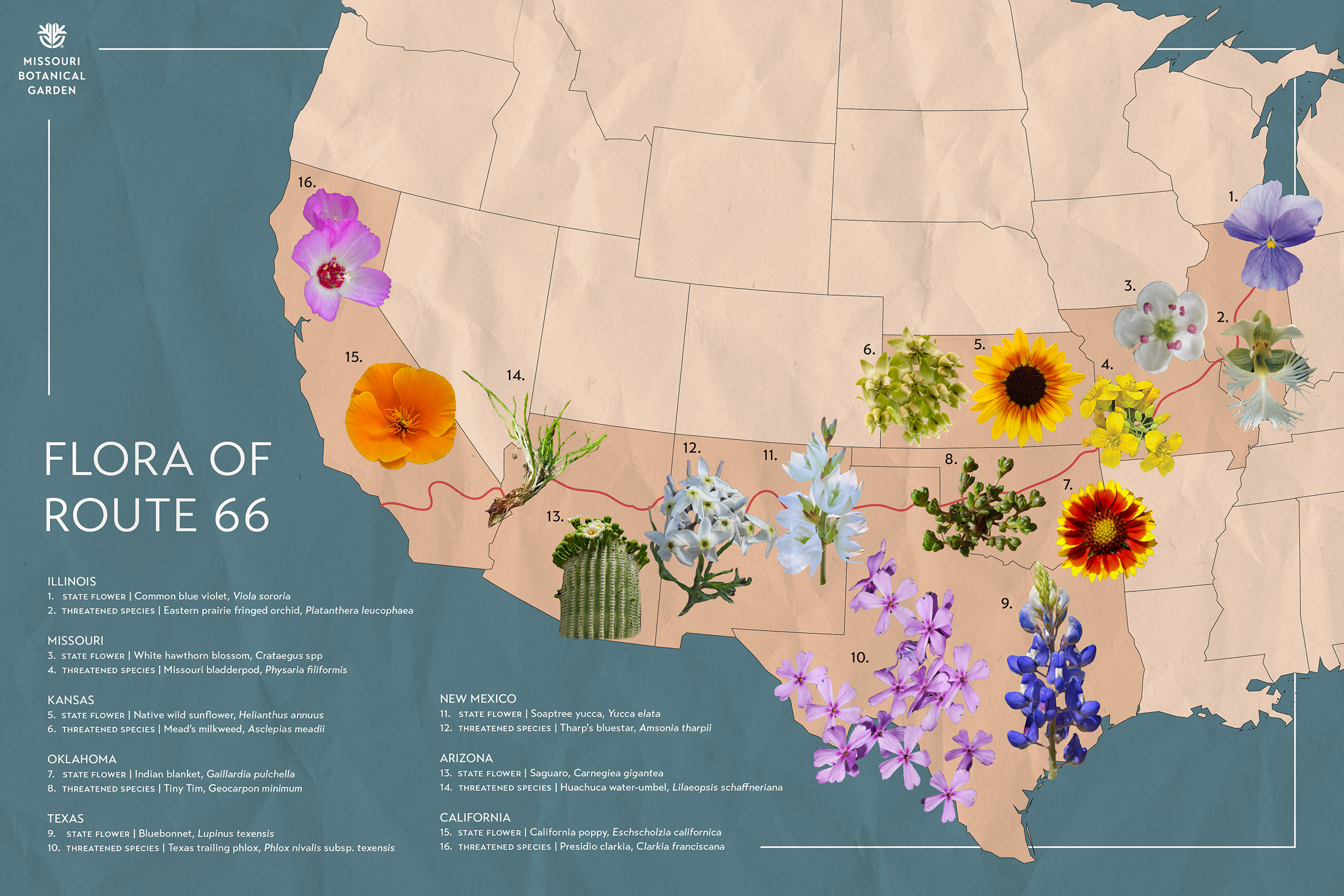
Established in 1926, Route 66 is one of America’s original highways that ran from Chicago to Santa Monica. For decades, road trips across the nearly 2,500-mile route have been an opportunity to see many unique sights of America, including its native flora. The route includes five major ecosystems, each with endemic species. Endemic species exists only in one specific geographic area and nowhere else in the world.
During this special 100-year anniversary year, we invite you to learn more about the native flora of Route 66, as represented by their state’s chosen floral emblem. Many of these beautiful blooms are on display at the Missouri Botanical Garden.
In coming weeks, look for part two of of Route 66 series, which will explore the Missouri Botanical Garden’s efforts to same some of the most threatened native species along Route 66.
Floral Emblems
Countries around the world choose a floral emblem to represent their country, often choosing something that highlights the native landscape or has a deep symbolic meaning. The United State’s national flower is the rose. All U.S. states also have a chosen floral emblem, often a native species unique to the state. Route 66 includes eight states, each of which has an official state flower. Explore the flora of Route 66 through these state symbols.
1. Illinois: Common blue violet, Viola sororia

Bloom Time: April to August
Year Adopted: 1908
Designation: Illinois schoolchildren voted for their favorite flower and tree to represent the state. Wild rose and golden rod were other top contenders.
More about this species: The common blue violet, Viola sororia, grows throughout the northeastern U.S., including in Missouri. In addition to Illinois, New Jersey, Rhode Island, and Wisconsin chose the blue violet as their floral emblems.
Have you noticed more showy violet flowers in the spring? Learn more about how this species is responding to climate change.

At the Missouri Botanical Garden: A lovely ground cover, look for violets throughout the Garden in the spring, as well as in the Woodland Garden at Shaw Nature Reserve.
2. Missouri: White Hawthorn Blossom, Crataegus

Bloom Time: May
Year Adopted: 1923
Designation: Gov. Arthur M. Hyde signed a bill naming the hawthorn blossom the official Missouri state floral emblem. The statute does not identify a specific species but rather lists plants scientifically designated as “crataegus,” referring to the genus name.
More about this species: More than 75 species of hawthorns grow in Missouri, including hybrids. At the time of its designation, botanists lamented that it was inappropriate to select a state flower of a notably cantankerous genus without selecting a specific species, according to the Flora of Missouri.

At the Missouri Botanical Garden: The Garden has 28 hawthorns on grounds comprising 15 taxa in its landscape. Shaw Nature Reserve is home to three species of hawthorn.
3. Kansas, wild sunflower, Helianthus annuus

Bloom Time: July and August
Year Adopted: 1903
Designation: The Kansas legislation waxes a bit poetic about the plant and its symbolism. It describes the sunflower as “hardy and conspicuous” flower of “unvarying and striking shape” that “has to all Kansans a historic symbolism which speaks of frontier days, winding trails, pathless prairies, and is full of the life and glory of the past, the pride of the present, and richly emblematic of the majesty of a golden future.”
More about this species: Also native to Missouri, the wild sunflower produces beautiful blooms up to 6 inches wide with orange-yellow rays and brown center disks. Birds—and humans—love its large edible seeds.

At the Missouri Botanical Garden: Sunflowers grow tall in the Whitmire Wildflower Garden at Shaw Nature Reserve each summer. Sunflowers bloom in several areas on the Garden’s main grounds, including near the Children’s Garden and the Kemper Center for Home Gardening landscape.
You can also see sunflowers at the Garden’s Sunflower+ Project site in North City.
4. Oklahoma: Blanket Flower, Gaillardia pulchella

Bloom Time: June to frost
Year Adopted: 1986
Designation: While the Oklahoma Rose, a hybrid tearose, is Oklahoma official state flower, Indian Blanket, Gaillardia pulchella is the state’s official wild flower.
More about this species: A member of the aster family, this species prefers dry open places with sandy soil and is native to areas in Central Missouri. The common name likens the flowers’ rich colors to blankets Indigenous people wove.

At the Missouri Botanical Garden: The Garden does not have Gaillardia pulchella in its Living Collection. However, Gaillardia aristata and Gaillardia x grandiflora, which share the common name “blanket flower” are on Garden grounds. Look for these colorful blooms in Rock Garden, Museum Landscape, and in Kemper Center for Home Gardening displays.
5. Texas: bluebonnet, Lupinus texensis

Bloom Time: March to May
Year Adopted: 1901
Designation: The Texas legislature chose bluebonnets over cotton boll and prickly pear cactus as the official state flower. Decades later, it also adopted a state flower song, “Bluebonnets.”
More about this species: Similar to Missouri, Texas did not select a specific species as its state flower. Instead, six species collectively referred to as “bluebonnets” represent the state. In the 1930s, the Texas Highway Department began a beautification project focused on planting bluebells on the sides of highways.

At the Missouri Botanical Garden: While Texas bluebonnets don’t grow on Garden grounds, look for its close cousin wild lupine, Lupinus perennis. Located in the Kemper Prairie Garden, wild lupine flowers with purple and blue blooms in the summer.
6. New Mexico: Soaptree Yucca, Yucca elata

Bloom Time: May and June
Year Adopted: 1927
Designation: Following support from a survey of students and the New Mexico Federation of Women’s Clubs, the legislature adopted the yucca as its state flower.
More about this species: Yucca, part of the asparagus family, are common throughout New Mexico. This tree-like species can grow up to 30 feet tall. Long flowering stems produce side branches covered with clusters of bell-shaped flowers.

At the Missouri Botanical Garden: The soap tree yucca can be found in the Jack C. Taylor Visitor Center landscape as well as in Cohen Court near the Kemper Center.
7. Arizona: Saguaro Cactus Carnegiea gigantea

Bloom Time: May and June
Year Adopted: 1931
Designation: The Arizona legislature adopted the saguaro cactus bloom as its state flower at the same time it adopted the cactus wren as the state bird.
More about this species: Saguaro cacti can grow 40 to 60 feet, weigh as much as 8 tons, and live for more than 200 years. It produces waxy, white blooms in the spring. Arizona law strictly protects this species.

At the Missouri Botanical Garden: Look for this, and many other species of cacti, in the Shoenberg Arid House. Arid plants have been a key part of the Missouri Botanical Garden’s living collection for more than 150 years.
8. California: California poppy, Eschscholzia californica

Bloom Time: March to July
Year Adopted: 1903
Designation: The California legislature chose the bright orange California poppy to represent the Golden State, also noting the symbolism of gold sought during the gold rush.
More about this species: The California poppy, Eschscholzia californica, is one of more than 700 species in the poppy family, Papaveraceae. Its blooms are typically bright orange but can be yellow-orange. April 6 of each year is “California poppy day.”

At the Missouri Botanical Garden: The Garden doesn’t have any California poppies growing, but look for Missouri native poppies like the celandine poppy, Stylophorum diphyllum. These yellow poppies bloom from April to June and can be found in the Children’s Garden, English Woodland Garden, and Kemper Center for Home Gardening. They can also be found in the Ozark Ethnobotany Garden at Shaw Nature Reserve.
Catherine Martin
Senior Public Information Officer
Many thanks to Living Collections Director Becky Sucher, Matthew Albrecht, Vice President of Conservation and Restoration, Shaw Nature Reserve Director Quinn Long, Horticulturist Jared Chauncey, and Assistant Scientist Aaron Floden for providing information for this article.
Leave a Reply