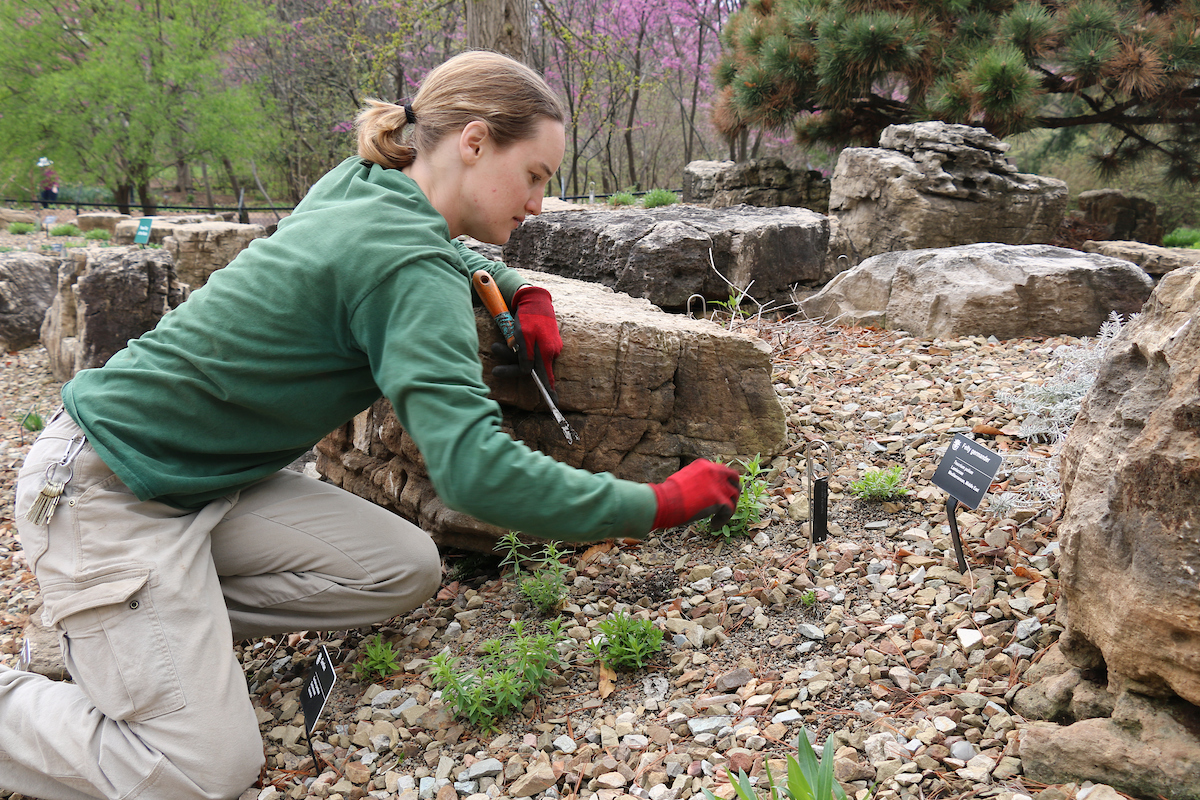
Senior Horticulturist Mariel Tribby knows that rock gardens are not for everyone–at least at first glance.
“They are gardens to take your time with and study,” Tribby says. “A lot of times, rock gardens are created as imitations of what you will see in nature, so that is something to notice.”

Tribby has worked for the Missouri Botanical Garden for over a decade and currently oversees three rock gardens – each with its own conditions, challenges, and design.
Her passion for the rocky environments and their adaptive plants is something she hopes to share with visitors, home gardeners, and budding horticulturists.
What is a rock garden? Sometimes called a rockery or a rockwork, a rock garden is a garden a part of a garden with a landscaping framework of rocks, stones, and gravel, with planting appropriate to this setting.
Discovering Rock Gardens
Originally from the high dessert of New Mexico, Tribby is no stranger to rocky environments and adaptive plants.
But her love for rock gardens and horticulture really flourished after graduating with a bachelor’s degree in environmental science.
“I sort of discovered horticulture after school,” Tribby said. “There were some classes at my community college that I started taking. And then I did the Master Gardener program in Albuquerque.”
During her first few years in the field of horticulture, Tribby was getting more of a general, hands-on learning experience. She took care of various gardens at Chanticleer Garden and Longwood Gardens.

“I saw all these plants on display, and the design was very beautiful.”
It was at Longwood that she got acquainted with the North American Rock Garden Society – which she would serve as a board member for – and began exploring rock gardens more.
“I also just like the way they look,” Tribby said. “The rocks and the plants together. You can grow so many different plants like natives or bulbs.”

Mariel Tribby’s Favorite Plant: Missouri evening primrose (Oenothera macrocarpa)
Tribby has a special appreciation for the plants that can grow in seemingly inhospitable conditions.
“I think what I love most about them is their different adaptations,” Tribby said. “With alpines a lot of them are low growing to deal with the high winds. They’ll have thick leaves or will be silver or hairy to reflect the sun. They might be shorter so if the snow is on top of them, they won’t break.”
Exploring Rock Gardens Around the Globe

Tribby’s desire to learn more about rock gardens led her to take on several international internships as a young horticulturist.
In the spring and summer of 2013, Tribby was a horticulture intern at the Royal Botanical Garden in Edinburgh and Lautaret Alpine Botanical Garden. During both internships she maintained a blog, documenting her exploration and education.

“One of the highlights of my last week at the garden was a trip to the Cairngorms National Park, about 2.5 hours north of Edinburgh,” Mariel wrote in 2013. “RBGE has an alpine test plot located here at an elevation of about 1200 meters. It was high enough for snow to still be on the ground further up the pass! The plants in the plot are examined a few times a year to see how they perform.”
Later in her career while working at the Missouri Botanical Garden, Tribby was able to continue traveling. In the past decade, she has visited Russia as part of the US-Russia Botanical Exchange and participated in a month-long scouting trip in Kyrgyzstan as part of a walnut fruit forest conservation project in collaboration with Gareev Botanical Garden in Bishkek.
Discover More: Kyrgyzstan- A hotspot of biodiversity
Creating and Maintaining Rock Gardens at the Missouri Botanical Garden
Shortly after returning from her European travels in 2013, Tribby began working at the Missouri Botanical Garden. Today, she oversees the Heckman Rock Garden, Floyd Pfautch Bavarian Garden, and Cohen Court.
“I think I’ve been really lucky to work here and work with the plants that I love and have enough freedom to design with them,” Tribby said. “That is not always the case at other gardens. I’m lucky to try out a lot of different plants, and to have all of our resources like having a big nursery to grow things and trading seeds around the world.”
Tribby’s experience at other botanical gardens and her background in climate change give her a unique perspective on the rock gardens she works in.
“I think rock gardens are really good things to think about for climate change, because these plants are pretty resilient,” Tribby said. “As the weather shifts in Missouri, and we have more droughts, you might think about these plants that do well in drier conditions.”
The Heckman Rock Garden

The Heckman Rock Garden shows a variety of plants growing in rocky terrain. Photo by Tom Incrocci/Missouri Botanical Garden. 
A sculpture of a young girl named Cora in the Heckman Rock Garden. Photo by Sundos Schneider/Missouri Botanical Garden. 
A plant bed in the Heckman Rock Garden show how large rocks and boulders are used in garden design. Photo by Tom Incrocci/Missouri Botanical Garden. 
Blanket flower (Gaillardia aristata). Photo by Nathan Kwarta/Missouri Botanical Garden. 
Red Glory (Opuntia polyacantha ). Photo by Cassidy Moody/Missouri Botanical Garden.
The Heckman Rock Garden is located just outside the Shoenberg Arid House and to the northwest of the Climatron®. It features a myriad of flowering bulbs, succulents, perennials, and shrubs from desert, steppe, montane, Mediterranean and other dryland habitats.
Tribby says the best time to visit this rock garden is April–June.
“I’m always trying to stretch the season more,” Tribby said. “There is always something flowering in there, it just might take a little more time and focus to spot it.”
The Floyd Pfautch Bavarian Garden
The Bavarian Garden is located in the southeast corner of the Garden, just beyond a small parking area near the back of the Garden.
This rock garden is designed to resemble the area known as Bavaria, which stretches across eight countries in south-central Europe. The Bavarian Garden displays plants that grow in alpine regions across the globe including including Europe, the Caucasus, and the Rocky Mountains.
Tribby started working at the Garden around the time this experimental garden opened and says she has learned a lot about alpine plants.
“It has been really rewarding,” Tribby said. “It’s been good to see that things have been successful in there, because there were a lot of things that died. I’ve learned so much about where to plant things and how much to water, because that was a big learning curve.”
Because these plants are used to higher elevation and cooler temperature, Tribby suggests visiting the Bavarian Garden in the early spring.
The Cohen Court


Located just east of the Linnean House, the Cohen Court highlights plants with a connection to notable botanist George Engelmann.
Engelmann was an early scientific advisor to the Garden and was well-known for his study of plants along the U.S.-Mexico border. The Cohen Court highlights those plants he studied in the region, as well as plants named in his honor.
“I’m trying to bring more diversity in there, other than cacti,” Tribby said. “Prickly pears are great, but like in the Arid House, you see the diversity. I want to try to reflect some of that while finding the things that are hardy.”
Tribby says she has experimented with “zone pushing” in this area, bringing in plants that normally grow in Zone 7 regions.
Horticulture: an Art and A Science
One thing Tribby would like more people to understand is that horticulture is more than manual labor; it is the science of cultivating plants.
“People will think we just pull weeds,” Tribby said. “But there is so much more to the job beyond the labor that you see us doing out here.”

Each season, Tribby and other horticulturists examine the conditions of their garden beds, experiment with plant placement and soil, and maintain and nurture the plants–all while keeping aesthetics in mind. They are also collecting data on how their plants perform in various conditions and locations.
“I’d like people to know that many of us have degrees in horticulture or years of experience,” said Tribby. “Anyone can garden and appreciate plants, and we would love to share our knowledge. Please feel free to ask us questions when you see us in the Garden.”
Jessika Eidson | Public Information Officer
Thank you to Mariel Tribby for providing her expert opinion and sharing her story with us.


Leave a Reply