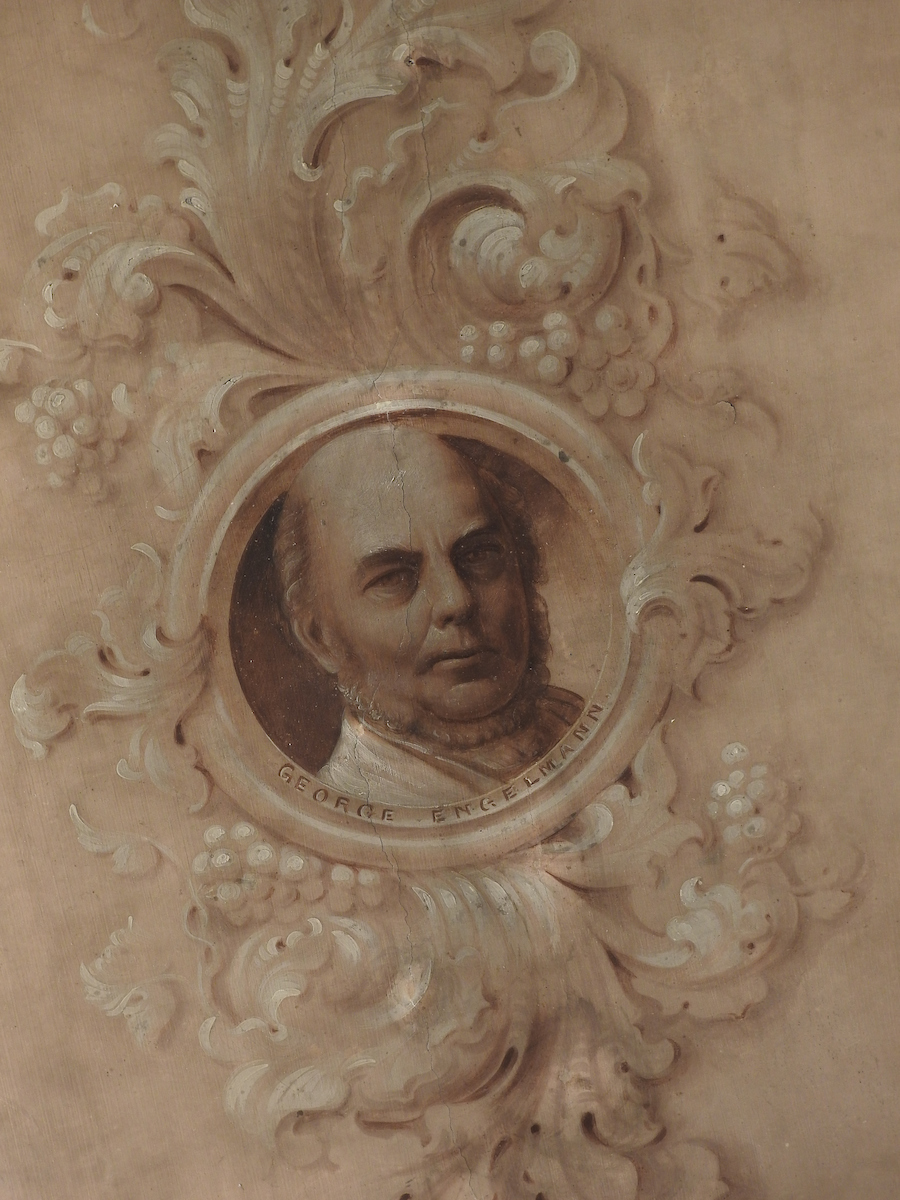
Dr. George Engelmann is a 19th century botanist largely responsible for laying the groundwork of the Missouri Botanical Garden’s science and conservation efforts.

But it may surprise you to learn that this notable St. Louis figure was a German immigrant and medical doctor, whose “amateur” botany earned him the respect of the world’s most notable scientists of the day and a permanent place in the Garden’s history.
Early Life of George Engelmann
Family and Education
George Engelmann was born in 1809 in the German city of Frankfurt. Engelmann was the oldest of 13 children, nine of which survived to adulthood.
During the 1820s, Engelmann explored botany under the tutelage of Professor Johannes Becker at the Senckenberg Institute in Frankfurt. Often Engelmann and other students had risen before five o’clock to tramp with the professor through streams, ponds, and fields to collect specimens.
As a young man, Engelmann attended the University of Heidelberg, with the assistance of a scholarship founded by the Reformed Congregation of Frankfort. It was here that he made several friends who would go on to be influential in the fields of naturalism and botany.
Engelmann eventually left the college after some involvment in a failed student protest against censorship according to the State Historical Society of Missouri.

He later attended Berlin University and finally the University of Würzburg, earning a degree as a Doctor of Medicine in 1831. Though a medical doctor by trade, Engelmann’s inclination toward botany was evident in his dissertation titled De Antholysi Prodromus, which examined the structure of monstrosities and aberrant forms of plants.
Engelmann eventually moved to Paris, where he met and befriended other scientists who shared tales of globetrotting and exploration, possibly inspiring the young naturalist’s own desire to travel.
Engelmann Moves to America
After practicing medicine and science for a few years in Paris, Engelmann sailed to the United States where some relatives had already settled.
He spent time traveling on horseback around Southern Illinois, Missouri, and Arkansas before finally settling in – what was then – the frontier trading-post town of St. Louis in 1835.

Engelmann established a medical practice in St. Louis, living in absolute poverty for four years while building his practice. During this time he saved enough money to earn a trip back to Germany where he married his cousin, Dorothea “Dora” Hartsmann. Note that the practice of marrying cousins was more common and accepted in the 1800s.
It was on his way home with his new wife that Engelmann met his life-long friend Asa Gray, considered to be the most important American botanist of the 19th century and who later played a role in the foundation of the Missouri Botanical Garden.
Scientific Endeavors of George Engelmann
After a few years in the St. Louis area, with the benefit of speaking German, French, and German, Engelmann built his medical practice, allowing him to pursue his interest in botany during his free time. He was even able step away for years at a time to pursue his passion.
“But the lasting impression which he has made upon North American botany is due to his wise habit of studying his subjects in their systematic relations, and of devoting himself to a particular genus or group of plants (generally the more difficult) until he had elucidated it as completely as lay within his power.”
– Asa Gray
He was a founder and longtime president of the St. Louis Academy of Sciences and an original founders of the National Academy of Sciences.
Cacti and Grape Vines

Engelmann is best known for his research on Cacti, with his findings still being used by modern scientists. He notably studied the species found at the United States/Mexico border.
He was also one of the first botanists to study North American vines and helped save the wine industry that was being decimated by pests.
Related: Grapes And The Garden – The Science, Production, And Appreciation Of Wine
Engelmann also studied pines, rushes, spurges, and other little-known and difficult groups.

Did you know? Engelmann had many other scientific interests including meteorology. On establishing his home in St. Louis, he began a series of thermometrical and barometrical observations, which he continued for forty-seven years. He posthumously published a paper on these observations.
Engelmann and the Missouri Botanical Garden
By 1856, Engelmann had quite the reputation as an “amateur botanist.”
So much so that when Missouri Botanical Garden founder, Henry Shaw, asked Sir William Jackson Hooker, director of the Royal Botanic Gardens at Kew, for advice on his new garden, he was directed to Engelmann.

Engelmann had many contacts among American scientists and it was he, in turn, who put Shaw in contact with Harvard University’s Asa Gray, then America’s leading naturalist.
With the advice of Engelmann, Hooker, and Gray, Shaw was convinced to build a botanical garden rather than merely a pleasure garden.
Establishing An Herbarium and Library

It was Engelmann who started the Missouri Botanical Garden’s Library, tasked by Shaw with purchasing the books that would become the heart of the Garden’s research collection. Upon his death, Engelmann also donated his own collection of books to the Peter H. Raven Library.
On his travels, Engelmann was also able to purchase the herbarium of the recently deceased German botanist Johann Jakob Bernhardi. He bought the 60,000 specimen herbarium for $600.
Upon his death, Engelmann donated his entire collection of more than 95,000 plant specimens to the Garden, most of which were collected in the western and southwestern United States. Today the Missouri Botanical Garden Herbarium contains over five million specimens.
Naming the Garden
Engelmann not only laid the groundwork for the Garden’s research, but also had a hand in naming the Garden.
One of the first things Shaw did in his garden was to build a tall stonewall along the Northern and Eastern sides of the tract. In a break in this wall, Shaw built an impressive stone building as the entrance gate.

Originally, Shaw intended to inscribe a Latin phrase on this building, Hort. Bot. Missouriensis. Fortunately, Engelmann convinced Shaw that the use of such a phrase seemed merely pompous, and Shaw eventually used the English translation of the phrase. And thus the Garden became The Missouri Botanical Garden thanks to Engelmann.
Death and continuing legacy of George Engelmann

Engelmann died after a sudden return of a reoccurring illness in 1884, just two days after his 75th birthday and five years after the death of his wife.
George Engelmann is currently buried alongside his wife in Bellefontaine Cemetery.
George and Dorothea had one child, George Julius Engelmann, who followed in his father’s footsteps and became a obstetrician and gynecologist, as well as a founding member of the American Gynecological Society.
Plants Named In Engelmann’s Honor

Like many renown botanists, several plant species have been named in honor of George Engelmann, including some species he studied during his lifetime.
- Engelmann Oak (Quercus engelmannii)
- Engelmann Spruce (Picea engelmannii)
- Apache Pine (Pinus engelmannii)
- Engelmann’s quillwort or Appalachian quillwort (Isoetes engelmannii)
- Engelmann’s Prickly-pear (Opuntia engelmannii).
Washington University School of Botany
After Engelmann’s death, Shaw created the School of Botany at Washington University, whose professor would would also be an employee Garden.
This professorship was named after Engelmann, requiring a noted scholar who also had a talent for administration.
Engelmann’s Image at the Garden

A bronze bust of George Engelmann is on display in the Strassenfest German Garden. Paul Granlund created the centerpiece as a tribute to the German native for his accomplishments and contributions to the Missouri Botanical Garden. The sculpture features some of the species of plants described by Engelmann or named for him, including conifers and cacti.


Right: The restored portrait of George Engelmann currently found in the Sachs Museum.
In 2017, a hidden portrait of Engelmann was discovered during renovations of the Stephen and Peter Sachs Museum. His portrait is featured alongside his old friend Asa Gray and botanical icon Carl Linnaeus.


Leave a Reply