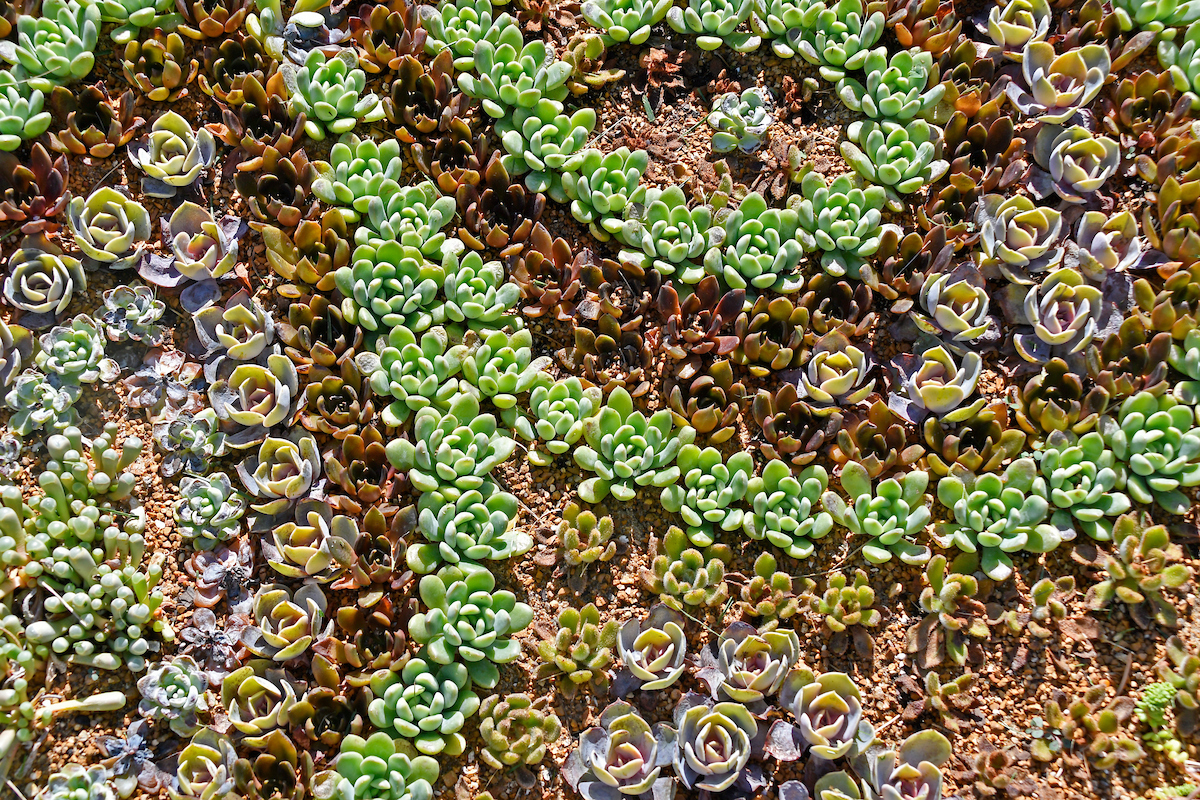
The Missouri Botanical Garden’s newest art exhibition, Patterns in Nature: The Art of HYBYCOZO, sparks inspiration for artists across mediums, including gardeners. Justine Kandara, a Horticulturist with the William T. Kemper Center for Home Gardening, shares some insight on how to bring patterns to your garden.
For centuries, gardeners and landscapers have cleverly found ways to create visible patterns using plants.

Some of the earliest geometric planting designs can trace their origins to ancient Egypt and Persia, where walled gardens filled with fruiting trees and aromatic plants such as jasmine and lilies were symbols of power.

Formal French and English garden designs also use repeating shapes, motifs, and clean lines to convey a sense of grandeur.
Smaller-scale home gardens and naturalistic gardens can still draw from geometric patterns by incorporating repetition into planting designs or using straight lines to guide the eye through a space.

Planting in groups of three or more and repeating the same plants across a large bed can help create a cohesive, visually pleasing design. Colors, textures, and shapes can also be repeated, even in potted plantings.


Of course, you can also enjoy some patterns in your garden on a smaller scale by using the naturally occurring patterns found in plants.
Snake’s Head Fritillary or guinea-hen flower (Fritillaria meleagris)


Fritillaria Meleagris has a unique checkerboard pattern on its delicate, nodding flowers. The genus name is from the Latin word fritillus, meaning dice box, a reference to the checkerboard pattern on the petals.
Genus Trillium


Many trillium species have mottled patterns on their three, leaf-like bracts. Trilliums emerge in spring, and the mottling on their bracts may help them to camouflage in the dappled sunlight of the forest floor and escape the notice of herbivores such as deer.
Nerve Plant or Mosaic Plant (Fittonia albivenis)

Crossing veins and lines form a net-like or mosaic pattern on the leaves of Fittonia albivenis. Botanists call these patterns “reticulate”. As a houseplant, nerve plant is commonly grown in terrariums where it enjoys the increased humidity. You can also spot it throughout the Climatron.
Leave a Reply