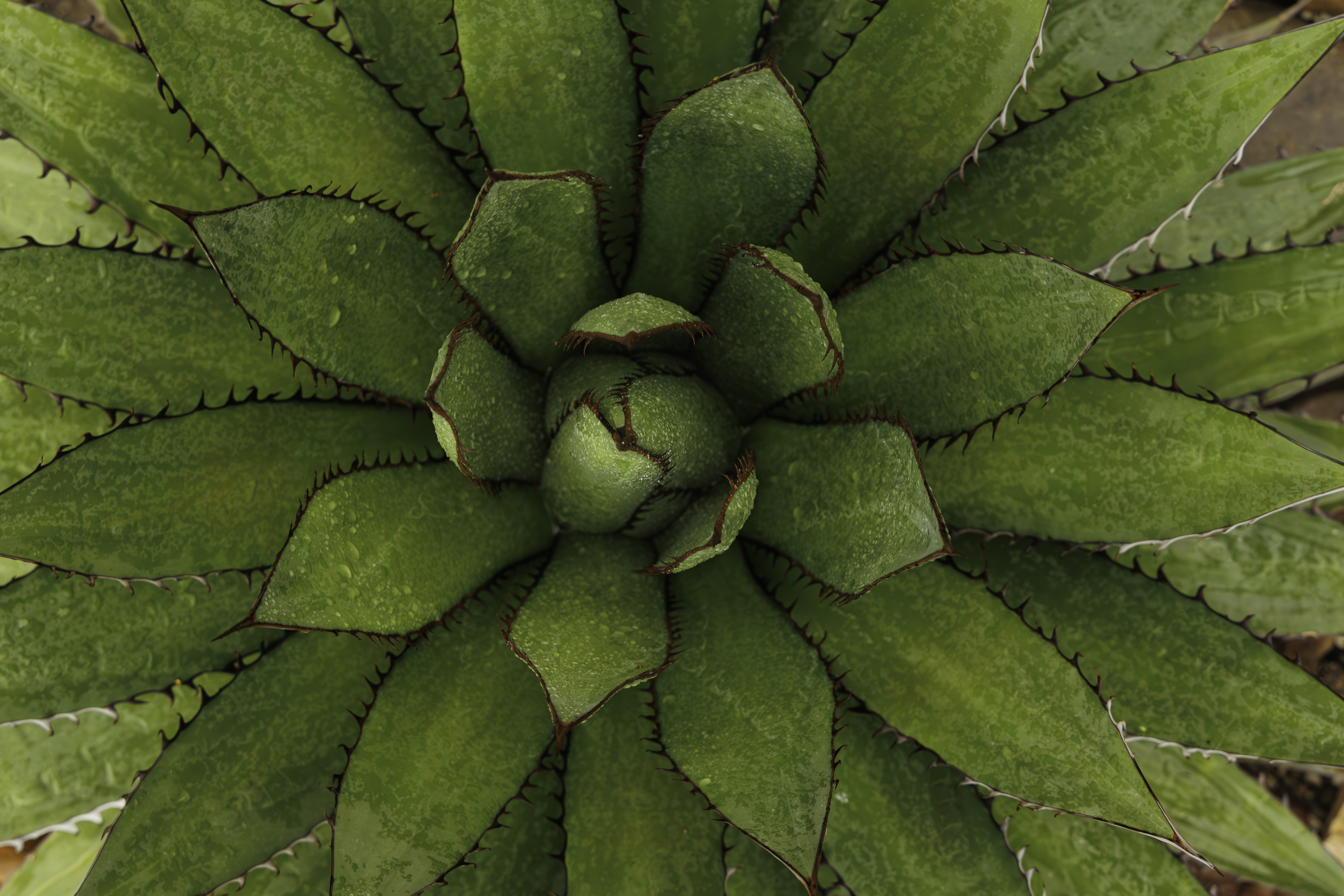
Patterns are everywhere in the natural world. At the Missouri Botanical Garden, we are exploring these patterns through Patterns in Nature: The Art of HYBYCOZO, on display through September 26. We also encourage visitors to look for patterns in the Garden’s living plant collection.

This blog explores patterns in arid plants, which include cacti and succulents.

Arid plants have been a key part of the Missouri Botanical Garden’s living collection for more than 150 years. Look for some of these arid plants with unique patterns on display in the Shoenberg Arid House.

Patterns in Nature: Arid Flowers

While more well-known for their spiky exterior, many cacti also produce beautiful flowers that come in many colors and patterns.

Starfish Flower, Stapelia mutabilis

A maroon, star shaped flower with a pattern of yellow stripes and a dark maroon star center with a yellow circle in the middle
The starfish flower, or carrion flower, is known for its blooms’ unique appearance and smell— like the corpse flower, it smells like rotting meat. Photo by Nathan Kwarta.

Pincushion cactus, Mammillaria

Pink flowers form a circle around a green cactus with spikes forming an atricate pattern
A crown of flowers sits near the top of a pincushion cactus in the Shoenberg Arid House. This is a common feature of this sort in this genus. Photo by Tom Incrocci.

Star Flower, Orbea variegata

A yellow, star-shaped flower with a maroon leopard-like spots. A yellow circle within the flower holds another star-shaped flower.
Although a different genus, the star flower, Orbea variegata, is also known by the common name of carrion flower. Like Stapelia mutabilis, it produces star-shaped blooms with an unpleasant smell. Photo by Nathan Kwarta.

Shield Flower, Dorstenia foetida

Flowers look like lime green circles with darker lie green tentacle-like protrusions
The shield flower produces eight-pointed star or sunburst blooms. Photo by Nathan Kwarta.

Patterns in Nature: areole

Many arid plants have areoles, bud-like or sunken areas that spines, flowers, or branches grow from. These often have vivid or intricate patterns.

Chin Cactus, Gymnocalycium

Light green flowers with dark pink circles, each with a yellow circle, bloom on a green cactus with white spikes
Gymnocalycium in bloom. Photo by Jared Chauncey.

Golden Barrel Cactus, Kroenleinia grusonii

A green cactus with a yellow center on top blooms in a smiley face pattern with two yellow circles and maroon flowers blooming in a smile pattern.
Golden Barrel cactus, Kroenleinia grusonii, in the Shoenberg Arid House. Photo by Nathan Kwarta.

Prickly Pear Cactus, Opuntia

A light green cactus with dark maroon circles where its spikes grow.
Prickly pear, opuntia microdsy. Photo by Jared Chauncey.
A light green cactus with maroon circles and white spikes blooms with a bright pink flower with a yellow center
A Missouri-native prickly pear cactus, Opuntia woodsii, blooms in the Rock Garden outside of the Shoenberg Arid House. Photo by Nathan Kwarta.

Patterns in Nature: Arid Plant Leaves

Century Plant, Agave Americana

The tall leaves of a plant has stripes in various shades of green
Agave, a genus of arid plants native to the Americas, grows patterns through their spine and teeth and imprints those patterns on leaves as they unfurl from the rosette. Here, a large century plant, Agave americana, grows in the Shoenberg Arid House. Photo by Nathan Kwarta.

Wicked Agave, Agave horrida

A brighter green agave plant with dark brown spikes
Another agave species, Agave horrida, in the Shoenberg Arid House. Photo by Nathan Kwarta.

Living Stones, Lithops

Gray plants with darker gray patterns on top mimic stones
Lithops have leaves, featuring intricate patterns, fused together to look like pebbles. Shown here in the Garden’s Holiday Flower and Train Show, living stones are also on display in the Shoenberg Arid House. Photo by Nathan Kwarta.

Patterns in Nature: Arid Plant Branching

Some arid plants show divaricate branching, or branches that are widely apart or form distinctive, interlaced zigzagging branch patterns. This is an evolutionary trait shown across many plant groups to ward off herbivores looking for a tasty treat.

Zigzag plant, Decarya madagascariensis

A light green plant with intricate, zig-zagging branch structure
A native to Madagascar, Decarya madagascariensis, is on display in the Shoenberg Arid House. Photo by Madison Yocks.

Texas ebony, Ebenopsis ebano

Zig zag branches are adorned with puffy white flowers and small green leaves
In addition to interesting branching patterns, Texas ebony produces puffy white blooms. Photo by Mary Lou Olson.

Cynanchum socotranum

Leafless green branches with white spikes and one white  bloom.
 Cynanchum socotranum is a leafless succulent. Photo by Madison Yocks.

Catherine Martin
Senior Public Information Officer

Many thanks to Senior Horticulturist Jared Chauncey for providing information for this blog.

Leave a Reply

Discover more from Discover + Share

Subscribe now to keep reading and get access to the full archive.

Continue reading