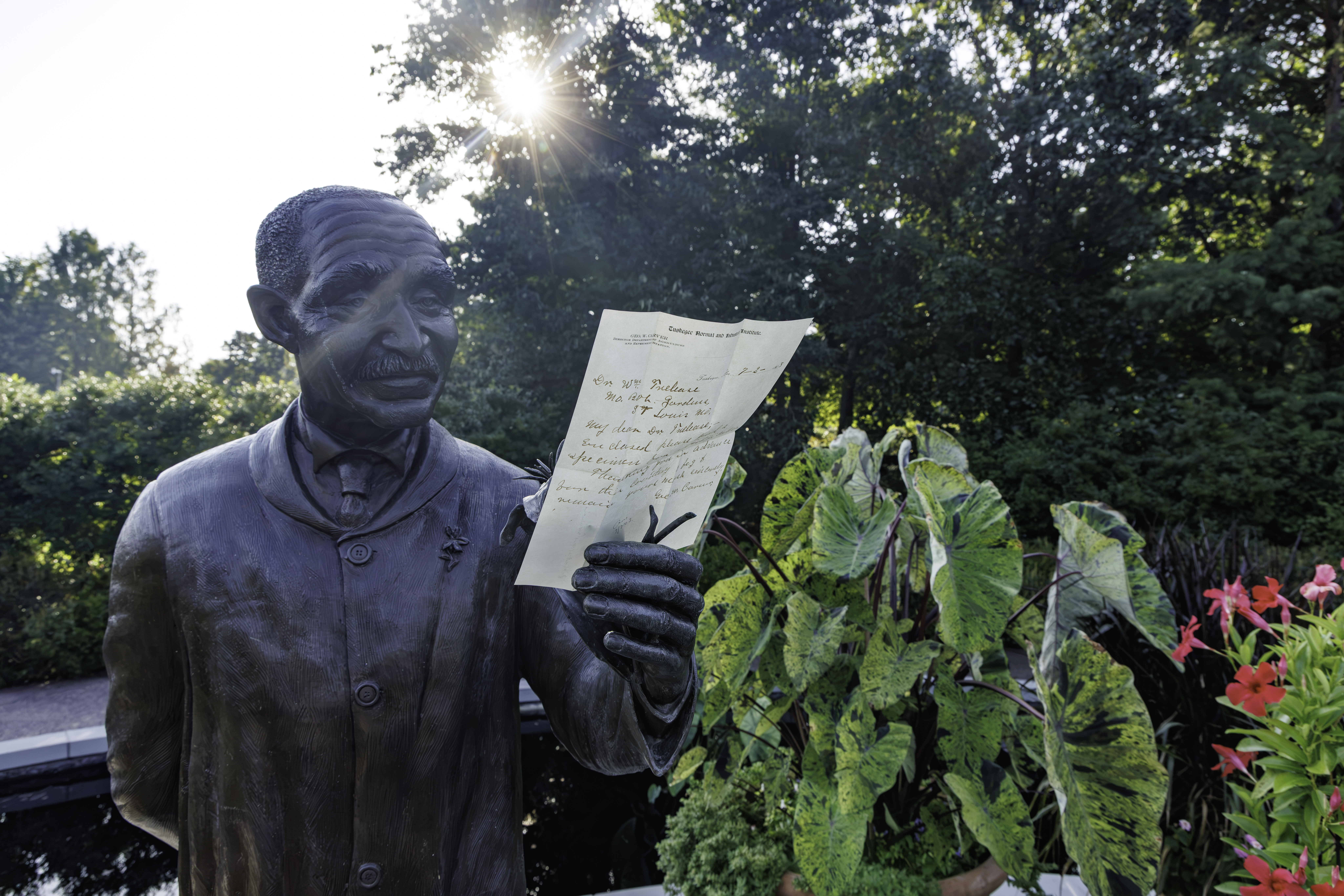
On a September day in the Missouri Botanical Garden’s Herbarium, Digitization Specialist Emily Hughes found something unexpected in the collection: a letter from trailblazing botanist George Washington Carver.
The Missouri Botanical Garden has one of the largest herbaria in the world, with nearly 8 million specimens. The oldest dates back to 1692. With such a large historic collection, it’s not unusual to find notes or letters among older specimens as the team works to digitize specimens. But this letter, written to then-Garden Director William Trelease, certainly stood out.
“I know that the herbarium has other specimens from George Washington Carver as well, and that there is a statue of him in the Carver Garden, but to have a letter from him in his own hand, and with it written on his official Tuskegee letterhead seemed pretty special,” Hughes said.
Discovery through Digitization

Through the transformative 6-year Revolutionizing Species Identification (RSI) project, made possible by an anonymous $14.4 million grant, the Garden is in the midst of digitizing its expansive herbarium collection. The Garden has thus far hired 21 new staff members through the project to support this ambitious digitization effort.
Since the project’s launch in early 2025, the team has digitized more than 1.5 million specimens. Through the process, imaging team members have found dozens of historic letters or other artifacts each month.
“The main focus of the RSI project is to bring essential botanical data to the global research and conservation community,” said Garden Herbarium Director Jordan Teisher. “Discoveries like this Carver letter, however, remind us that the creation of an herbarium is a fundamentally human activity. It was the passion of countless people like George Washington Carver collecting plants, trying to identify them, and sharing their observations that helped make the Missouri Botanical Garden Herbarium the invaluable resource it is today.”
Uncovering Carver

A fully digitized herbarium specimen includes a photo and a complete transcription of a specimen label. Labels contain important collection data such as date, collector, location, and habitat. Most collection labels are handwritten and can be challenging to decipher.
Hughes was transcribing early 20th-century herbarium labels for RSI when she found the Carver letter.
The specimen was simply labeled “Carver.” Through the Garden’s Tropicos database, she confirmed “Carver” was indeed George Washington Carver. She then started to transcribe the letter. In the letter, Carver asked Trelease, who was the Garden’s director from 1889 to 1912, for help identifying a plant specimen. On the back of the letter, evidently in Trelease’s handwriting, a note identifies the plant as Dichondra repens. Scientists later identified it as Dichondra carolinensis, commonly known as Carolina ponyfoot.
After transcribing the letter and entering the other data, Hughes shared the specimen with Collections Manager Lauren Boyle.
“I’m always interested in seeing the day to day finds resulting from the RSI imaging and transcription work taking place at the Garden,” Boyle said. “So many of our specimens remain a mystery. This find by Emily was a particular treat. The accompanying hand-written letter, in Carver’s own cursive, takes a personal tone. It provides another clue into George Washington Carver’s continuing relationship with William Trealease and the Missouri Botanical Garden. And how cool is it to touch an object connected to such an impressive scientist and humanitarian!”
George Washington Carver and the Missouri Botanical Garden

George Washington Carver was born into slavery in southwest Missouri, near Diamond Grove, around 1864. Best known for his revolutionary work with peanuts, Carver also made extensive contributions to botanical science, agriculture, and education. The Missouri Botanical Garden’s George Washington Carver Garden honors his life and accomplishments.
The Garden’s Herbarium contains at least 40 specimens Carver collected. The Carolina ponyfoot specimen that accompanied the 1903 letter is the only specimen from Carver’s time at Tuskegee. Many of the other specimens are grass species Carver collected in Iowa between 1894 and 1897.
Garden experts thought the grass specimens likely came to the Garden via Louis Pammel, a former student of Garden Director Dr. William Trelease. Pammel left St. Louis for Iowa State in 1889. In 1891, Carver became the first African American to enroll at Iowa State.
There, Carver became a student of Pammel’s. The two continued a close relationship throughout Pammel’s life. Carver continued to correspond with Pammel’s widow and daughter Violet after Pammel died in 1931, according to George Washington Carver: In His Own Words by Gary R. Kremer.
Carver and Trelease

Given Carver’s connection with Pammel, Kremer, retired executive director of The State Historical Society of Missouri. said it is likely Carver and Trelease would have had direct interactions.
“It seems almost certain that Carver would have spoken extensively with Pammel about Trelease and that Pammel would have introduced Carver to Trelease,” Kremer said.
To a modern eye, the greeting in Carver’s letter, “my dear Mr. Trelease” seems to indicate a familiar relationship. However, most of Carver’s letters began with “My dear.” As he became more familiar with an individual, he opened with other terms of endearment like “my beloved” or “my esteemed friend.”
“The better he got to know someone, the more affectionate the salutations became!” Kremer confirmed.
Kremer also noted another connection between Carver and the Garden — at one point Carver had enrolled in the Garden’s Shaw School of Botany.
“I had made partial arrangements to enter the Shaw School of Botany, St. Louis, from which I hope to take my doctors’ degree, a degree that no colored man has ever taken, but your many letters urging the cutting down of expenses, and your desire to have me study the food question, in which I am also deeply interested, and the very important relationship the farm as a whole stands to the financial side of the school I canceled my engagement with Shaw.”
Excerpt from George Washington Carver letter to Booker T. Washington
Treasures Untold

The Garden’s Archives team will continue to look more into Carver’s connections with the Missouri Botanical Garden and Director William Trelease. It’s possible more clues could be hidden in the Herbarium. It’s certain more stories await.
“As we digitize millions more specimens, we know we will continue to uncover more historic treasures like the Carver letter,” Teisher said. “These pieces of history could reveal more connections between the Garden and notable botanists, or highlight insights into botany of the early 20th-century that are still relevant today. We look forward to learning more from our collections, thanks to the RSI project.”
Catherine Martin
Senior Public Information Officer
Leave a Reply