This year marks the 25th Winter Olympics, with competitions held at venues across north-central and northeastern Italy. As the world watches top athletes try for gold, we’re highlighting a few plants native to Northern Italy. These plants deserve their own recognition for their beauty, rarity, and horticultural importance.
Characterized by Alpine lakes and meadows, vast forests, and the towering peaks of the Dolomites, Northern Italy is home to breathtaking landscapes and beautiful flora.
Snow Drop (Galanthus nivalis)

Living up to their name, snowdrops bloom in late winter or early spring, sometimes emerging and blooming through snowfall.
Snowdrops are bulbs native to most of mainland Europe, where they grow in deciduous woodlands, meadows, pastures, and rocky slopes. They have escaped gardens and naturalized in parts of eastern North America and the St. Louis area, where you can spot the blooms poking through snow cover in February and March.

Spring ephemerals such as snowdrops give valuable insight to scientists studying climate change and its impact on phenology, or the timing of various parts of an organism’s life cycle.
yellow lady’s slipper orchid (Cypripedium calceolus)

Native to much of Europe and east through Siberia to China, this beautiful orchid grows in mixed woodlands and forest openings.
In the spring, stems reaching up to two feet tall emerge from underground rhizomes bearing three to four leaves and one to two flowers that bloom from late spring into early summer.

Like many orchids, yellow lady’s slipper seeds are minuscule and require very specific conditions to germinate, making it difficult to propagate from seed. This orchid is considered rare and vulnerable to extinction across most of its range, with populations in decline due to poaching, climate change, and habitat loss.
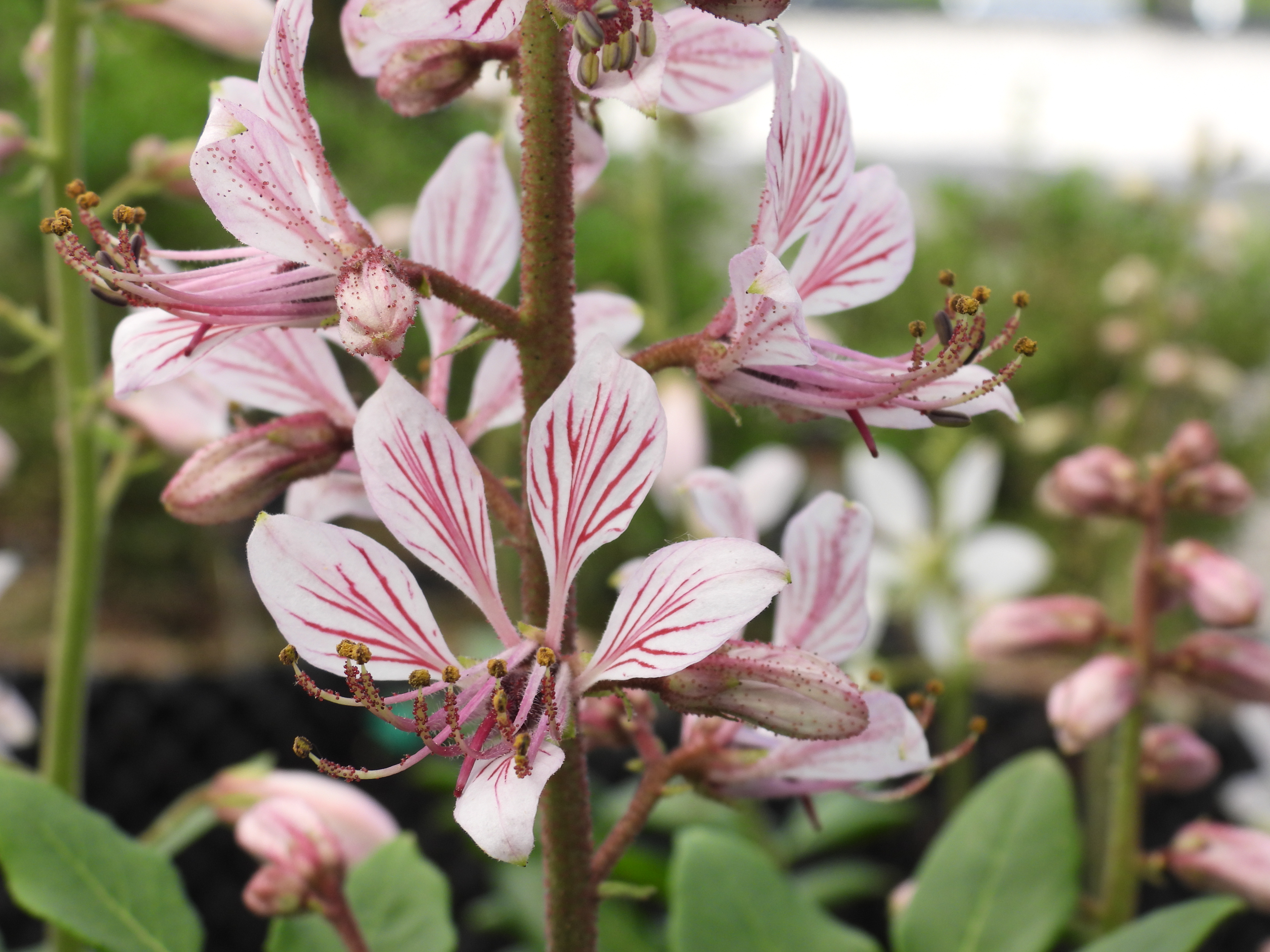
dittany, gas plant, or burning bush (Dictamnus albus)

This herbaceous perennial grows in open woodlands, forest margins, and on rocky slopes in southern Europe and the Caucasus region. It produces a showy display of pink and white blooms on upright, loose spikes from spring into summer.

In addition to the flowers and leaves, Dictamnus albus has another peculiar trait that really shines, especially on warm, summer nights. The flower spikes produce volatile oils and other organic compounds that will rapidly ignite in hot weather, producing a quick-burning pyrotechnic display that does not harm the plant. This is how the plant came to be known as the gas plant or the burning bush.

Keep in mind that this plant contains oil that, though pleasant-smelling, can cause Phytophotodermatitis (a mild-to-severe skin rash) for some individuals, especially when handled on a sunny day. Wearing long gloves and pants to protect skin against oil is recommended.
dark columbine (Aquilegia atrata)

This columbine gets its common name from its dark, reddish-purple flowers, which bloom in summer.

Dark columbine is native throughout Europe, but is also one of the more common columbine species spotted blooming in the Alpine forests and meadows of northern Italy.
Columbines first evolved in Asia before rapidly expanding and diversifying across North America and Europe over the span of a few million years. Today, we recognize around 70 species and countless hybrids and cultivars commonly found in gardens around the world.
fire lily (Lilium bulbiferum)

Native to moist meadows, grassy slopes, and open woodlands of central and southern Europe, the fire lily lives up to its name with its showy display of fiery orange blooms.
The 1-to-3-foot-tall, upright stems emerge from underground bulbs and bear one to five flowers in summer.

Its specific epithet bulbiferum means “bearing bulbs” and refers to the small, aboveground bulbs called bulbils that may form at the leaf axils along the stem. These bulbils can be removed from the stem and used to propagate a clone of the parent plant. Other lily species also exhibit this trait, such as Lilium lancifolium (tiger lily).
Alpine aster (Aster alpinus)

Like its specific epithet and common name suggest, this small aster calls high altitude mountain slopes home.
Flowering stalks emerge from low-growing clumps of basal foliage, topped with a solitary flower head made up of narrow, violet-blue ray florets surrounding a central cluster of bright yellow disk florets. Mature plants in bloom will typically reach less than 12 inches tall.

Unlike most of the asters we are familiar with here in the Midwest, which bloom in the fall, the Alpine aster blooms in summer.
Enjoy Alpine Blooms at the Missouri Botanical Garden
Explore the Garden’s alpine plants in the Floyd Pfautch Bavarian Garden.

Justine Kandra | Horticulturist with the William T. Kemper Center for Home Gardening
Leave a Reply