Step through the enchanting moon gate, take a seat at the grand pavilion, and immerse yourself in the quiet seclusion of The Margaret Grigg Nanjing Friendship Chinese Garden.
This year, the Missouri Botanical Garden celebrates the 30th anniversary of the Chinese Garden, a symbol of St. Louis’ enduring connection to its Sister City, Nanjing.

“Sitting alone in a secluded bamboo grove,
I was singing while playing the qin
Before realizing, in the deep grove,
The moon had already joined me
With her beautiful light.”
–Ancient Chinese poem by Wang Wei (699-759 A.D.), inscribed in the Margaret Grigg Nanjing Friendship Garden
Historic Connections: Sister Cities and Scientific Partnerships
The history of The Margaret Grigg Nanjing Friendship Garden dates back nearly two decades before the garden’s opening. In 1979, St. Louis and Nanjing became Sister Cities. This was a monumental relationship, as St. Louis became the first U.S. municipality to have a Sister City in the People’s Republic of China.

This relationship also paved the way for scientific collaboration between the Missouri Botanical Garden and Chinese botanical institutions.
Flora of China

and Prof. Wu Zheng-yi; (standing, left to right): Dr. William Tai, Dr. David E. Boufford, Prof.
Chen Xin-qi, Prof. Huang Cheng-jiu, Prof. Chen Shou-liang, and Dr. Bruce Bartholomew. Courtesy of the Peter H. Raven Library at the Missouri Botanical Garden.
Born in Shanghai, Dr. Peter H. Raven, President Emeritus of the Missouri Botanical Garden, took a special interest in developing St. Louis’ relationship with Nanjing during his tenure.

In 1988, the Missouri Botanical Garden, Harvard University, and the California Academy of Sciences signed a landmark collaborative agreement with the Chinese Academy of Sciences to produce the first English-language flora of China. The Flora of China Project continued for several years, resulting in 25 volumes and a free online resource for researchers.

Historic Herbarium Shipment

In 1993, the Garden received around half a million plants from China to store in the Garden’s massive herbarium. This was the first time since the 1930s that a significant number of Chinese plants were available to “the West”.
Creation of the Chinese Garden
In 1994, the Missouri Botanical Garden began constructing the Margaret Grigg Nanjing Friendship Garden in honor of the 15-year anniversary of St. Louis’ Sister City relationship with Nanjing.
The Garden worked with five experts from the Nanjing Municipal Bureau of Urban Parks and Open Space Administration, who consulted on the project.


Chinese-American architect Yong Pam designed the space in the style of a scholar’s garden one might find in Nanjing. Traditionally, scholars’ gardens were a place not only to take in the beauty of nature, but also to study and take part in poetry contests.


In September of 1995, the Missouri Botanical Garden hosted a special preview of the Margaret Grigg Friendship Garden for guests. In May of 1996, the Garden dedicated the space during the Chinese Festival (now called Chinese Culture Days).

Did you know? You can explore the Garden’s bulletin’s as far back as 1913. Read the full 1995 bulletin article detailing the Chinese Garden’s creation >

2026 Chinese Culture Days
May 2-3 | 9 a.m.–5 p.m.
Immerse yourself in the majesty, tradition, and pageantry of China during this two-day festival.

Authenticity and Tradition in the Chinese Garden
Many pieces of the Margaret Grigg Nanjing Friendship Garden, including the signature pavilion, were crafted with traditional materials in China and shipped to the Garden. The pavilion was crafted in Nanjing and reassembled piece by piece in St. Louis.

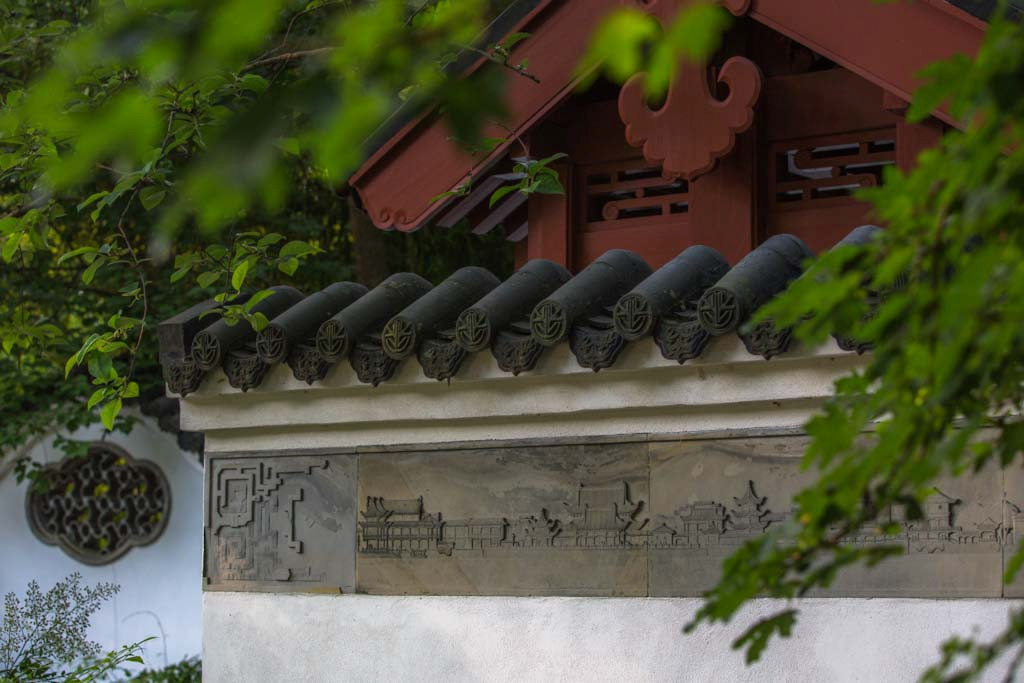
A mosaic in the pavement of the Chinese Garden depicts two cranes. These mosaics were created in China. Photo by Tom Incrocci. Stone panels mounted like a scroll painting on the wall of the Chinese Garden depict a contemporary view of the Confucius temple area in Nanjing. Photo by Kent Burgess. 
The bright red pavilion in the Chinese Garden was constructed in Nanjing, before being taken apart, shipped to St. Louis, and reassembled in the Chinese Garden. Photo from the Garden archives.
Though not crafted in China, the moon gate captures several traditional elements. The circle itself represents perfection in Chinese culture, while the fan-shaped plaque features characters carved using stencils by famed calligrapher Liu Hai-Su.


The Chinese Garden’s authenticity can also be found in the spirit of its traditional landscape style. Chinese gardens are designed to be a place separate from daily life and distractions. The pavilion becomes an essential place to rest and contemplate nature, while the water and large boulders embody yin and yang.

Plants in the Chinese Garden
By the time the Chinese Garden was constructed, the Missouri Botanical Garden had a vast knowledge of the region’s plants thanks to the Flora of China Project.

Though varying season to season, some staples of the Chinese Garden include bamboo, plum trees, hibiscus, lotuses, rhodendrons, and azaleas.

The Chinese Garden also features several rare and endangered plants.
The Seven-Son Flower (Heptacodium miconioides)


Seven-Son Flower (Heptacodium miconioides), is prominently featured at the two diverging paths of the Chinese Garden.
Native to the Anhui, Zhejiang, and Hubei regions of eastern China, this ornamental shrub or tree is known for its fragrant, creamy-white flowers in spring that appear in seven-branched clusters. It is rarely found in the wild due to logging and wood harvesting in the area. The International Union for Conservation of Nature (IUCN) Red List currently lists this plant as vulnerable to extinction.
White Forsythia (Abeliophyllum distichum)

The early blooms of white forsythia surround the small pond at the heart of the Chinese Garden. They bloom in late March, with soft, white, and slightly fragrant flowers.
Endemic to South Korea, only around 4,000 white forsythia exist in the wild. Habitat destruction for housing and commercial construction, as well as recreational collecting, led to decreasing numbers. The IUCN Red List currently lists the showy shrub as endangered.
Hardy impatiens or Mount Emei balsam (Impatiens omeiana)


Hardy Impatiens grow unassumingly along the front entrance of the Chinese Garden, until fall, when their yellow snapdragon-like flowers bloom.
Impatiens omeiana is native to Szechwan in western China and is named after Mount Omei, the highest of the Four Sacred Buddhist Mountains of China. In fact, this species is endemic to Mt. Omei.
The IUCN Red List currently lists the spreading perennial as endangered due to its limited geographic distribution area and tourism to the mountain.
Visit the Chinese Garden during Chinese Culture Days 2026

The Chinese Garden is nestled between the Lehmann Rose Garden and the William T. Kemper Center for Home Gardening. You can spot its iconic moon gate and guardian lions (fu dogs) at the entrance.
The Chinese Garden offers beautiful views year-round, but one of the best times to visit is during Chinese Culture Days. During this festival, you can enjoy relaxing music, games of Go, and Taichi demonstrations while taking in the beauty of the Chinese Garden.
2026 Chinese Culture Days
May 2-3 | 9 a.m.–5 p.m.
Immerse yourself in the majesty, tradition, and pageantry of China during this two-day festival.

Jessika Eidson | Public Information Officer
Thanks to Min Lui with Chinese Culture Education and Services for her research and insight on this topic.

Leave a Reply