It should come as no surprise that as a world-class scientific research center, the Missouri Botanical Garden values access and preservation of botanical knowledge– so much so that the Garden has its own library.
The Peter H. Raven Library, currently located in the Bayer Center just a few blocks from the Garden’s entrance, dates back to the 1850s and has been an invaluable research tool for generations of scientists.


Second image: A researcher using the Library in 2024. Photo by Nathan Kwarta/Missouri Botanical Garden.
Currently, the Library houses over 250,000 books in its collection, including several thousand over rare books. Many of these have been digitized for modern and future researches.
The Library also provides access to modern books and research, including hundreds of digital scientific journals and databases.
Did you know? Those interested in using the Garden’s Library are encouraged to make a research appointment.
“The Peter H. Raven Library has a fairly narrow but deep focus, with many books in the collection held by only a few other libraries in the world,” says library manager, Doug Holland. “If every other library has replaced or discarded some obscure or aging book on botany, we will be the library that still has that book when someone needs it three hundred years from now.”
The History of the Missouri botanical Garden’s Library
At the time of the Missouri Botanical Garden’s founding, a library had been considered an essential part of research and education of major botanical gardens for the past few hundred years.
When the Garden’s founder, Henry Shaw, was planning his garden and soliciting advice from notable botanists of the day, they advised him to begin building a library, herbarium, and economic botany museum collections.
Establishing a Library
Two men were influential in the creation of a research library at the Missouri Botanical Garden: Sir William Jackson Hooker and Dr. George Engelmann.
In August of 1857, Sir William Jackson Hooker, the Director of the Royal Botanic Gardens at Kew, wrote to Missouri Botanical Garden’s founder Henry Shaw about the importance of having a library and museum attached to the Garden.
Very few appendages to a garden of more importance for instruction…than a library and economic museum; and they will gradually increase like a rolling snowball.
– Sir William Jackson Hooker, the Director of the Royal Botanic Gardens at Kew, in a letter to Henry Shaw
Shaw quickly took the advice to heart, empowering his friend and colleague Dr. George Engelmann to purchase books in Europe that would become the heart of the Garden’s research collections.


Engelmann was influential in making the Garden a world-renowned scientific institute, persuading Shaw that the Garden be more than a public park and become involved with scientific work like the great botanical institutions of Europe. In order to achieve this goal, Engelmann no doubt saw the value of having a research library.
The Growing Library
The original Library opened on the Garden grounds in 1859 at what is now the Stephen and Peter Sachs Museum. Purchased books and eventually Engelmann’s large collection of books donated after his death would all be kept at this location until the 1890s.

In the 1890s, the Library moved to Shaw’s reconstructed Town House, now the Shoenberg Administration Building, to join the Herbarium.
Related: Why Dead Plants Matter – The Importance Of An Herbarium
The Library remained here until 1972 when it moved with the Herbarium to the newly built Lehmann Building. In 1997, with the Herbarium and Library outgrowing the space, the Library moved again to its current location in the Bayer Center.

It was named in honor of the Garden’s recently retired president Dr. Peter H. Raven in 2011. As of 2024, the Peter H. Raven Library now houses over a quarter of a million books spread across over 5 miles worth of shelving.
The Peter H. Raven Library in the Modern Age
In the modern age, the Peter H. Raven Library still acts as a research hub for botanists, but also has expanded to conserving and digitizing rare books, as well as archiving the Garden’s history.
A Research Hub for Botanists
To this day, the Peter H. Raven Library’s primary function continues to be supporting the scientific research and information needs of the botanical world.

Through purchases, subscriptions, and gifts, the Library’s collection has continued to grow. There are now more than 250,000 monographs and journals, and 6,000 volumes of rare books in the collection. These rare books include many full-size plant illustrations important to botanical, horticultural, and natural history sciences.
Our role is to curate this collection for use and knowledge now and into the distant future.
– Doug Holland, manager of the Peter H. Raven Library
The Peter H. Raven Library is globally recognized as one of the most comprehensive libraries of botanical literature in the world.
The Rare Books Room at the Peter H. Raven Library

As Garden scientists and visiting researchers conduct groundbreaking research, it is important that the Library not only collects the most current scientific literature in print and digital formats, but must also maintain a comprehensive collection of older books.
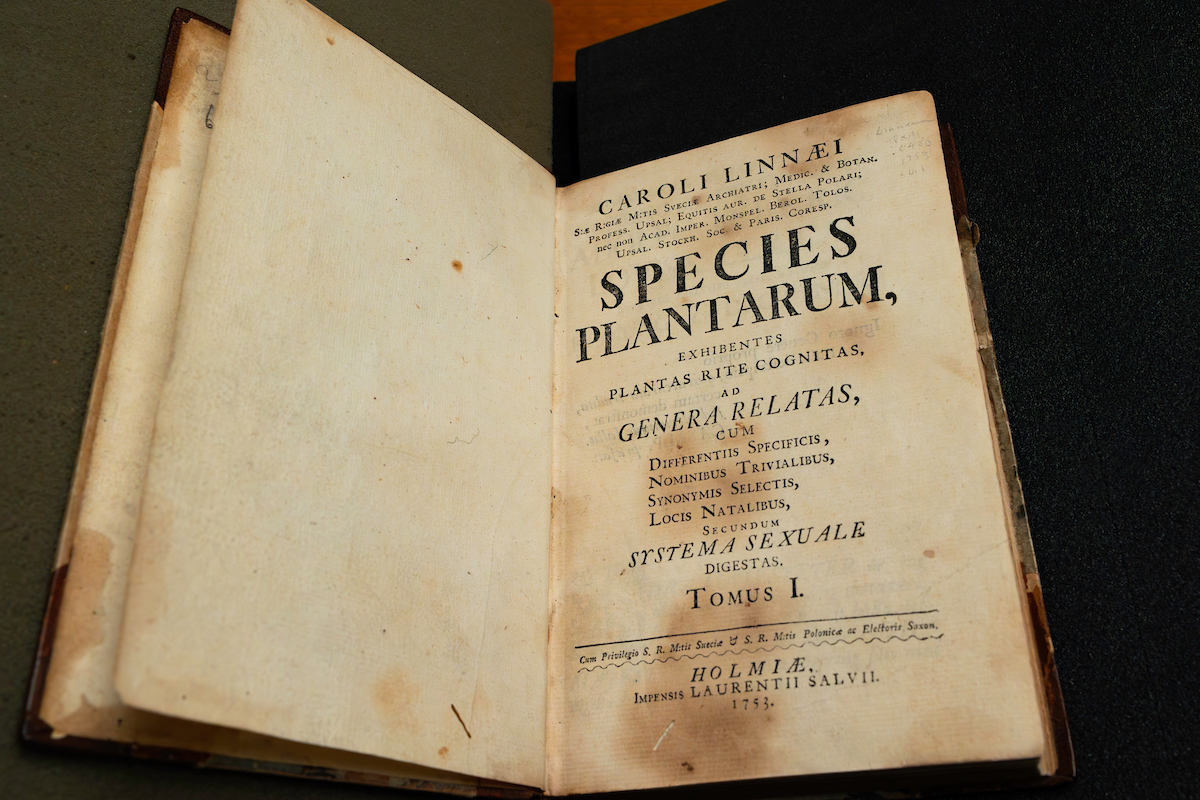
“Unlike some fields of science, botany depends heavily upon publications of the 18th and 19th centuries to maintain a stable system of names for plants,” Doug Holland, the library curator, explains. “Since the genus-species binomial system was established with the publication of Carl Linnaeus’ Species Plantarum in 1753, it means botanists must consult over 250 years of books and journals, often on a daily basis.”
The Rare Books Room contains books dating back to 1474, including publications that shaped the field of botany such as Species Plantarum 1st Edition, 1753, by Carl Linnaeus, and a first edition of On the Origin of Species by Charles Darwin, 1859.


The librarians ensure these books are kept in ideal conditions for longevity. This includes climate and temperature control, security, lower lighting, and special handling practices.
The Book Conservation Lab at the Peter H. Raven Library
The library not only acquires and houses books, it also employs a book conservator to take care of them, stabilizing and repairing them when necessary.
he conservator also creates protective enclosures for collection items to ensure they remain undamaged and useable over time.
In fact, the Peter H. Raven Library has the only dedicated institutional book conservator and lab in the St. Louis region, a testament to the commitment of the Garden to the long-term preservation of the library collection.

View of some of the presses, type setting equipment, and paper cutting devices in the Laboratory. Photo by Tom Incrocci/Missouri Botanical Garden.

The Biodiversity Heritage Library for The Digital Age
The Peter H. Raven Library is one of the founding members of the Biodiversity Heritage Library (BHL), the world’s largest open access digital library for biodiversity literature and archives.
The BHL is a collaborative effort from the libraries of prestigious natural history institutes, botanical gardens, and universities. The Peter H. Raven Library has been digitizing many of its rare books and contemporary Garden publications for researchers and science enthusiasts to view. Below are some digital images from the BHL.


The Missouri Botanical Garden Archives
The Peter H. Raven Library is also responsible for the Missouri Botanical Garden Archives, which documents the history of the Garden from the founder’s first days in St. Louis in 1819 to blueprints of the most recently completed buildings.

As part of the archival process, the Garden has created a digital archive with a historic timeline, photos, and historical documents.
Related: Missouri Botanical Garden And The Underground Railroad
Who can use the Peter H. raven library?
Unlike the Garden’s Herbarium, which is limited to researches, the Peter H. Raven Library is open for use by anyone, but Garden staff and visiting researches from peer institutions around the world are some of the most regular patrons of the Library.
We ask any visitors who are not Garden staff to make an appointment so the librarians can help them access the Library and find the information they need.
Make A Library Appointment
The librarians are generally available to help visiting researchers Monday–Friday, 8:30 a.m.–5 p.m. local time. The full catalog of the Peter H. Raven Library can be found at available at mbg.searchmobius.org/search


Doug Holland | Manager of the Peter H. Raven Library
Jessika Eidson | Public Information Officer
Leave a Reply