Plants have long been associated with witchcraft, from symbols of protection and ingredients in spells and potions to supposed evidence of wrongdoing used against innocent women.
Wendy Applequist, associate scientist in the Garden’s People and Plants Division, explores the history of plants linked to witchcraft. She explains how both harmful and beneficial plants earned “witchy” reputations—and how some of these beliefs persist today.
Witchcraft: Folklore and History
The word “witchcraft” can evoke everything from fantasy and folklore to the very real tragedies of historical witch hunts.

Modern fantasy novels often portray witches as rural folk healers with specialized knowledge of beneficial plants. As Applequist explains, historical practitioners who used such knowledge were often known by other names.
“Such people existed, of course, but were known by such names as ‘cunning folk,’” Applequist explains. “They would have worked very hard to avoid being called witches because that could get them killed, especially as the power of academic medicine grew.”
During the late medieval and early modern periods, people accused of witchcraft faced persecution, including torture and execution.

“Plants associated with witchcraft in folklore needn’t have had anything to do with the victims of witch-hunts,” Applequist says. “Even when people on trial reported the use of some plant, we have to take that with a large grain of salt, since they had been tortured to extract confessions that pleased their persecutors.”
Toxic Plants for Poisons
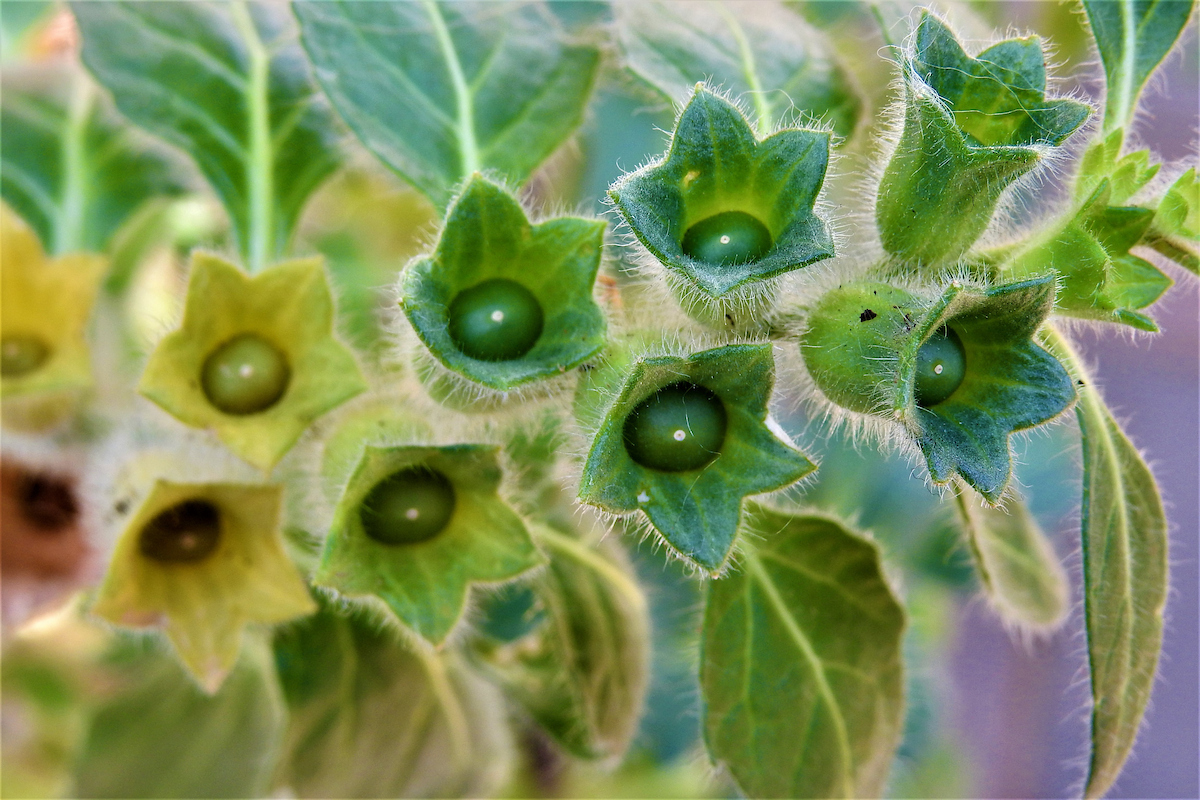
Poisonous plants such as henbane (Hyoscyamus niger), deadly nightshade (Atropa belladonna), and wolfsbane or monkshood (Aconitum species), were believed to be favored ingredients in witches’ poisons and potions.
Home gardeners should avoid these plants, particularly in areas accessible to children or pets, because of their toxicity.

“Instead of adding these extremely poisonous plants to your home garden, consider visiting the Garden’s specimens,” suggests Justine Kantra, horticulturist with the William T. Kemper Center for Home Gardening. “Monkshood can be found in the Strassenfest Garden and English Woodland Garden. But please remember to not touch any plants in the Garden for your safety and the plant’s safety.”
Henbane and the Legend of Flying Ointments

Some people accused of witchcraft confessed to making “flying ointments” from plants such as henbane (Hyoscyamus sp.). They claimed that applying the ointment allowed them to fly on broomsticks to “sabbats,” where they supposedly met a being identified as the Devil.
“Henbane and other toxic members of the potato family, Solanaceae, are hallucinogenic,” Applequist explains. “Such an ointment might have given witches the experience of making a trip that didn’t really happen.”

Many of these women confessed under duress. Accusers may also have sought to implicate others by claiming that accused witches had visited them
Thorny Hawthorns and Blackthorns

People who carried a blackthorn (Prunus spinosa) staff were sometimes accused of witchcraft, while hawthorns (Crataegus sp.) could be regarded as protective plants.
Both plants are large, thorny shrubs or small trees in the rose family. Their sharp thorns can cause serious injuries, and both have been associated with folklore. Hawthorns and blackthorns can also form dense hedgerows, which may have contributed to their connections with “hedge witches.”
“But when found as solitary trees, they might be associated with the non-human fairy or ‘fair’ folk, whose existence was and in some places still is widely accepted,” says Applequist.
Both plants produce edible fruits. Hawthorn also has a history of medicinal use, including for conditions related to the heart and blood pressure.
Plants with conflicting reputations
Some plants have conflicting reputations in folklore, associated with both protection from evil and gatherings of witches or “trickster” spirits.
Alder (Alnus sp.) was associated with the “fair” folk, and cutting the trees was considered taboo. Alders often grow in low-lying, foggy areas that may seem spooky, and their reddish wood can look like blood when freshly cut.

Elder (Sambucus nigra) was said to repel evil, but it was also believed to serve as a gathering place for witches. Folklore held that the tree contained an indwelling spirit that could harm anyone who cut it down without first using the proper protective charm.
“Elder fruits are edible, and they and the flowers are medicinal, but the leaves and stems are toxic, which might have made the plant seem sinister,” says Applequist.

Mullein (Verbascum thapsus) also had a dual reputation: it was associated with witches but was believed to offer protection from evil. Its yellow flowers have been used in preparations for respiratory conditions and earaches.
Positive “Magical” and Medicinal Plants

Other plants developed more positive reputations in folklore and were used in charms believed to offer protection or aid enchantment.
For example, vervain (Verbena officinalis) is an Old World medicinal plant associated with Egyptian, Greek, and Roman deities and with Christian legends. Though it is not particularly potent, it has been thought useful in enchantment.
Moonwort (Botrychium lunaria) was also claimed to be a useful ingredient in charms, including those believed to open locks or remove horseshoes.

Some plants with medicinal properties were also believed to protect against witchcraft and other supernatural attacks. Rue (Ruta graveolens) and rowan (Sorbus aucuparia) were regarded as plants that could repel witchcraft. Rue is somewhat toxic and should not be taken internally without appropriate expert guidance.
St. John’s wort (Hypericum perforatum) has a long history of medicinal use. It was traditionally used to treat wounds and was believed to repel demons and fairies. Clinical trials have confirmed that it can be an effective treatment for depression.
Herbs and Garden Ornamentals for Protection

“Common herbs and garden ornamentals also had their spiritually protective uses,” says Applequist.

Rosemary (Salvia rosmarinus), for example, was thought to repel witchcraft when planted outside a home’s door. The plant was also associated with female power and was said to signify that a woman was in charge of the household.
Other protective plants said to ward off evil and witchcraft include:
- Lavender (Lavandula angustifolia) to repel evil spirits,
- Periwinkle (Vinca minor) to repel witchcraft and evil spirits and use in love charms
- Migraine-prophylactic feverfew (Tanacetum parthenium) warded off evil spirits and bad dreams
- European peony (Paeonia officinalis) could be planted outside the door to ward off witchcraft
- Betony (Betonica officinalis) might keep the house safe.
If you have any interest in creating your own witch-inspired garden, the William T. Kemper Center for Home Garden can help you decide which plants are right for your space.
Leave a Reply