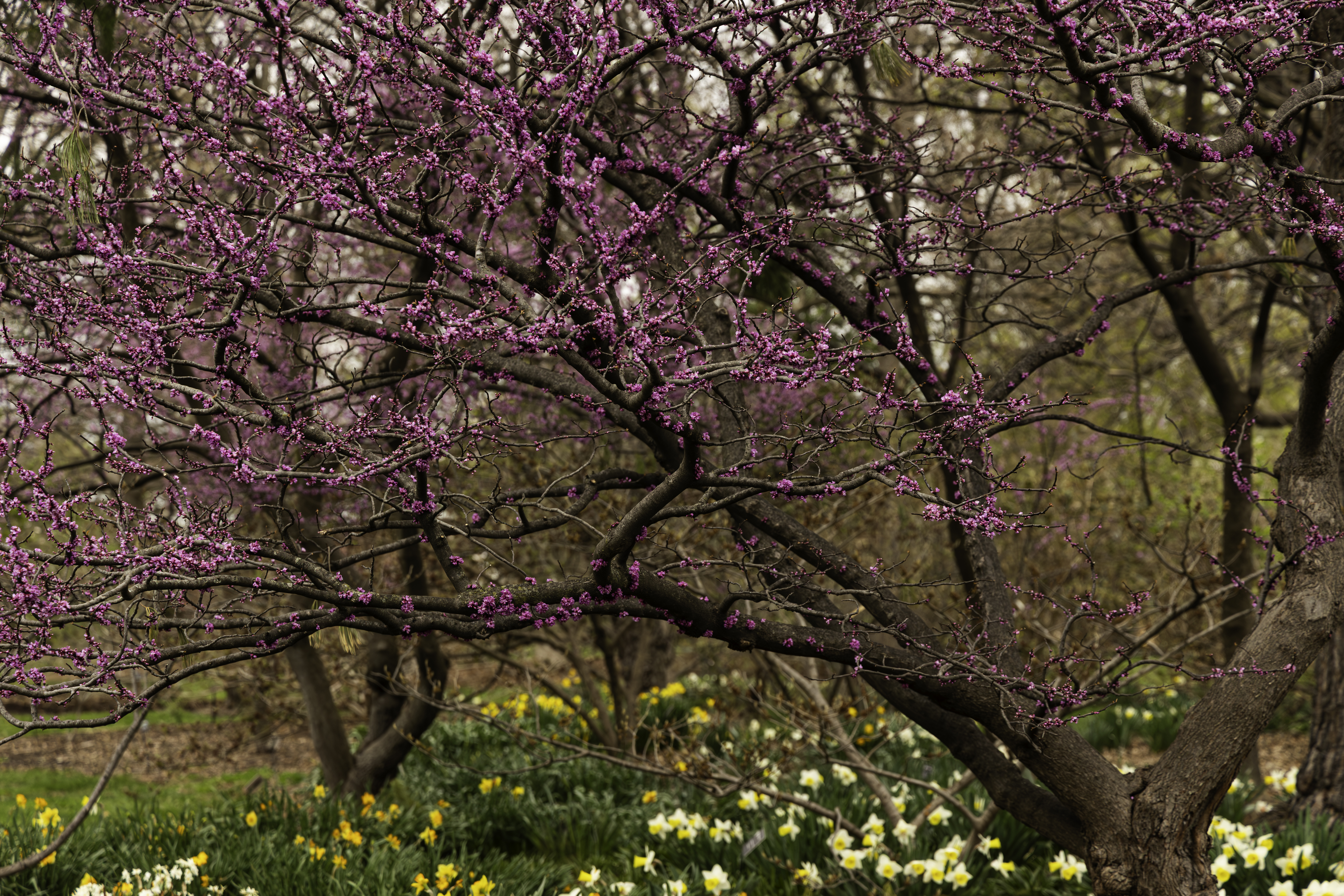
Missouri celebrates Arbor Day on the first Friday in April. What better way to celebrate than adding a Missouri native tree to your yard?
Spring and fall are the best times to plant trees in Missouri. The Missouri Botanical Garden’s William T. Kemper Center for Home Gardening has everything you need to know about planting trees in this guide.
The home gardening team recommends the following native trees.
Missouri Native Trees with Edible Fruits
Serviceberry, Amelanchier arborea

This Missouri native tree, whose Latin name translates to “growing in a tree-like manner,” can be grown as a tree or bush. It blooms with showy white flowers each spring that give way to berries in the summer. The ripe berries look similar to blueberries and are a popular ingredient in jams, jellies, and pies. Birds and butterflies love serviceberry trees.

Where to plant it: Full sun to part shade
Soil preference: Tolerates a wide range of soil, including clay
Height: 15 to 25 feet
Suggested use: Ornamental
Pawpaw, Asimina triloba

Also known as the “custard apple,” this Missouri native tree produces the largest edible fruit in North America. People have described pawpaw fruits as a mixture of banana, papaya, mango, and pineapple, sometimes with a melon or bitter aftertaste. They can be eaten plain or in treats like pie and ice cream. Before fruits appear, pawpaw trees produce large purple, cup-shaped flowers in the spring.

Where to plant it: Full sun to part shade
Soil preference: Moist, acidic, fertile soils
Height: 15 to 20 feet, sometimes as tall as 30 feet
Suggested use: Rain garden
Black Chokeberry, Aronia melanocarpa

More of a shrub than a tree, this Missouri native also produces showy flowers and edible fruits. It blooms in May with white flower clusters and produces black autumn berries. The berries are tart and bitter, earning the “chokeberry” name, but are sometimes used to make jams and jellies.
Where to plant it: Full sun to part shade.
Note: Full-sun is best for fruit production
Soil preference: Wide range of soil tolerance, including boggy soils.
Height: 3 to 6 feet
Suggested use: Hedge or rain garden
Missouri Native Tree with Flowers

Eastern Redbud, Cercis canadensis
This Missouri spring staple produces beautiful rose-purple blooms in early spring each year that provide early-season nectar for hummingbirds. Songbirds enjoy eating the redbud’s flowers and seeds as well as caterpillars and other insects that feed on redbuds.
Did you know? The less common white red bud traces its rise in prominence back to the Missouri Botanical Garden.
Where to plant it: Full sun to part shade.
Soil preference: Wide range of soil tolerance, including boggy soils.
Height: 20 to 30 feet
Suggested uses: Street tree, ornamental (flowering)
Flowering Dogwood, Cornus florida

Missouri’s state tree, the flowering dogwood, blooms in early spring. The dogwood’s true flowers are tiny, yellowish-green clusters. Each cluster is surrounded by white petal-like bracts. Another common Missouri native variety is Cornus florida f. rubra, which has pink bracts.

Where to plant it: Full sun to part shade.
Soil preference: Moist, organically rich, acidic soils in part shade.
Height: 15 to 30 feet
Suggested uses: Ornamental (flowering)
Missouri Native Tree with eye-catching bark
River Birch, Betula nigra

This Missouri native deciduous tree occurs on floodplains, swampy bottomlands, and along streams throughout the state. Its salmon-pink to reddish brown bark exfoliates to reveal lighter inner bark.
Where to plant it: Full sun to part shade.
Soil preference: Moist, acidic, fertile soils, including semi-aquatic conditions, but also tolerates drier soils.
Height: 40 to 70 feet
Suggested uses: Shade Tree, Rain Garden
Missouri Native Shrub with winter appeal
Ozark Witch Hazel, Hamamelis vernalis

Notable for producing showy yellow blooms as early as January, witch hazel is a winter favorite Missouri native. A warm, sunny day will typically trigger the yellow to red-orange blooms to open, releasing a pleasing, spicy fragrance.
Where to plant it: Full sun to part shade.
Soil preference: Moist, acidic, organically rich soils
Height: 6 to 10 feet
Suggested uses: Rain Garden, winter interest
Catherine Martin
Senior Public Information Officer
Leave a Reply