Zen Buddhist traditions first developed in China in the 6th century CE, and spread from there to Vietnam, Korea, and Japan. Various schools of Zen teachings developed in Japan over the centuries, but they all share basic tenets of meditation, simplicity, and living in the moment.

Zen gardens first appeared on the grounds of Japanese Zen temples during the middle of Japan’s medieval period. Their primary purpose was to provide the monks residing at the temple with a place of meditation, contemplation, and mindfulness.
Every plant, stone, and landscape feature has a specific meaning, and the act of maintaining the carefully manicured space becomes a sort of meditation in and of itself.
Zen Gardens for Your Home
Home gardeners do not need to create their own full-fledged, traditional Japanese Zen garden to achieve the same outcome. Any garden can become a place of meditation and tranquility.
Simply find a shady spot, place a bench, seat, or outdoor cushion, and sit quietly for a time. Take in the sights, smells, and sounds of your garden and let the busyness and stresses of your day to day fade to the background.
But if you do want to integrate Zen garden techniques into your home landscape, here are a few simple ideas to get started.
1. Visit A Japanese Garden in person or virtually

Begin your journey into Zen gardening by seeing how the style can be incorporated in various spaces.
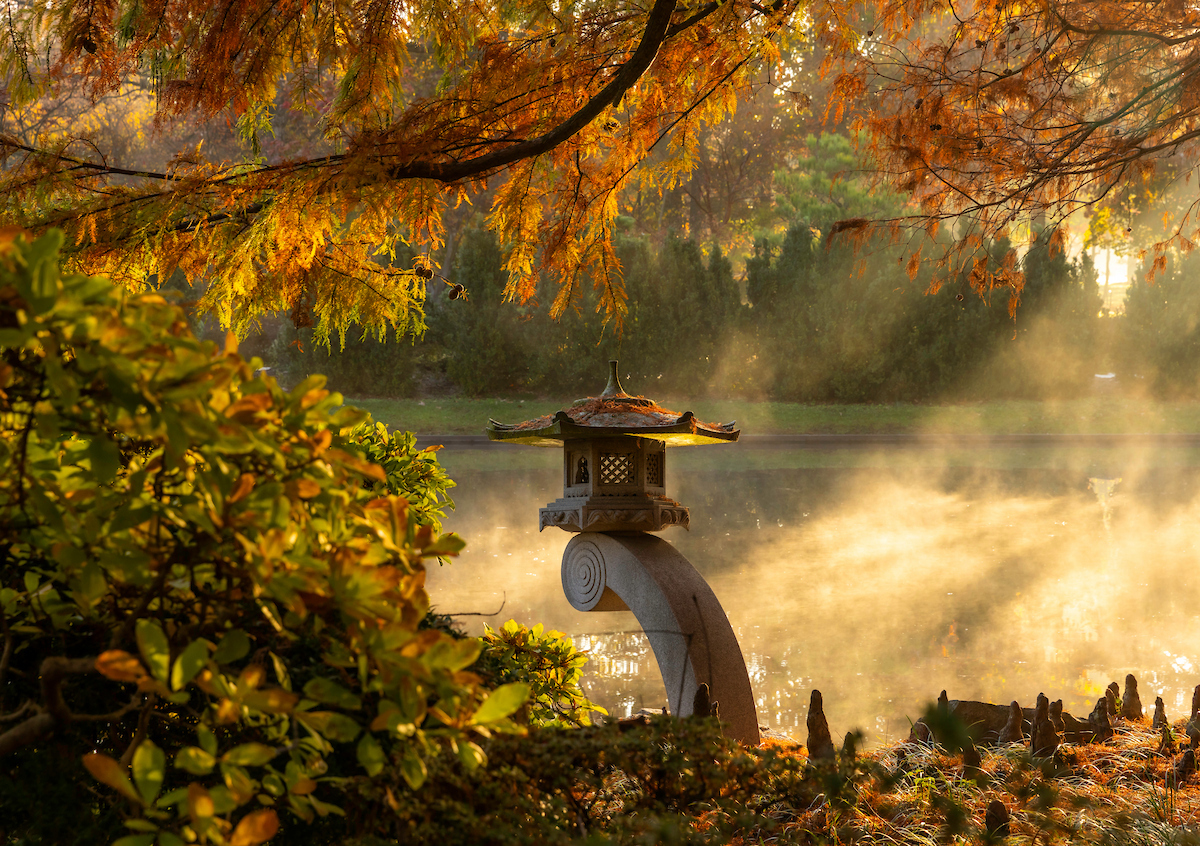
Visiting Seiwa-en, the Missouri Botanical Garden’s own Japanese Garden. Here you can see find tenants of Zen and the Shinto religion incorporated throughout the 14-acre landscape.
You can also virtually visit inspiring Japanese gardens. The Portland Japanese Garden in Portland, Oregon, and the Ryoan-ji Zen Garden located outside Kyoto, Japan, both offer virtual tours of their space.
2. Less is more

Instead of packing in as many plants as possible into a space, Zen gardens might opt for a few choice specimens that can be enjoyed through the seasons.
Weeping cherry trees or Japanese maples make excellent botanical focal points.
3. Include a water element


Ponds invite reflection and calm contemplation, but dry “water features” are also very common in Zen gardens.
Beds of small gravel or sand can be carefully raked into swirling patterns that are meant to evoke real water. The actual practice of creating the water-like patterns can become a meditative practice.
4. Consider basic garden design principles

Contrasting colors and textures will add interest to any garden. These concepts are particularly important in Zen gardens where plant paletes are typically minimalist.
5. But some principles of Western garden can be eschewed

When creating a Zen garden, in some instance you will want to abandon the more rigid gardening rules of Western culture.
Take symmetry for example. Zen gardens are typically not laid out on straight axes, but balance is maintained through careful placement of plants, stones, and other features. Asymmetry makes the garden interesting to look at from all angles.
Learn more about Zen and Ikebana
Connect with St. Louis’ Zen Buddhism community and learn the art of Ikebana during the annual Japanese Festival August 30–September 1.

Justine Kandra | Horticulturist with the Kemper Center for Home Gardening

Leave a Reply