The Holiday Flower and Train Show is a beloved Missouri Botanical Garden tradition during the holiday season.
The show features charming G-Scale model trains that travel through a colorful display of blooming poinsettias and miniature landscape designed to be at eye-level for young guests to enjoy.
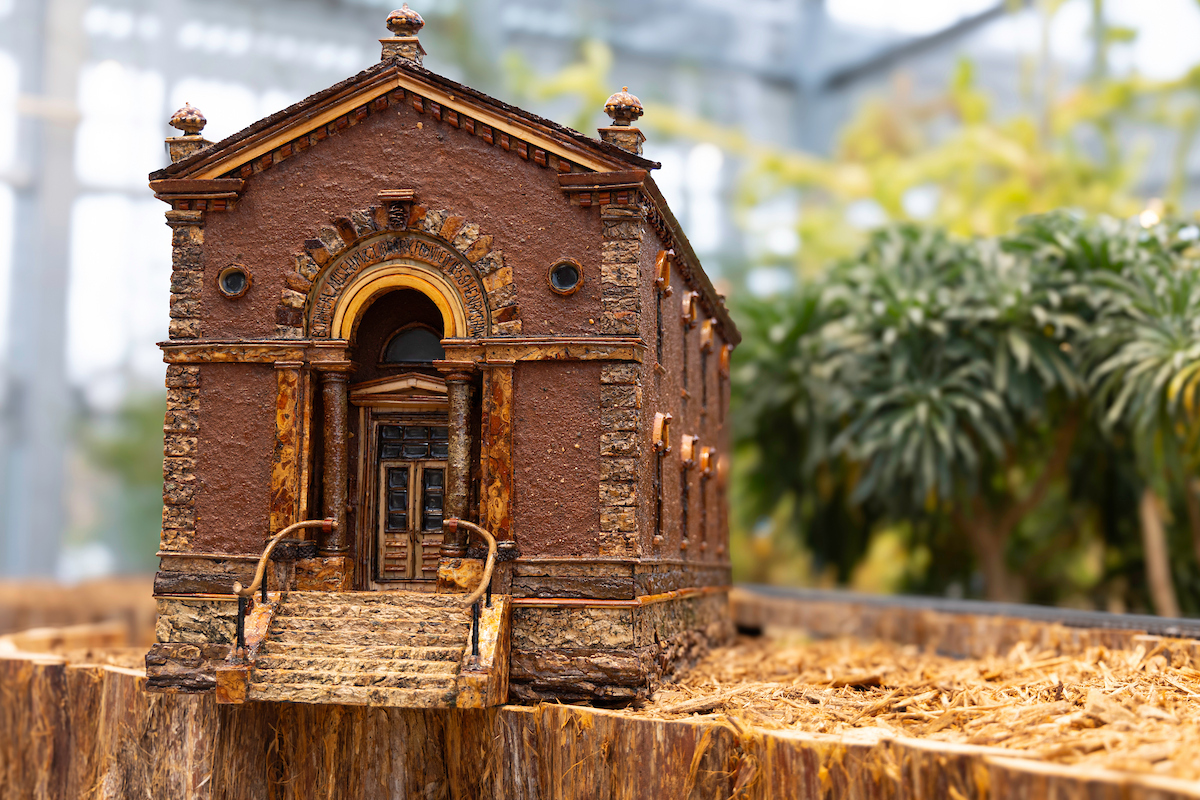
Among the most popular elements of the Holiday Flower and Train Show features are several miniature replicas of landmarks in the Garden created with botanical materials. These expertly-drafted, and hyper-detailed pieces were created by Applied Imagination Ltd.

“Botanical architecture was initially developed by Applied Imagination’s founding visionary, Paul G. Busse,” the creators explain. “Founded in 1991, Applied Imagination was the convergence of Paul’s work with landscaping, garden railroads, and his unique use of plant material. We are so thrilled to bring our unique creations to the Missouri Botanical Gardens Holiday Flower and Train Show. For over 30 years, our artisans have evolved this unique style of modeling, each building taking 100-500 hours to complete.”
Along with Garden buildings, the artists also replicated several homes in the Shaw Neighborhood to represent the area the Garden resides in.
Tower Grove House


Tower Grove House was designed by famous St. Louis architect George I. Barnett in a traditional Lake Cumo Italianate style of architecture, one of the first of its kind in St. Louis in 1849. The Garden’s founder and its first director both lived in this house during their tenure.

The building now acts as a museum of the Victorian Age and the Garden’s history, welcoming guests throughout the year.
Crafted by Sylvia Powell and Ann Gessendorf, the miniature, botanical replica took 300 hours to create using bark, leaves, sticks, acorn caps, pine cone scales, cinnamon, bamboo and pine sticks to recreate the iconic Garden landmark.


Linnean House


Built in 1882, the Linnean House (also “Linnæan House” in some historical references) has operated as the oldest public greenhouse west of the Mississippi River.


The miniature replica of Linnean House took 500 hours to create, and was the work of Ava Roberts, Evan Wolff, and Ann Gessedorf. On display in the Holiday Flower and Train Show, it captures the building’s nods to Carl Linnaeus, the “father of taxonomy,” who laid the foundation for the modern scheme of binomial nomenclature. Details include a bust of Linnaeus made with magnolia pods, as well as his name in horse chestnut wood.
Herring House


The Garden constructed Herring House in 1895 as a residence for the Garden’s groundskeeper. While it no longer has a permanent resident, the small home is a beloved part of the Victorian District.
This miniature replica created by Ann Gessedorf, uses bark from oak, black walnut, and horse chestnut trees, as well as pine cone scales, cedrela, and birch branches to make the building in 200 hours.


Stephen and Peter Sachs Museum


The scientific heart of the Garden for more than a century before closing to the public in 1982, the Stephen and Peter Sachs Museum is now home to yearly exhibits highlighting plants and their connections to art and culture.


The miniature replica on display at the Holiday Flower and Train Show took 250 hours for artists Skylar Kutcher, Ann Gessendorf, and Stephanie Winter to complete. The replica captures the details of this restored building, including the words over the stairs which designate the building as a “Botanical Library and Museum” and the small windows on the roof.

Mausoleum


The second mausoleum commissioned by Garden founder Henry Shaw before his death stands just north of Tower Grove House. It contains a marble likeness of Shaw sculpted by Ferdinand von Miller II and colorful stained glass windows.
Did you know? The Garden’s founder Henry Shaw originally planned to be buried in a mausoleum that now contains the Victory (of Science over Ignorance) statue.


The miniature replica of the Mausoleum, as well as the replica of Shaw’s sculpture inside, were created by Stephanie Winter and took 125 to complete. Winter used palm, date vine and grapevine, honeysuckle branches, arborvitae, horse chestnut and cinnamon curls to recreate the landmark.


The sculpture replica contains palm, honeysuckle sticks, bleached weeping willow, and eucalyptus leaves.
Other features of the Holiday Flower and Train Show
The new miniature replicas add to the wonder and charm of the Holiday Flower and Train Show, but there are several other pieces of the display that will leave visitors in wonder and awe.
Several charming G-scale trains and trolleys run throughout the small scene. Living Stones ( Lithops) Japanese Holly (Ilex crenata), Japanese falsecypress (Chamaecyparis pisifera), and other small plants dispersed throughout the miniature scenery mimic trees and stone pathways.


Vibrant poinsettias (Euphorbia pulcherrima), Kalanchoe, and Cyclamen create a lush, festive environment throughout the Emerson Conservatory, coinciding with the permanent Mediterranean plants that call the conservatory home throughout the year.

Explore the holiday Flower and Train Show
Now–January 3, 2026
Included in daily admission to the Missouri Botanical Garden (9 a.m.–3 p.m.) and Garden Glow admission (5 p.m.-End of night).
Trains active 10 a.m.–2 p.m. daily and 5–9 p.m.
Jessika Eidson | Public Information Officer
Thanks to Pat Scace, Supervisor of Horticulture-Floral Display, and Laura Busse Dolan, President and CEO of Applied Imagination Ltd., for their expertise and contribution to this blog.
Leave a Reply