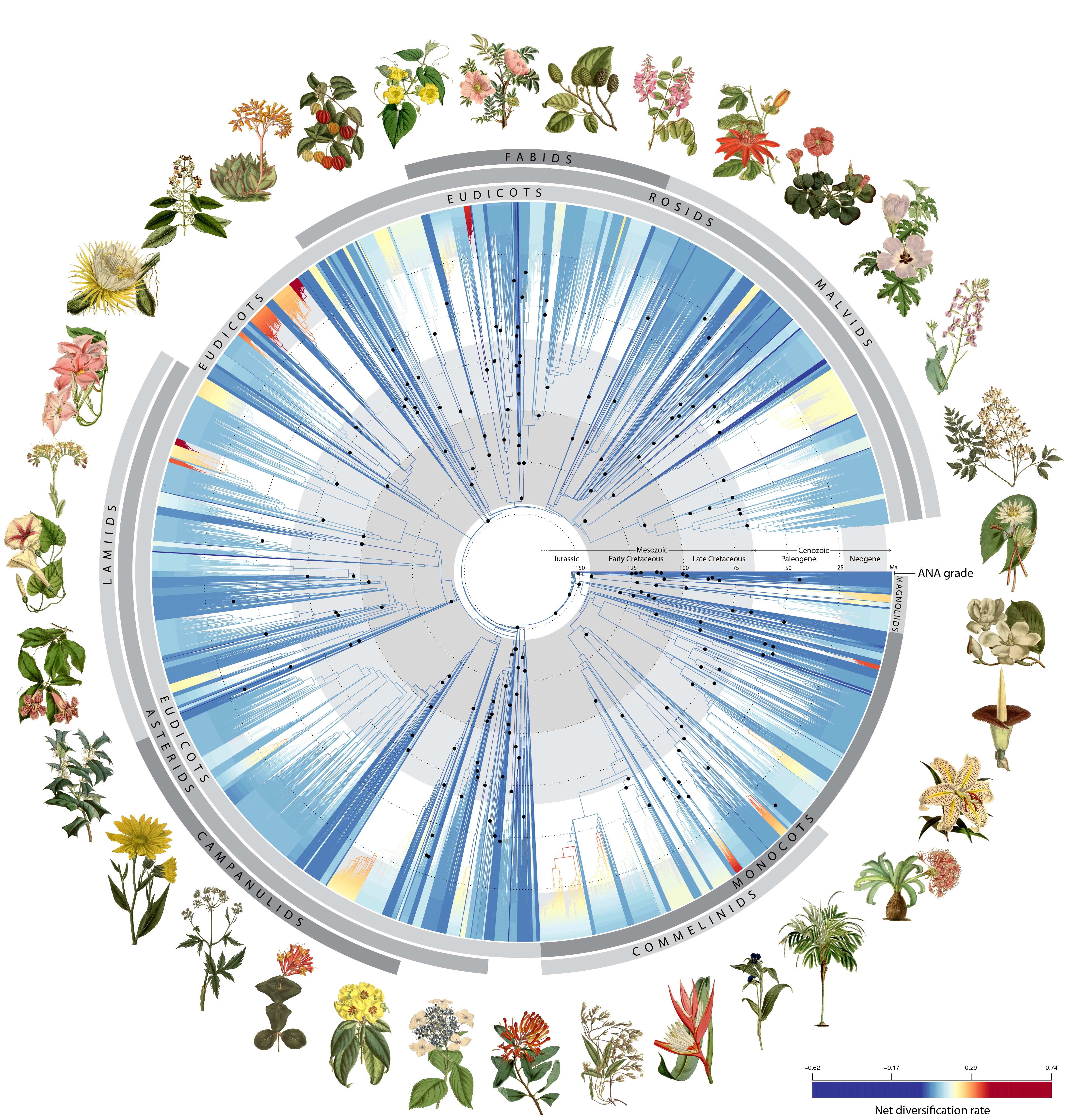
Missouri Botanical Garden scientists were among an international research team that used 1.8 billion letters of genetic code to build groundbreaking tree of life.
A paper published this spring in the journal Nature shares the most up-to-date understanding of the flowering plant tree of life.
“This is the result of a major international collaborative effort aimed at understanding relationships among flowering plants,” said Garden Scientist Mónica Carlsen.

What is a tree of life?
Sometimes referred to as a “periodic table for flowering plants,” the tree of life is a tool that biologists use to map how organisms are related.
Building the tree of life
Using 1.8 billion letters of genetic code from more than 9,500 species covering almost 8,000 known flowering plant genera, this incredible achievement sheds new light on the evolutionary history of flowering plants and their rise to ecological dominance on Earth. The study’s authors believe the data will aid future attempts to identify new species, refine plant classification, uncover new medicinal compounds, and conserve plants in the face of climate change and biodiversity loss.
“Understanding how the amazing diversity of flowering plants we see in our planet have originated and how many millions of years it took to evolve, makes us feel more deeply connected with nature and puts in perspective the importance of global plant conservation for all,” said Carlsen.

Major Milestone
The Garden is among 138 international organizations that contribute to the milestone project that built on 15 times more data than any comparable studies of the flowering plant tree of life.
Among the species sequenced for this study, more than 800 have never had their DNA sequenced before including six samples provided by Carlsen. The sheer amount of data unlocked by this research, which would take a single computer 18 years to process, is a huge stride towards building a tree of life for all 330,000 known species of flowering plants – a massive undertaking by Kew’s Tree of Life Initiative.

Why the tree of life matters
The flowering plant tree of life, much like our own family tree, enables us to understand how different species are related to each other. Scientists uncover the tree of life by comparing DNA sequences between different species to identify changes (mutations) that accumulate over time like a molecular fossil record. Our understanding of the tree of life is improving rapidly in tandem with advances in DNA sequencing technology. For this study, scientists developed new genomic techniques to magnetically capture hundreds of genes and hundreds of thousands of units of genetic code from every sample, orders of magnitude more than earlier methods.
“The flowering plant tree of life has enormous potential in biodiversity research,” Carlsen explained. “Just as one can predict the properties of an element based on its position in the periodic table, the location of a species in the tree of life allows us to predict its properties. This new data will be invaluable for enhancing many areas of science and beyond.”

Where did scientists get the DNA?
The research team used a wide diversity of plant material, old and new, to be sequenced. Even when the DNA is badly damaged, the team can still use it.
Herbaria
One key source for collecting DNA was from the world’s herbarium collections – collections of dried plant specimens – that comprise nearly 400 million scientific specimens of plants.
Across all 9,506 species sequenced, over 3,400 came from material sourced from 163 herbaria in 48 countries.

The Missouri Botanical Garden has one of the largest herbaria in the world, with more than 7.5 million specimens. Dozens of samples for the project came from the Garden’s Herbarium, including rare species with restricted geographic ranges not known from living collections. Bognera recondita, a genus in the aroid family comprising just a single species, for instance, found only in remote areas of Amazonian Brazil near the Peruvian border. Its name means “hidden.’
“Herbaria are critical resources for the study of the world’s plants, especially when those plants grow in areas that are difficult or dangerous to access,” said Garden Herbarium Director Jordan Teisher. “A walk through the aisles of the Herbarium is like being able to teleport across continents, from the slopes of the Andes to the deep forests of the Congo or remote islands of Indonesia.”
Global plant collections
Additional material from plant collections around the world, whether in DNA banks, seeds, or living collections, were also vital for filling key knowledge gaps to shed new light on the history of flowering plant evolution. The team also benefited from publicly available data for over 1,900 species, highlighting value of the open science approach to future genomic research.

Solving a Centuries’ Old Mystery
Flowering plants alone account for about 90% of all known plant life on land and are virtually everywhere on the planet. Yet, our understanding of how these plants came to dominate the scene soon after their origin has baffled scientists for generations, including Charles Darwin. Flowering plants originated more than 140 million years ago after which they rapidly overtook other vascular plants including their closest living relatives – the gymnosperms (non-flowering plants that have naked seeds, such as cycads, conifers, and ginkgo). Darwin was mystified by the seemingly sudden appearance of such diversity in the fossil record.
For their research, the scientists used 200 fossils to see how flowering plants evolved across geological time. They found that early flowering plants did indeed explode in diversity, giving rise to over 80% of the major lineages that exist today shortly after their origin. However, this trend then declined to a steadier rate for the next 100 million years until another surge in diversification about 40 million years ago, coinciding with a global decline in temperatures.

Working Globally, Open Access
In total, 279 authors were contributed to the research, representing many different nationalities from 138 organizations in 27 countries. International collaborators also shared their unique botanical expertise, as well as many precious plant samples from around the world. Five Garden scientists are among the coauthors. They provided samples from the Garden’s collections and shared their expertise in species identification and taxonomy.
Thanks to these shared efforts, the tree and all of the data that underpin it are openly and freely accessible to both the public and scientific community, including through the Kew Tree of Life Explorer. The study’s authors believe such open access is key to democratizing access to scientific data across the globe.
“Open access makes it possible for more scientists, policy makers, practitioners, and the general public to be able to view, cite, re-use and share this work along with its potential benefits,” said Carlsen.
Leave a Reply