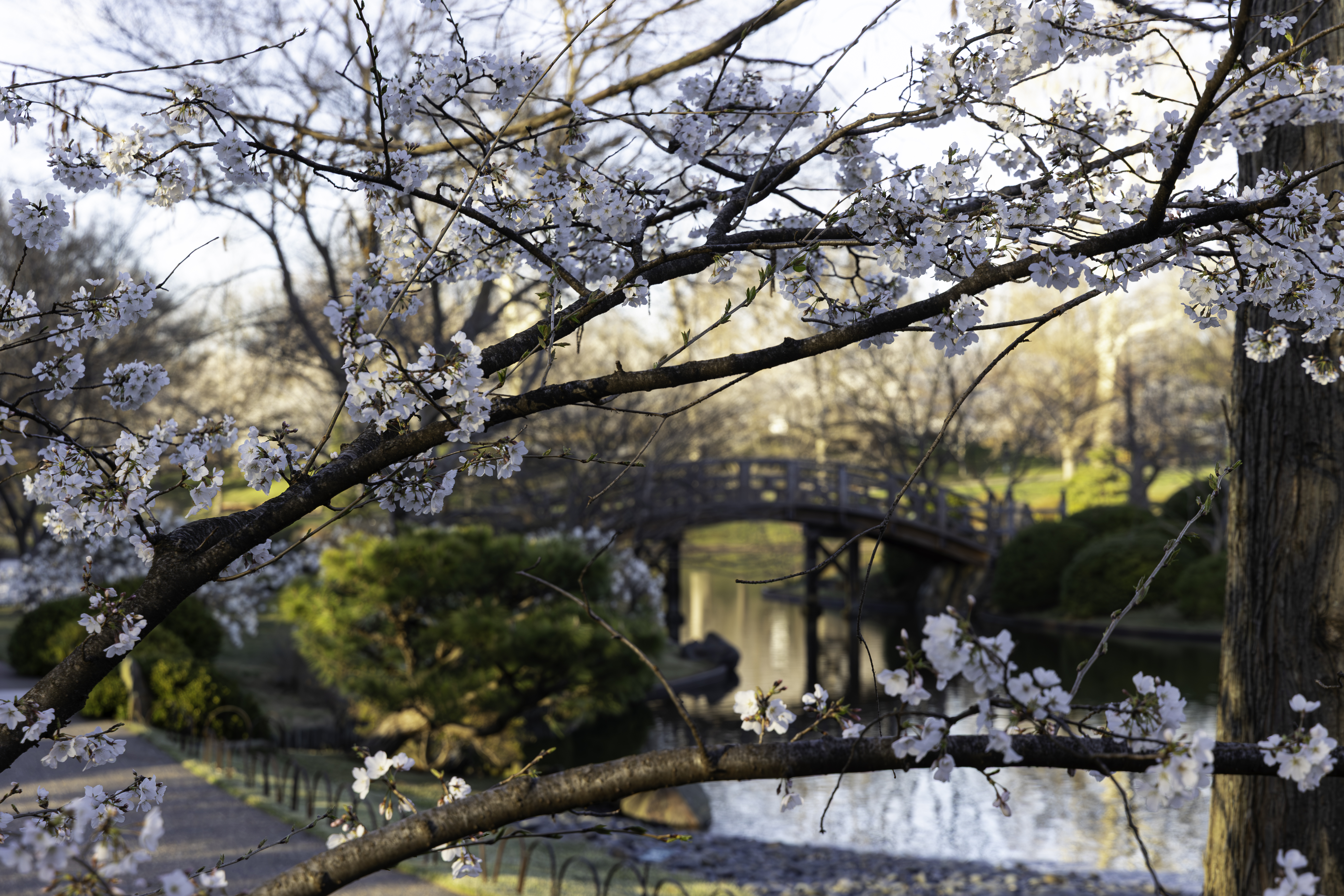
Every spring, people across the Northern Hemisphere flock to see and photograph the picture-perfect blooms of Yoshino cherry trees. The cherry tree, originally from Japan, is now the most popular species worldwide.
Japanese Cherry Blossoms

Yoshino cherry trees are a hybrid species from Japan, which is reflected in its Latin name Prunus × yedoensis. “Prunus” means cherry or plum tree and “yedoensis” means “from Yedo (Edo)”, the former name for Tokoyo. The common name “Yoshino” refers to Mount Yoshino, home to many cherry trees.
A hybrid is a plant created when humans crossbreed two species. Yoshino cherry trees, Prunus × yedoensis, are a cross between Prunus speciosa (Oshima cherry) and Prunus pendula f. ascendens.
The genus Prunus includes more than 400 species of flowering trees that produce stone fruits, including cherries, plums, peaches, nectarines, apricots, and almonds. They are part of the rose family, Rosaceae.
Yoshinos are better known for their flowers rather than fruit. Its fragrant white flowers, often tinged pink, are a favorite early spring bloom. The trees can grow up to 40 feet high by 40 feet wide.
Yoshinos at the Missouri Botanical Garden

Outside of Japan, Yoshino cherry trees are a popular spring site in China and the U.S., notably in Central Park in New York City and in Washington D.C. where thousands bloom in the Tidal Basin each spring. The
The Missouri Botanical Garden has 50 Yoshino trees in its living collection, including 20 that trace their lineage directly to the trees in Washington DC. The Consulate General of Japan gifted the trees to the Garden in 2012 as part of a ceremony marking the 100th anniversary of the original gift.
Dried cherries

In addition to living collections, the Missouri Botanical Garden’s Herbarium holds 25 Yoshino cherry specimens.
The Missouri Botanical Garden is home to one of the largest herbaria in the world, with nearly 8 million specimens. Learn more about Revolutionizing Species Identification program, which will digitize this important collection. >
The collections all come from China and Japan. The specimens from Japan were collected across more than 100 years with the oldest dating back to 1908. Herbarium specimens through time can provide scientists with valuable data. For example, Garden scientist Matt Austin used herbarium data to study how climate change is affecting the flowering time of native plants.
Chasing cherry blossoms

In the spring, the big question is always: when will Yoshino cherry trees hit peak bloom? A recent study indicates that Yoshino cherry trees are hitting peak bloom earlier due to warming temperatures. Historically, at the Missouri Botanical Garden, records show peak bloom as early as March 23 or as late as April 17.
In recent years, the Garden has seen earlier bloom times with peak more frequently happening at the end of March. In 2024, the Yoshino cherry trees hit peak bloom on March 14.
Wild Cherries

Yoshino cherry trees do produce small black cherries. Birds love the fruit, but humans find the taste bitter. The species humans do eat trace their roots back to Central Asia. Many stone fruits in the genus Prunus, including some cherries, originated in he Walnut Fruit Forests in Kyrgyzstan. It is one of the most endangered forests in Central Asia, with as much as 90% of the forest disappearing in the past 50 year years.
The Garden, in partnership with Gareev Botanical Garden, launched a project in 2017 aiming focused on protecting these wild crop relatives of apples, pears, almonds, cherries, and plums that face the the risk of extinction. These species are conserved ex situ at Gareev Botanical Garden in their seed bank and living collections, with duplicate material secured at Missouri Botanical Garden, supporting the long-term goal of reintroduction into protected Walnut-Fruit Forest habitat.
See these wild Prunus species at the Garden! You can find information about where to find these species here. >
One of the major challenges for scientists was identifying the correct species to conserve as many are frequently hybridized. As a follow-up, the Garden used grant funds to collect DNA and complete genetic analyses of two species to understand the genetic diversity and species delineation.
Garden scientists are also looking at American crop wild relatives and the critical role they can play in food security.
Cherry uses and symbolism

Aside from their many culinary uses, humans have found other uses for cherries as well. Bark from black cherry, Prunus serotina, is a popular ingredient in herbal cough syrup. Some people use cherry fruit’s anti-inflammatory and antioxidant properties to treat a variety of conditions. “Cherry blossom” is a popular fragrance, although typically made artificially.
While Yoshino cherry trees aren’t used by humans for food or medicine, they do have symbolic meaning. Yoshinos are one of many varieties and species of flowering cherry that are celebrated during hanami, or cherry blossom festivals. The cherry trees symbolize the vibrance of spring, the renewal of growth, but also the passing of time, and the fading of beauty as the blossoms drop.
Growing cherry trees at home

Yoshino cherry trees are a beautiful addition to a home landscape. They can be used as a shade tree or street tree. They grow best in full sun to part shade. There are also Missouri-native Prunus species that can offer increased benefits for native insects, birds, and other wildlife.

Wild plum, Prunus americana, and Chicksaw Plum, Prunus angustifolia
Both species grow as small trees or large shrubs commonly found growing on woodland edges and in old pastures. The branches can be thorny. The white, fragrant, spring blooms are attractive to a number of insect pollinators including the Henry’s elfin and white-M hairstreak butterflies. The fruits are edible and range in flavor from sweet to quite tart or astringent. Birds, squirrels, raccoons, and white-tailed deer all love the fruit.
Chokecherry, Prunus virginiana

These small trees are native to wooded slopes, ravines, and the bases of bluffs. They produce clusters of white flowers in spring that give way to small, dark purple to black fruits. Although astringent, the fruits are often processed into jams, jellies and sauces..Birds love the fruits, as reflect in another common name: bird cherry.
Black Cherry, Prunus serotina

Although they require a larger space, black cherries are an excellent tree for native wildlife. They support more than 30 species of birds and 300 species of butterflies and moths in our region. These are large trees, reaching 60′ tall or more. Like chokecherry, the fruits are not eaten raw off the tree but can be processed into jams or jellies or used to flavor alcoholic beverages such as wine or brandy.
Catherine Martin
Senior Public Information Officer
Many thanks to Justine Kandra, Horticulturist in the Kemper Center for Home Gardening; Becky Sucher, Director of Living Collections and Conservation Horticulture; Wendy Applequist, Associate Scientist in the William L. Brown Center; Jordan Teisher, Vice President, Biodiversity Research and Herbarium Director; and Dan Schachner, Horticulturist.
Leave a Reply