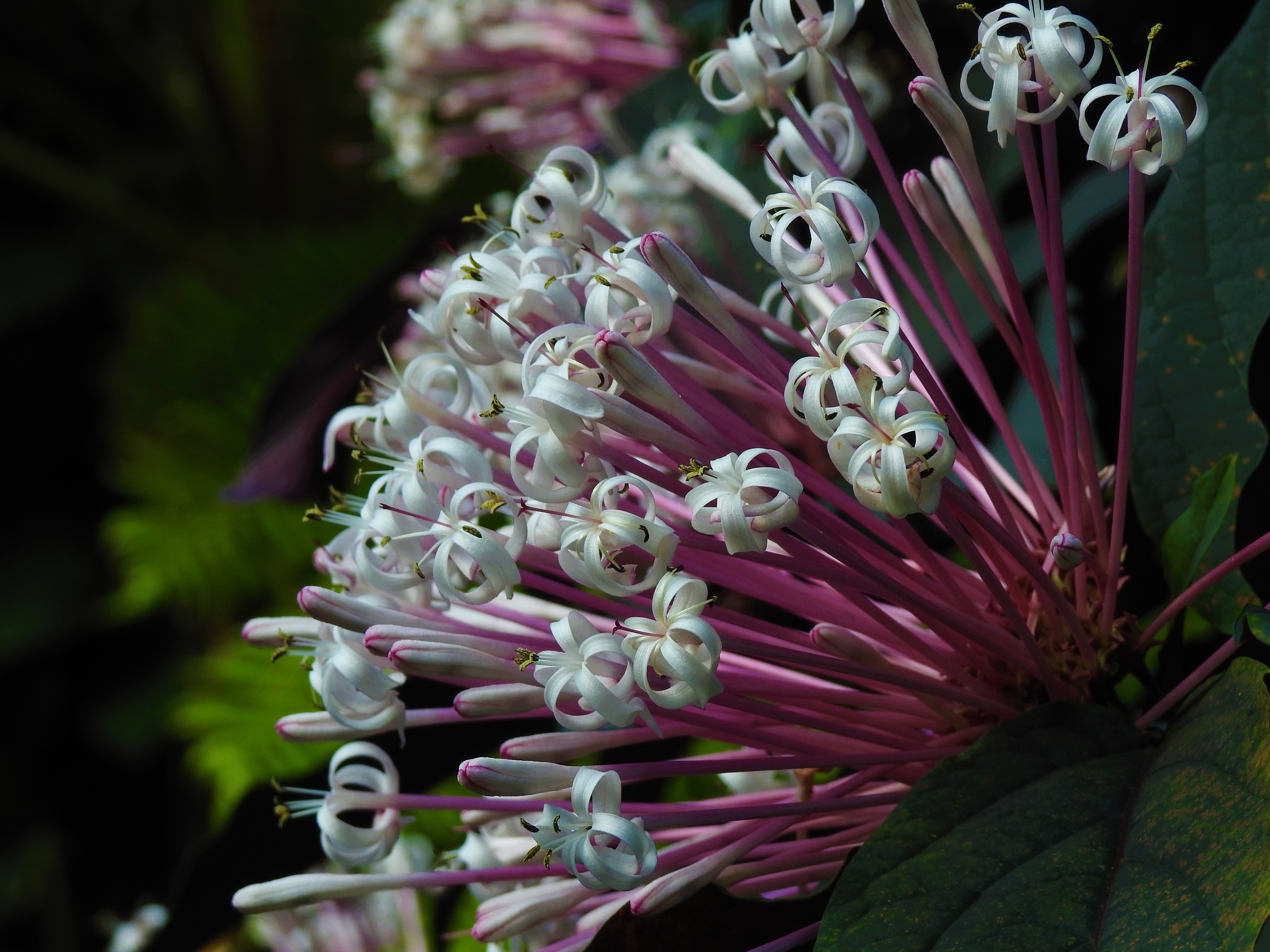
Known for its cluster of showy blooms the starbust bush, or Clerodendrum quadriloculare, blooms every winter in the Climatron at the Missouri Botanical Garden.
Shooting stars and fireworks

Clerodendrum quadriloculare is known by several common names including the starburst bush, fireworks or shooting star plant, winter burst, Phillipine Glorybower, and Bagawak morado. Its clusters of tubular pink flowers inspired many of its flashy names. “Mordado” is Spanish for purple, refers to the purple undersides of the plant’s leaves.
The name of its genus, Clerodendrum, combines the Greek words for “fate” and “tree.”
What is it?

This plant is a member of the mint family, Lamiaceae. This large family includes others herbs, like sage, as well as a variety of trees and shrubs.
While called the “starburst bush,” Clerodendrum quadriloculare can be pruned to tree-like form and grow as tall 15 feet. Its unopened flowers look like pink q tips. When it blooms, it produces unique clusters of tubular flowers that can grow as large as a foot.
Hummingbirds, butterflies and moths all love the nectar of the starburst bush’s blooms.
Where Does it Grow?

Clerodendrum quadriloculare is native to Papua New Guinea and the Philippines.
It is a prolific grower that thrives in full sun and tolerates shade. It spreads easily and can form dense patches with tough wood that is nearly impossible for people to remove. In tropical areas outside of its native habitat, like the Cariibean and Pacific Islands, it is considered invasive.
Where to find it at the Garden

The Garden received a Clerodendrum quadriloculare plant from Riverview Flower Farm in Florida in 1998. The shooting star bush has lived in the Climatron ever since. Visitors can find it near the fish tank across from the entrance of the Brookings Exploration Center.
Clerodendrum quadriloculare blooms once a year, typically in January. Individual flowers only last about a day, but the plant quickly replaces them with another flower of the same infloresence. This keeps the plant blooming for about a month. The beautiful blooms smell faintly like a gardenia or jasmine flower.
The plant is not invasive in Missouri, where it can’t survive the cold winter outside of the Climatron. But even in the Climatron, horticulturists have to keep it in check! Staff dug out unwanted starts for the plant in 2023 and now monitor the surrounding area and remove any plant “pups.”
The Tropical Conservatory at the Sophia M. Sachs Butterfly House is also home to Clerodendrum quadriloculare, which is popular with its pollinators.
In the Garden’s Herbarium

In addition to the plants in the living collection, the Missouri Botanical Garden’s Herbarium also has specimens of Clerodendrum quadriloculare.
The Missouri Botanical Garden is home to one of the largest herbaria in the world, with nearly 8 million specimens. Learn more about Revolutionizing Species Identification program, which will digitize this important collection. >
Garden Scientist Mónica Carlsen collected one specimen from the plant in the Climatron. She made the collection through her work on the Global Genome Initiative in Gardens (GGI-Gardens) program, in collaboration with the Smithsonian. The Global Genome Initiative was established “to preserve and understand the genomic diversity of life” through the use of sequencing technology. The program partnered with botanical gardens globally to collect 20,000 genomic samples. The Missouri Botanical Garden team collected 663 samples on Garden grounds, largely in the Climatron.
Read more about the Garden’s work on the Global Genome Initiative. >
Starburst Plants for cooler climates


While the starburst bush can’t survive cooler climates, there are many showy Missouri natives that can bring a tropical feel to your landscape. Trumpet Honeysuckle, Lonicera sempervirens, has tubular flowers that attract butterflies and hummingbirds. Wild bergamot, Monarda fistulosa, has tubular clusters of light pink or lavender flowers that butterflies and hummingbirds love. Blazing Stars, Liatris aspera, also has a celestial common name and explodes with pollinator-attracting purple blooms from August to October.
Catherine Martin
Senior Public Information Officer
Many thanks to Garden Horticulturist Madison Yocks, Scientist Mònica Carlsen, and Herbarium Director Jordan Teisher, and Butterfly House Living Collections Manager Chris Hartley for providing information for this article.

Leave a Reply