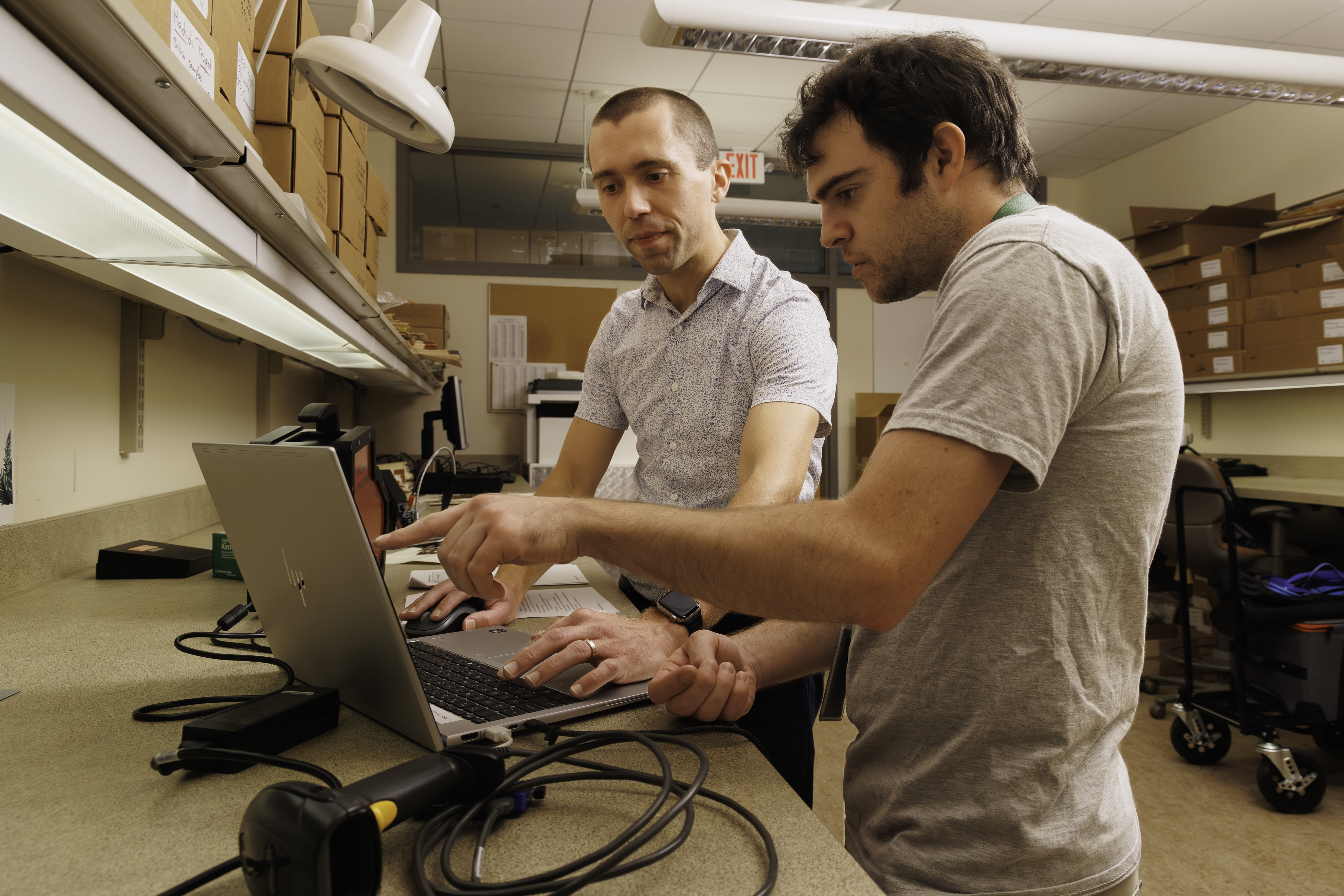
The Missouri Botanical Garden is partnering with global colleagues to create a network of data that will support AI plant identification. The data, which comes from hyperspectral scanning of herbarium specimens, also provides a new level of information about plant species that can support conservation efforts.
A new paper co-authored by the Garden’s Biodiversity Data Curator Matt Austin looks at how capturing spectral reflectance from herbarium specimens can provide crucial information about plant species. Scientists from around the world are working to compile a global dataset of spectral reflectance to support research and conservation efforts worldwide.
What is spectral reflectance?

Spectral reflectance is how much light reflects off a surface.
This includes the wavelengths we can see. For instance, the human eye perceives leaves as green because they reflect green wavelengths and absorb blue and red wavelengths.
Spectral reflectance also includes wavelengths we can’t see, like infrared waves. Hyperspectral scanning captures this “invisible” information, which can tell scientists a lot about a plant’s identity, traits, and health.
Is hyperspectral scanning technology new?

Spectral scanning technology has actually been around for a long time! Astronomers use it to determine the chemical composition of far-away stars. Pharmaceutical scientists use spectroscopy to verify drugs contain the correct ingredients. Botanists have used reflectance spectroscopy for decades to learn more about living plants, in particular to infer agricultural crop health.
What is new is the application of hyperspectral scanning technology to herbarium specimens. . While some scientists pioneered this approach about a decade ago, it has only started to become more widely adopted in recent years.Technology has also evolved to capture a broader range of wavelengths at a much higher resolution.
What can hyperspectral scanning tell us about Herbarium specimens?

Leaves and other plant structures absorb light at different wavelengths, depending on their physical and chemical traits. Many of these characteristics are preserved in Herbarium specimens. This means scientists can use hyperspectral scanning to learn how much of these traits are present in an herbarium specimen.
Functional traits in plants are characteristics like leaf size, thickness, or nitrogen content that impact a plant’s overall health and role in the ecosystem.
Scientists can use this information to describe, analyze, and predict plant processes like growth, how plants change over time, and responses to environmental changes.
Why use hyperspectral scanning on Herbarium specimens?

Combined, the world’s herbaria contain an estimated 400 million plant specimens. Gathering spectral reflectance data from even a fraction of these specimens can provide scientists with information about plant ecological and taxonomic diversity across time and space that would be difficult or impossible to gather in the field with living plants.
The International Herbarium Spectral Digitization (IHerbSpec) working group has initiated a globally collaborative program as scientists work to compile this global dataset. IHerbSpec is also working to establish protocols, standards, and best practices for hyperspectral scanning. This ensures scientists are all using the technology the same way.
“The IHerbSpec group is helping formalize a new type of herbarium digitization, which will have countless applications for plant research and conservation,” Austin said. “The IHerbSpec members are also incredibly friendly and collaborative, which makes the work all the more enjoyable.”
What is the Missouri Botanical Garden’s role in this work?

Through the Revolutionizing Species Identification Project, the Missouri Botanical Garden is an active contributing member of IHerbSpec.
The RSI Project, funded by an anonymous $14 million grant, is allowing Garden staff to capture spectral reflectance data while digitizing its expansive herbarium collection.
Learn more about the RSI project >
How can this data be used for plant identification?

The structure and chemical composition of leaves differs between plant species. This means spectral reflectance is like a “fingerprint” for plant specimens. These unique spectral fingerprints can be used for species identification.
Missouri Botanical Garden scientists describe about 200 new plant species each year. That’s 10 percent of all new species described worldwide! Learn more. >
Identifying plant species is the first crucial step in conservation. Scientists must know what they are conserving before they can determine the best methods for conservation.
But the process of identifying plants is very time-consuming. The so herbaria like the one at the Missouri Botanical Garden are exploring ways technology can help speed up this critical step.
What would be the role of AI in plant identification?
Through RSI, AI technology will be trained to automatically identify herbarium specimens based on plant features derived from spectral reflectance. Scientists will then be able to upload data from an unidentified plant to a new project website for rapid automated species identification.
This won’t eliminate the need for plant taxonomists! Instead, it will allow them to use their time and expertise more efficiently identifying difficult specimens that do not match AI-based models, refining those models where they do not perform well, and describing new species.
What else can Spectral reflectance data be used for?

There are an endless number of research applications for these datasets.
Spectral reflectance data measured from herbarium specimens could allow researchers to study how plants are adapting to global change at large spatial scales. For example, researchers could study whether plants in drought-prone areas are absorbing less nitrogen than plants in areas with higher precipitation. Or, researchers could study whether rising temperatures are associated with increasing leaf thickness.
An herbarium-based reference library of species’ spectral fingerprints might enable identification of plants in remote areas of the world using hyperspectral cameras attached to drones.
“As with all new technologies, we are just at the beginning of discovering the vast potential and limitations of hyperspectral scanning and artificial intelligence in plant taxonomy and conservation. The applications we are actively exploring now are promising and thrilling, but perhaps even more exciting are the diverse ways these tools may be used by future scientists in ways we cannot currently imagine.”
Missouri Botanical Garden Herbarium Director Jordan Teisher
Catherine Martin
Senior Public Information Officer
Leave a Reply