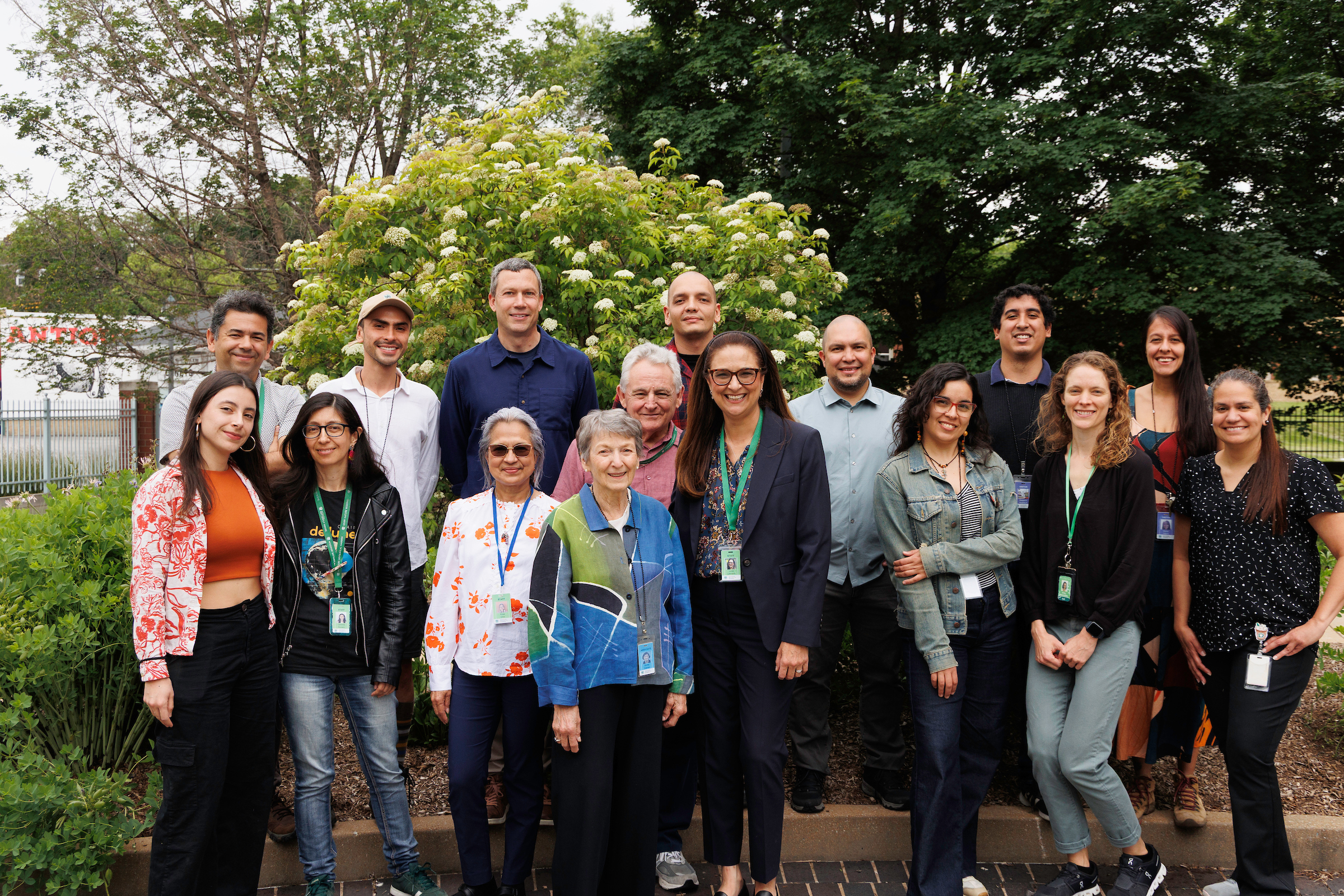
Missouri Botanical Garden President Dr. Lúcia Lohmann first visited the Missouri Botanical Garden when she was an undergraduate student studying biology at the University of São Paulo in Brazil.
“That visit is what changed my career path and made my journey possible,” she said.

After the visit, Lohmann moved to St. Louis, where she earned her master’s degree and PhD in Ecology, Evolution, and Systematics from the University of Missouri, St. Louis, working closely with the Garden.
She received support from different sources, including a fellowship from the Whitney R. Harris World Ecology Center at UMSL, which supported the field component of her research.
After completing her PhD, she worked as a postdoctoral fellow at the Garden’s Center for Conservation and Sustainable Development. Fellowships to support early-career scientists are essential for the future of botany, Lohmann said.
“In our changing world where plant species are disappearing before our eyes, it is more important than ever that we train the next generation of botanists. Fellowships of this nature can be decisive in their careers, providing the resources, mentorship, and professional networks needed to establish their research programs, build international collaborations, and gain visibility,“ Lohmann said. “The Missouri Botanical Garden has a lot to offer — the expertise of our staff, resources like our Library and Herbarium, and connections to research projects around the world. We love welcoming young botanists, sharing our knowledge and resources, and watching their careers develop in different parts of the Globe.”
About Garden fellowships

Since opening in 1859, the Missouri Botanical Garden has been a home for scientific education and training for future scientists.
The Garden continues that focus today with partnerships with local universities, internship programs, and fellowships. Since the 1990s, the Garden has offered international botany fellowships, with more than 150 students participating to date.
International fellowships are an important part of the Garden’s broader effort to support science education. Fellows get hands-on experience, including work in the Garden’s Herbarium, greenhouses and labs. Fellows also get the opportunity to work with world-renowned Garden scientists who serve as their mentors. The training can be instrumental in their careers. And, many go on to teach other botanists, sharing their Garden training across the globe.
What Botany fellowships does the Garden Currently offer?
The Garden has offered a variety of international botany fellowships over the years. Current botany fellowships include:
- Alwyn H. Gentry Fellowship.
Focus area: Latin America
- Shirley A. Graham Fellowship in Systematic Botany and Biogeography.
Focus areas: Latin America, Tanzania, Madagascar, and Vietnam
- Chris Davidson- Sharon Christoph fellowship.
Focus area: Latin America
- Aroid fellowship
Focus area: Research projects in the Araceae family.
- Curatorial Fellowship
Focus area: specimens curation of the Garden’s Herbarium
How long do fellowships last?
Fellowships last for a few weeks up to 3 months.
Where do fellows go after the Garden?
The vast majority of international fellows go on to pursued their master’s and/or PhD, and a post-doctoral position. Most returned to their home country to pursue scientific careers as professors, researchers, science program directors, or even start new research programs.
Do garden fellows go on to train more future botanists?
At least 60 percent of these fellows are now university professors, training students in science.

Meet the 2025 fellows and their mentors
In 2025, nine international fellows from six countries will train at the Missouri Botanical Garden. Each fellowship has its own focus and each fellow is paired with a Garden mentor. A few of this year’s fellows, and their mentors, shared more about their experiences and the role mentorship plays.
Yeison Londoño-Echeverri and Roy Gereau

Yeison Londoño-Echeverri
Home Country: Colombia
Research Focus: Taxonomy of the citrus family, Rutaceae, in his native Colombia
The Garden’s Herbarium, one of the largest in the world with a particularly impressive neotropical collection, prompted Yeison Londoño-Echeverri to apply for the fellowship. He hopes his time at the Garden will help him better understand the limits between species and genera of Rutaceae in the Neotropics.

Yeison Londoño-Echeverri does field work in Cerritos, in humid forest enclaves in the middle of the dry forests of the Cauca River Valley, Colombia. Photo by Sebastian Gutierrez.
Currently pursuing his master’s in biology at the University of Antioquia, Medellín in Colombia, Londoño-Echeverri hopes to continue in academia and write scientific publications. He also plans to be involved in community work and outreach throughout his career
“I hope my work serves to better understand and conserve Neotropical flora,” he said.
During his time at the Garden, he will get to learn from his mentor, Roy Gereau’s, decades of experience studying tropical botany.
“For me, it means I can access the knowledge and experience my mentor has gained throughout his career. It is a invaluable opportunity,” he said.
Mentor: Roy Gereau
Position at the Garden: Assistant Curator in Africa and Madagascar
Number of years at the Garden: 42

Gereau and Londoño-Echeverri previously published a paper together. Gereau is interested in the research on Rutaceae and decided to sign on as his mentor.
This is Gereau’s second go-around as a mentor to an international fellow at the Garden. His first mentee, Tânia Maria de Moura, went on to become a researcher at the Instituto Federal Goiano in Brazil. She has a distinguished publication record primarily focusing on legumes.
The Garden’s fellowship program is helpful not just to young botanists, but to the Garden as an institution, Gereau said.
“It provides deserving candidates with an opportunity to utilize the Garden’s resources to enhance their careers and simultaneously improves the herbarium and database through their efforts,” he said.
Derek John V. Bagonoc and Carmen Puglisi
Derek John V. Bagonoc
Home Country: The Philippines
Research focus: A taxonomic conspectus of the genus (Glochidion) in the Philippines.
Derek John V. Bagonoc is pursuing a master’s in taxonomy at the University of the Philippines Visayas. As he researches Glochidion, he hopes to consolidate existing data to create a user-friendly taxonomic guide to the genus.
Bagonoc’s thesis advisor suggested he apply for the fellowship at the Garden and Bagonoc jumped at the opportunity.
“I am always excited to learn from experts and I want to diversify my sources of knowledge so that I can be a better version of myself,” he said.

Bagonoc in Sicogon Island during a short hike to Mt. Opao to conduct a flora inventory of the island. Photo by Lunhaw Madia-as.
Bagonoc hopes to share the knowledge he gains through a career in academia.
” I would like to teach future scientists with topics related to plant taxonomy and systematics, and what I have experienced from the Missouri Botanical Garden and apply it here in the Philippines in 10 years,” he said.
Already, Bagonoc does field work in partnership with local communities and government officials. He plans to share his experiences through the Garden fellowship, which could aid in their environmental protection efforts. As botany and taxonomy face decreased funding and interest, botany fellowships are more important than ever, Bagonoc said.
“The call to work on these fields is strong because it is the foundation of everything about the environment,” he said. “Specifically, plants play a major role in the ecosystem…When we identify the species, we can further study its ecology, its role in the ecosystem, and its physiology. With this knowledge, we can develop strategic solutions in conserving them.”
Alejandro Llanos-Prieto and Julián Aguirre-Santoro

Alejandro Llanos-Prieto
Home Country: Colombia
Research focus: a taxonomic revision of the genus Greigia (Bromeliaceae) From Colombia
Alejandro Llanos-Prieto learned about the Missouri Botanical Garden in his first botany course at the Herbario Nacional Colombiano. When he learned about the Garden fellowship, he thought it would be the perfect opportunity. The Garden’s expansive herbarium collection provides the data he needs to clarify what species of Greigia, a genus in the bromeliad family, occur in Colombia.
“Furthermore, as an early-career botanist, getting to work with Dr. Aguirre-Santoro, who was my supervisor for my bachelor’s thesis back in Colombia, and other experts at the Garden felt like a once-in-a-lifetime chance to grow as a researcher,” Llanos-Prieto said.

During his time at the Garden, he hopes to describe new Greigia species he’s identified in Colombia and contribute data to Aguirre-Santoro’s monograph compiling information about the diversity of this group of plants. He also wants to build relationships with Garden staff and refine his botany skills and expertise. He plans to use those skills to build a lifelong career in botany.
Mentor: Julián Aguirre-Santoro
Position: Curator, Herbarium
Years at the Garden: One

The fellowships’ selection process is key to its impact, Julián Aguirre-Santoro explained. The Garden selects high-potential students that have already demonstrated a passion for botany and are at the start of their graduate programs.
“I can’t think of a better way to leave a legacy,” he said. “It is almost guaranteed that these fellows will become the next leaders in tropical botany, especially in their home countries.”

vanina Salgado and Matt Austin/Emily Warchefsky
Fellow: Vanina Salgado
Home Country: Argentina
Research focus: taxonomy, morphology, and biogeography of South American Asteraceae (the daisy family)
Vanina Salgado was drawn to the fellowship opportunity at the Garden as a chance to connect with other researchers and work with the Garden’s expansive research collection of South American plants.
“By coming to the Garden I hope to ground some of the research I did during my doctorate and take the first steps in my postdoctoral research,” she explained.

During her time at the Garden Salgado has two Garden scientists as mentors, which she said is fundamental to her future.
“Having someone willing to dedicate their time and experience to your professional growth is a true gift,” she said. “In my personal experience, Matt and Emily have been involved, reassuring, and completely committed to teaching and to making my time at the Garden productive.”
As she steps into postdoctoral work, she hopes to produce impactful research that can ultimately provide tools for conservation and sustainable development.
Mentor: Matt Austin
Position: Biodiversity Data Curator
Years at the Garden: Two

Before landing a full-time gig as a Garden curator, Matt Austin was a Living Earth Collaborative postdoctoral fellow. The experience connected Austin with the Garden and taught him vital plant science information that he’s taken into his career. He was eager to provide the same opportunity for the next generation of scientists.
Only in his second year at the Garden, Austin has already mentored two budding botanists. His first mentee published her work from her Garden fellowship. She now works at the Atlanta Botanical Garden.
“Fellowship opportunities are tremendously important. They give fellows the opportunity to gain skills in botany that have the benefit of helping further their careers,” Austin said. “They also support the Garden’s mission and contribute to the development of the global botanical community.”
Ana Maria Trujillo Lopez and Carolina Romero

Fellow: Ana Maria Trujillo Lopez
Home Country: Colombia
Research focus: the taxonomic synopsis of Macrolobium in Colombia
Ana Maria Trujillo Lopez first saw the Missouri Botanical Garden’s name through its Tropicos database.
The Garden’s Tropicos Database houses information on Garden research projects and millions of digital Herbarium specimens. The Garden’s Revolutionizing Species Identification project will add millions more to the database.
Trujillo Lopez pursued a fellowship at the Garden to get a chance to see the Herbarium and study its specimens in person. She also hopes to help describe currently unnamed species in the Garden’s Herbarium.
Missouri Botanical Garden scientists describe about 200 new plant species a year, or about 10% of all new species described globally. Scientists estimate there may as many as 100,000 undescribed plant species and more than half may already be in herbaria.
“This interaction will contribute to my academic and professional development and provide me with new ideas for continuing the study of Neotropical legumes,” she said.

After her fellowship, Trujillo Lopez plans to share her experiences with her fellow students to encourage them to pursue fellowships.
“At a time when many herbaria are closing and botany seems to be losing its prominence, training new botanists and continuing to study plants becomes even more important,” she said. “Plants are the foundation of life on Earth. They sustain ecosystems, regulate the climate, and provide food, medicines, and essential materials. However, much of their diversity remains unknown or understudied, especially in megadiverse regions like Colombia.”
Mentor: Carolina Romero
Position: Science Specialist in the William L. Brown Center
Years at the Garden: 10

As a student, Carolina Romero had a Bascom Fellowship at Saint Louis University and did her graduate research at the Garden. The opportunity, she said, helped immensely, and she’s paying it forward. In her decade at the Garden, she estimates she’s had about five mentees so far.
“I think it’s a way to give back to the Garden and to encourage new students and young botanist to come and study here and to keep collaborating with the garden from their countries of origin,” she said.
Her mentees have gone on to graduate school and now are her research collaborators.
“I find joy in sharing what I have learned and what I know about plants. It’s also very rewarding to me to also learn from the students and the new perspectives they bring to our research,” she said.
Melisa Alegria Valencia and Monica Carlsen

Fellow: Melisa Alegria Valenci
Home Country: Colombia
Research focus: pollination in plant family Araceae
Like several fellows, Melisa Alegria Valencia was eager to work with the neotropical collection in the Garden’s Herbarium. Through her research in Araceae, specifically anthurium, Monica Carlsen’s work caught her eye. Carlsen has the largest genomic database for the genus with nearly 300 species.
“All this makes this an ideal and unique place to carry out a study combining Anthurium systematics and ecology,” she said.

Alegria Valenci said being at the Garden has opened her mind. She’s met researchers with wonderful ideas, collected research for her project, and paved the way for future research projects. Having a mentor means she’s had someone to guide her and discuss ideas and doubts.
“Working with Dr. Monica Carlsen has been a very pleasant experience. I have learned a lot from her, she is a great woman and researcher. I admire her a lot,” Alegria Valencia said.
Alegria Valenci wants to continue research the diversity of evolution of plants. This research, and fellowship and collaboration opportunities, are essential right now.
“We are in an age where life is based on superficial relationships and observations, and studying plants and training as botanists is a reminder that we need to reconnect with the earth, not forgetting that plants are fundamental to our existence,” she said.
Mentor: Monica Carlsen
Position: Scientist, Latin America Department
Years at the Garden: 8

Monica Carlsen was a Garden student for eight years as she worked on her masters and PhD at the University of Missouri-St. Louis.
“It provided resources otherwise unavailable at local universities, as well as mentorship opportunities from Garden staff that later became my collaborators and colleagues,” Carlsen said of the experience.
Now eight years into her career as a Garden scientist Carlsen has mentored five fellows in addition to dozens of other students through the Research for Experiences for Undergraduate students program. Past mentees have gone on to be professors or postdocs at universities in their home countries, while some are still working on their PhDs.
For Carlsen, there are many good reasons to serve as a mentor.
“To transfer my knowledge to the next generation of scientists, to provide learning and training opportunities for students that otherwise would not have then, to make sure that our collections are available and get used by a wider audience, including international students, to widen perspectives of students.”
Catherine Martin
Senior Public Information Officer

Leave a Reply