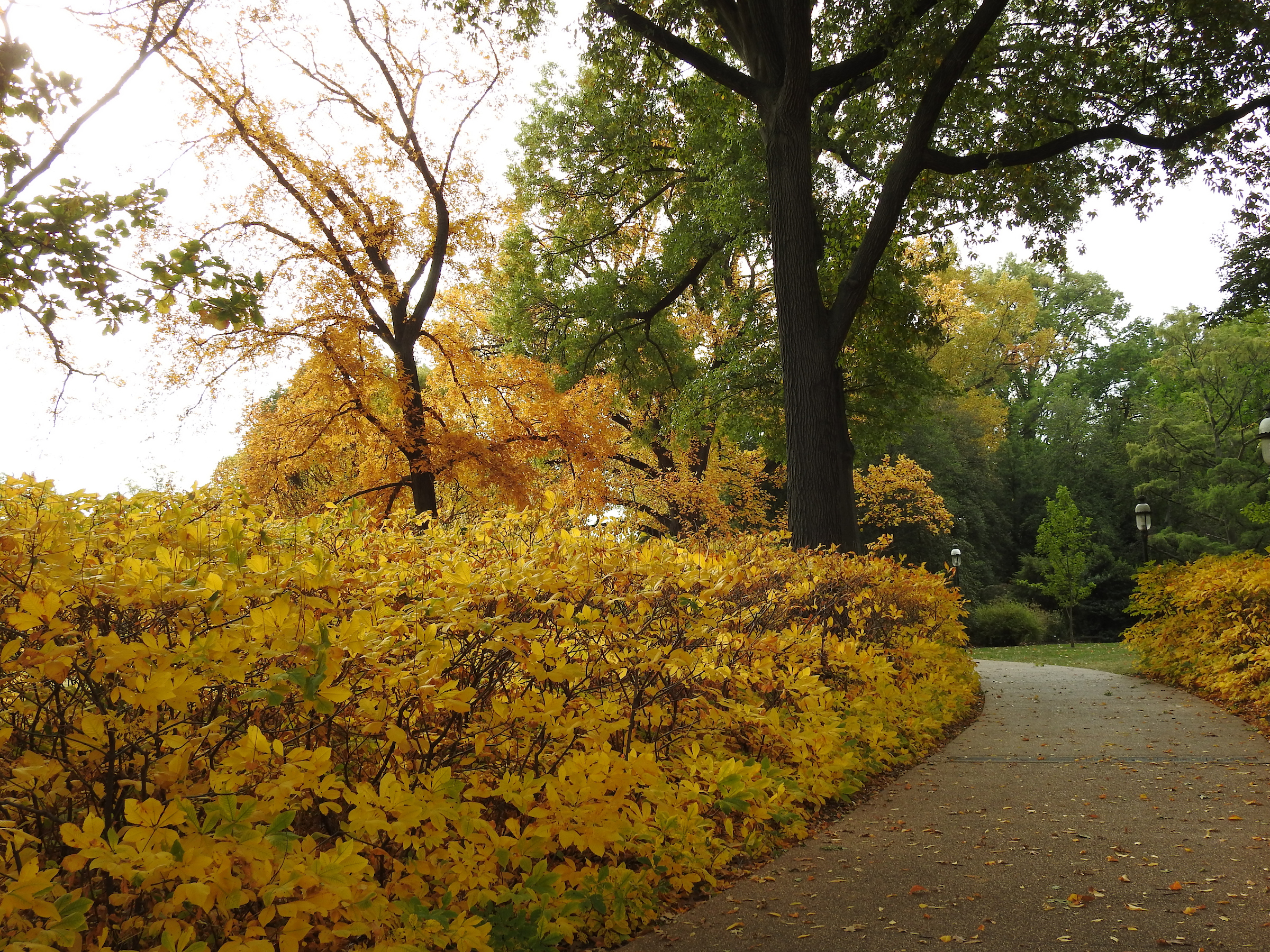

Every fall, brilliant golden foliage lights up the path just south of the Climatron at the Missouri Botanical Garden. This fantastic fall color comes from the bottlebrush buckeye, a large shrub native to the southeastern United States that also produces beautiful summer blooms. The showy shrub is a favorite sight in many seasons but is vulnerable in the wild.

What is bottlebrush buckeye?
Bottlebrush buckeye, Aesculus parviflora, is a shade blooming shrub that can grow up to 12 feet high and 15 feet high. It’s noted as one of the best summer-flowering shrubs for shady area. It produces spectacular midsummer bloom with feathery, tubular white flowers with red anthers. Butterflies and other pollinators love the flowers.

Where is it from?
Bottlebrush buckeye is native to rich woodland areas in the Southeastern United States. It now has a limited range of wild populations. It is found only along waterways and bluffs in specific regions of Alabama, West Georgia, and West South Carolina.

what threats does it face in the wild?
The biggest threats to bottlebrush buckeye are herbicide and washout. Invasive species and human development threaten the species as well. Since the species grows in bluffs and waterways, roadsides make the perfect habitat, but are at risk for washout.
A Garden team working to conserve the species found large flowering individuals were found to only develop in forest clearings, forest edges, and open ravines presumably due to greater light. The other individuals of a population tended to form very low running non-flowering masses. This puts the already low sexual reproduction of the species at even further risk, because flowering individuals are more likely to occur along roadsides where herbicide spraying is common. This puts the species at risk, especially its genetic diversity that is likely isolated and linked to river basins.

What is the Garden doing to save this species?
In 2017, the Garden received a grant for bottlebrush buckeye conservation. A Garden team collected 23 new accessions of the species comprising at least nine populations. Samples came from different counties and states, representing a large geographic sample of the species. The populations sampled included those from the edges of the species range as well as geographically isolated populations.
These detailed collections over the range of the species will allow for a baseline for future studies on the conservation, ecology, genetics, and horticulture of the species.

Where did the collected samples go?
The Garden team collected more than 350 divisions of the species for the project. The Garden distributed those plant materials to multiple institutions in the Central and Eastern U.S. to ensure the material is safeguarded for future use. The establishment of this metacollection, where living plant collections are managed collaboratively at multiple institutions, are very important for rare species that cannot be maintained in seed banks.
The variety of locations, from USDA Zone 4 to Zone 9, also allows scientists to study how plant material linked to collection locality, ecology, and genetics grows under multiple climate conditions. The results will yield data valuable to conservation efforts in the face of global climate change.
It will also provide data and material valuable to horticulture. Aside from more subtle characteristics like tolerance or form, unusual characteristics like branching flowers could potentially be of significant horticultural value.

Where can I find bottlebrush buckeye in the Garden?
A very large planting of bottlebrush buckeye can be observed on both sides of the sidewalk leading south from the Climatron at the Missouri Botanical Garden.
Catherine Martin
Senior Publication Officer
Leave a Reply