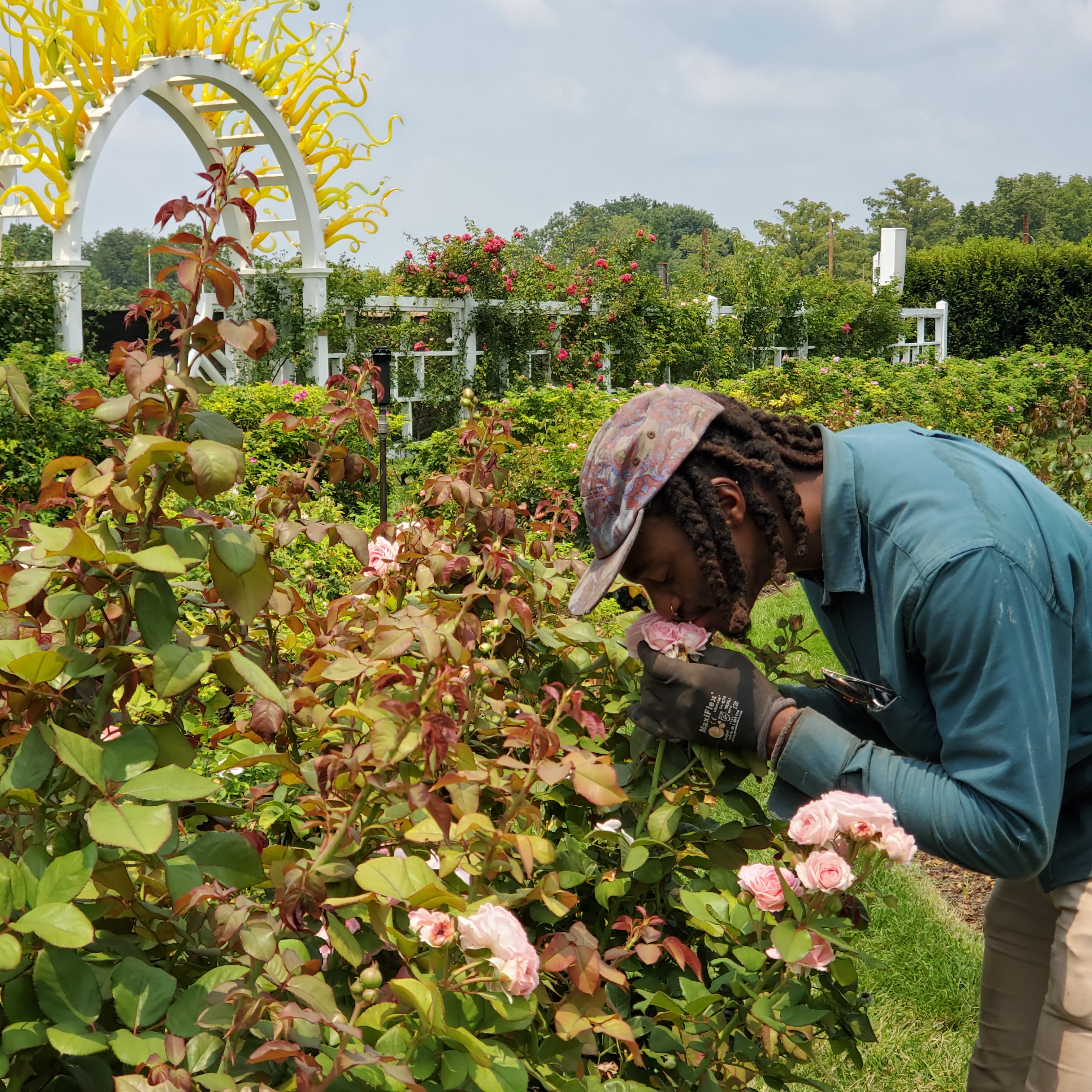
Stop and smell the roses. That’s how Matthew Norman, the sole Rosarian of the Missouri Botanical Garden, starts each day caring for some of our more “challenging” plants.

“I always go around and check my roses for pests and diseases while taking the time to enjoy the morning and smells,” says Norman. “My day is filled. There is never a day where I don’t have anything to do.”
As Rosarian, Norman oversees the care of over 1,500 plants that he admits are not the easiest to grow and nurture in St. Louis’ hot and humid summers.
Related: Celebrating 100 Years of the Gladney Rose Garden
But his love for the iconic plant and his job shines through in the beautiful displays he creates and in his interactions with visitors.

Local Roots For The Rosarian
Norman is a St. Louis native whose love for gardening and plants really began with his grandmother.
“My Granny taught me a lot of what I know today,” Norman says. “It was impressed on me at a young age, just being outside in the garden with her.”
While Norman spent a lot of time in his grandma’s garden throughout his childhood, it wasn’t until after he graduated from Kirkwood High School that he realized his passion for gardening could be turned into a career.
Norman began working for the Kirkwood Parks and Recreation Department in 2014, caring for the parks he’d visiting as a young person.
“That was were I really fell in love with it,” Norman says. “I didn’t know I could do this as a career, to spend my entire day outside and have so much variety and be in my own thoughts.”
Norman later worked with Forest Park Forever and AmeriCorps St. Louis, before landing an internship at the Garden in 2018. In 2019, he officially became the Garden’s Rosarian in 2019.
The Highs and Lows of Being a Rosarian
As a St. Louis local, Norman remembers coming to the Garden and says it feels like a dream working here now.
“It is moving to me, because this is my home; I grew up here,” says Norman, tearing up as he looks at the Gladney Rose Garden. “It’s a privilege, and I try not to take it for granted. Not many people get to work at a place they dreamed that they could possibly be inside these walls and do something here and make a difference.”


When Norman took the job as Garden Rosarian, he wondered why there weren’t more people excited to work with roses.
But he quickly learned that, like the plants, there are some figurative thorns that come with the title Rosarian.
“There are highs and lows,” Norman says. “They’re really beautiful plants; they are quintessential in our history. And then our climate here in St. Louis is hot and humid in the summer. No one likes it- the roses especially.”
Roses thrive in 60-70° F, which is why they’re often most vibrant in the spring and fall. But in the summer, the high temperatures cause plant functions to shut down, sears petals, and helps fungus thrive.
“It just took years of trial and error, and I learned from a lot of failures. I think you get more out of failure than success anyway.”
Lessons in Roses
Over the past 5 years, Norman has worked hard to better understand the plants in his care. He even returned to school to earn his associate’s degree in botany, going to night classes after work.

Norman says he’s also had many mentors throughout his career who encouraged him to pursue his passions.
“Horticulture is such an apprenticeship-oriented job,” Norman said. “You have to be with someone who is passionate about it and willing to show you.”
One important lesson Norman has learned as Rosarian: Acceptance.
“It helps you walk through life a lot better, handling situations and learning to let go,” says Norman. “But also keeping that passion.”

Matthew Norman’s Favorite Rose: Purple Pavement (Hybrid rugosa rose)
Scent, Memory, and Connection
Despite some of the ups and downs that come with caring for roses, Norman absolutely loves roses, specifically the way their scent evokes memories.

“There is such a strong connection in your brain between fragrance and memory,” Norman said. “I’ve really made a point in this part of my life to focus on my memory and building a working memory, so I love that roses can give me that burst of nostalgia.”
Norman recalls how when he began working with roses, one in particular reminded him of his kindergarten teacher. A few years into the role of Rosarian, that teacher reconnected with him in the Garden.
“To have her standing in front of me, I was so flooded with emotion. I got to hug her and talk to her and just share with her how much she meant to me,” Norman said. “She told me that she came that morning to find me.”
Norman says he often connects with guests, hearing what memories a rose brings to mind or answering questions about the plants he loves so much.
“The amount of connections I’ve been able to make through what I do here…” Norman says. “I never would’ve seen that in my life, where I get to connect with people on a level of plants and have it be so genuine.”
“Be a trailblazer”
Norman says that one reason he was reluctant as a young person to pursue a career in horticulture was because he didn’t see a lot of professional Black horticulturists, especially among men.

“I want to see other people who look like me doing this,” Norman says. “I know there are a few, but how can I encourage or inspire other young black children that this is a viable option and not to be afraid of those thoughts?”
Norman says he often thinks about his ancestors who were sharecroppers and forced to pick cotton while working. He says this generational trauma and stigmas can sometimes prevent people of color from pursuing outdoorsy career paths.
“I hope that someday as a group and community we can come together and get back to some of our roots and remember that our ancestors were really good at this for a reason,” Norman says. “You probably still have this in you. I know I do.”
Norman encourages others who are interested in horticulture to pursue their passion. He recalls his mother’s words of wisdom: speak up, speak out, be heard.
“Remember if there is something you are really interested in, you can find a way,” Norman said. “If you really believe in something, you can make it happen. Be a trailblazer.”
Explore the Rose Gardens
The Gladney Rose Garden has been in existence since 1917, when it housed many old garden roses, About 900 roses are displayed, including many varieties of climbing roses featured on the formal fence enclosing the garden.
The Anne and John Lehmann Rose Garden, established in 1976, has been called the more romantic of the two gardens, with a bushy mix of floribundas, shrub roses and other classifications. It is less formal than the Gladney Rose Garden, and contains about 600 roses representing 154 different varieties.


Leave a Reply