If you’re interested in environmentally-friendly gardening or landscaping, you’ve likely heard the term rewilding.
You may have even tuned into the Garden’s Member Speaker Series in 2023 when we hosted Lady Isabella Tree, author of The Book of Wilding: A Practical Guide to Rewilding Big and Small.
Rewilding as a trend and an environmental movement is becoming more popular. Erin Goss, Native Plant Initiative Coordinator for Shaw Nature Reserve, says rewilding in practice takes patience and time.
“I do believe for some people, rewilding is a romantic, simple fix to environmental issues,” Goss said. “But since the native plant garden movement has grown exponentially over the last 10 or so years, rewilding does seem a natural next step, as it asks for far more human investment than gardening.”
What is rewilding
The word “rewilding” has been around since the 1990s and has taken on many definitions and approaches.
Rewilding is a developing concept in ecosystem stewardship that involves reorganizing and regenerating wildness in an ecologically degraded landscape, with present and future ecosystem function being of higher consideration than historical benchmark conditions.
– du Toit and Perrorelli (2019) from The differences between rewilding and restoring an ecologically degraded landscape IN Applied Ecology
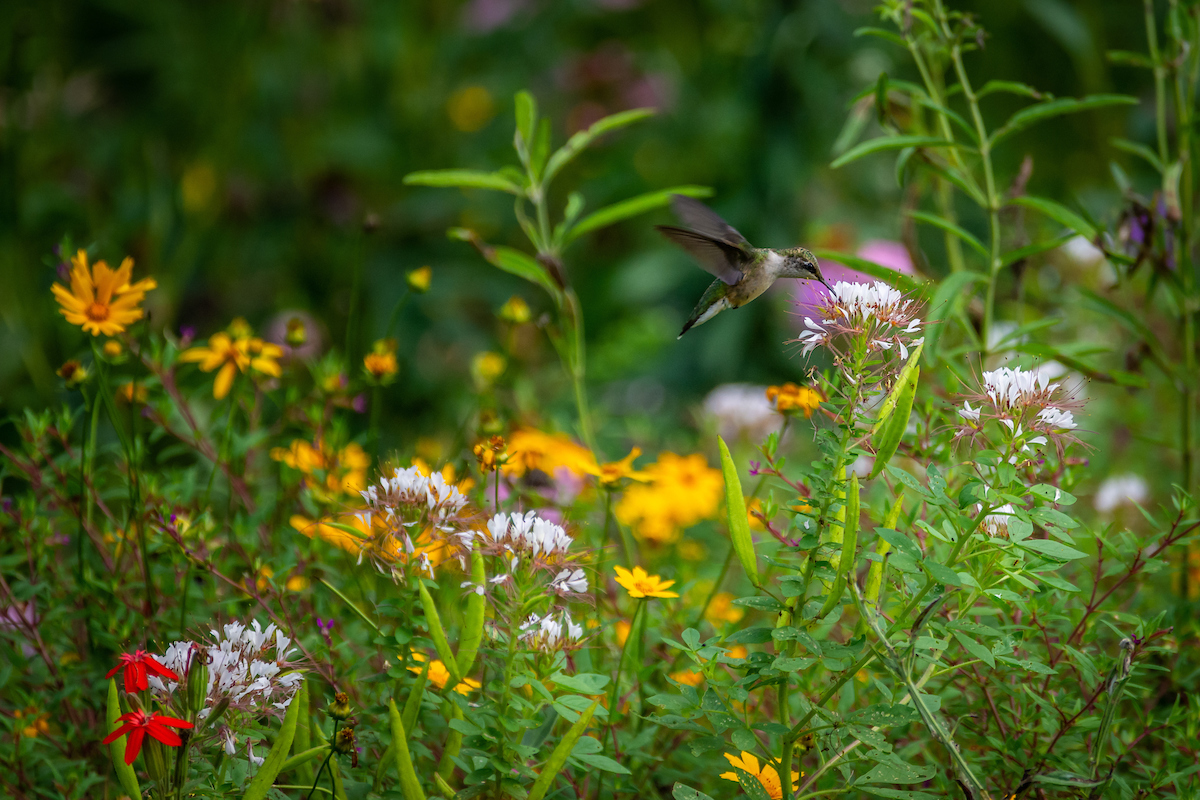
In 2024, the more popular definition of rewilding refers to the process of creating small ecosystems, often in urban and suburban spaces, that will benefit native plants and animals.
“It is important for people to understand that it isn’t seeding a backyard prairie and walking away or letting the vegetation in a backyard grow rampant – it is a long-term, purposeful partnership and relationship with the land,” Goss said.
Creating tiny ecosystems

Rewilding encourages a more wholistic approach to our landscapes than traditional gardening. Rather than focusing on growing a single plant, it looks at how that plant impacts several levels of an ecosystem.
“By using native plants and certain habitat-building practices, my yard can become an oasis of food, shelter, and water for pollinators, and small animals,” Goss said “Then in turn, those animals increase the availability of food, water, and shelter for owls and hawks and larger predators like foxes.”
Better together
Although it does focus on small spaces, rewilding ultimately is a movement that thrives when supported by a community.
If the tiny natural ecosystem in your backyard can connect to a tiny natural ecosystem in your neighbors’ yard, you can create an even larger space for native plants and animals to thrive.
“An oasis is a source of life amidst a desert, and many of our urban (and increasingly suburban and rural) areas are in ecological decline,” Goss said. “We need to grow our oases, and rewilding is an approach we can take towards that goal.”
Rewilding vs. Ecological restoration
Goss says, while it does share some similarities, rewilding is not the same as ecological restoration which happens on a much larger scale.

Shaw Nature Reserve, which contains over 2,400 acres of restored habitats, is a great example of local ecological restoration happening on a large scale.
“It is more adaptable to our urban environments than traditional ecological restoration,” Goss said. “But many aspects are long-time features of the native plant garden movement: providing food, shelter, and water for wildlife.”
Rewilding Your own yard

Along with strengthening natural environments, rewilding also offers many benefits to those who are creating and nurturing the tiny ecosystems.
For some people, it can be a physical, creative, and nurturing exercise. Others may enjoy seeing butterflies, bees, or birds in their yards or maybe they are participating in a citizen science program.
Rewilding can also be beneficial to your bank account since it is not as expensive as traditional landscape care. There are no fertilizers or soil conditioners or pesticides to purchase – but it may require more sweat equity.
Before you decide to rewild
Goss says before your decide to take on rewilding your yard, do some research.
Social media is popularizing the movement, but it does not always give a realistic expectations of the process. Reading books, watching webinars, and taking classes can help you better prepare.
Finally, make a plan by asking questions like:
- Why am I doing this? Get personal.
- How much can I feasibly do and – most importantly – sustain over time?
- What is the end game? What’s my yard supposed to look like or sound like or feel like?
- When do I want to start?
“Put your plan together first before you do anything else, including buying plants,” says Goss. “And don’t be afraid to tweak it or modify the plan over time as needed.”
Rewilding can sometimes be a long, tedious process. If you’re feeling stuck, Goss says to be patient and ask for help.
“Rewilding is about creating a miniature, resilient ecosystem and that takes time,” Goss says. “If you’re dealing with a degraded landscape full of invasives, you’re basically building an ecosystem from scratch. So, if it’s looking a bit rough, remember your “why,” keep actively managing, and focus on offering food, shelter, and water for wildlife. It can only get better.”
Rewilding Resources
- Scholarly Articles
- Webinar: Native Plants for Native Pollinators
- Books
- “Rebugging the Planet“
- “Cornerstones: Wild Forces That Can Change Our World“
- “Rewilding: Giving Nature a Second Chance“
- “Rewilding: Bringing Nature Back Where it Belongs“
- “Rewilding: The Radical New Science of Ecological Recovery“
- “Braiding Sweetgrass: Indigenous Wisdom, Scientific Knowledge and the Teachings of Plants“
- “Feral: Rewilding the Land, the Sea, and Human Life“
- “Wilding: The Return of Nature to a British Farm“
- “Wilder: How Rewilding is Transforming Conservation and Changing the World“
Jessika Eidson | Public Information Officer
Thanks to Erin Goss for providing her expertise for this blog.

Leave a Reply