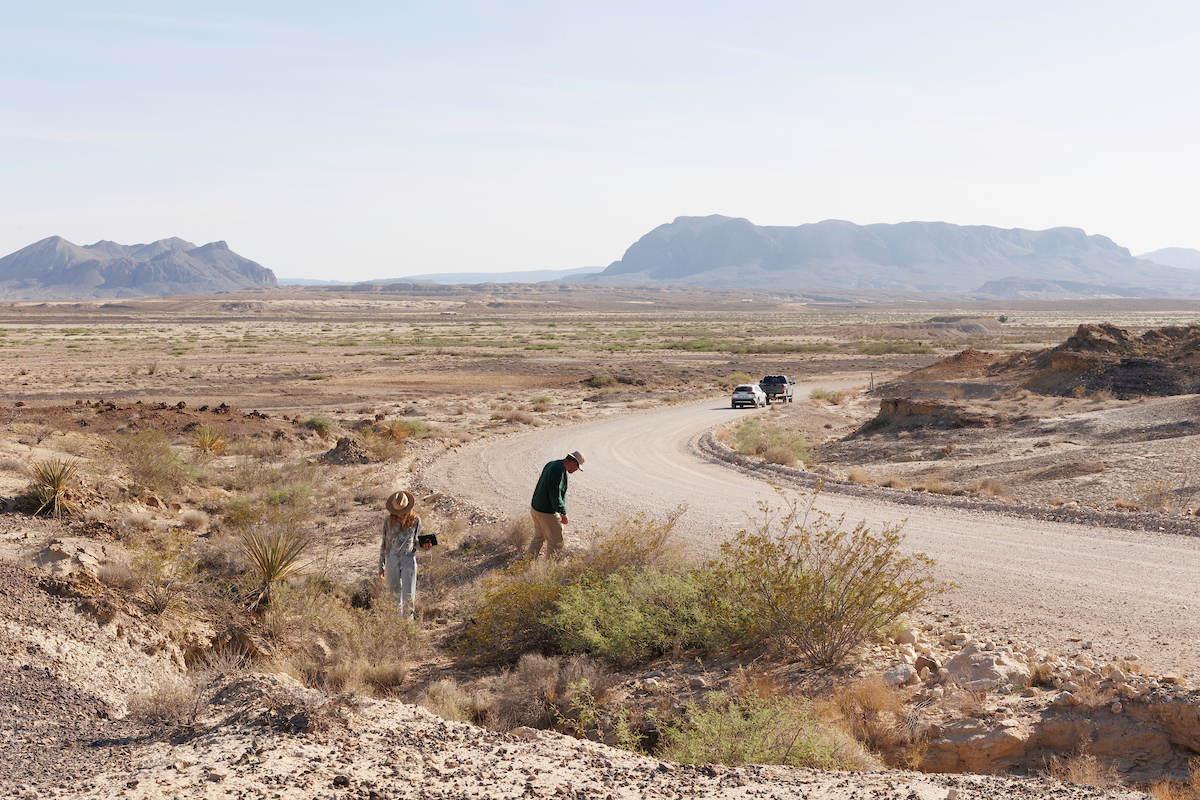
In late April of 2025, four members of the Missouri Botanical Garden Horticulture Staff spent 10 days exploring the vast Chihuahuan Desert in pursuit of rare and endemic plants.

As they collected seeds and cuttings of threatened desert plants, they had two goals in mind: to learn how to grow these rare plants for study at the Garden and to give visitors an opportunity to learn more about an often misunderstood habitat.
The Myth of the Empty Desert
Ben Thomas, Supervisor of Arid Plant Collections, says misconceptions about deserts lead to them being overlooked and understudied.
“Deserts are miraculously teeming with an abundance of biodiversity,” Thomas said. “And yet, we’ve synonymized the word desert with emptiness. In reality, deserts are some of most vulnerable landscapes on earth because they are so misunderstood. “

The Chihuahuan Desert in particular is the largest and most biodiverse desert in North America.
“It is also one of the least understood deserts, which makes it a priority for both plant conservation and educational opportunities,” Thomas said. “There are few botanical institutions that work in the region, which means that a significant proportion of dazzling desert plants remain unknown to horticulture, and many threatened plants are declining without human intervention.”
Choosing which plants to bring home from the Chihuahuan Desert
Years before the team journeyed to the Chihuahuan Desert, they were deciding what plants they wanted to find and bring back to St. Louis.

The plants needed to meet three criteria: plants that represent diversity of the desert, vulnerable species that are a priority for conservation, and plants that visitors will enjoy.
Eventually they narrowed their list to 20 species. The list included several cacti, wildflowers, grasses, and even desert ferns.
Partners in Texas

With their list of target species in hand, the team headed to Alpine, Texas. The extremely remote desert town in southwest Texas is home to the region’s only research university, Sul Ross State University.
Sul Ross houses an herbarium holding more than 100,000 Chihuahuan Desert plant specimens. The herbarium proved to be a valuable research tool during the trip, enabling the team to locate information and view examples of their target plants.

It was also through the university that the team was able to connect with locals and receive permission to collect on private land.
“A lot of landowners are really excited and eager to show us around their property and to have us collect plants for conservation purposes,” Thomas said. “So I think that is what’s really beautiful about private land connections.”


The Search for threatened Chihuahuan desert species
Throughout the 10-day trip, the team searched high and low in the Chihuahuan Desert for their target plants.

Their path included the desert canyons along the Rio Grande, the limestone hills overlooking Mexico, high-elevation oak woodlands in the Davis Mountains, and moonscapes-like gypsum flats west of Big Bend National Park.
Gypsum flats were of particular interest to the conservation team. The landscape can contain at-risk plants, and little research has been done on optimal growth for gypsum plants.
A gypsum flat is a type of habitat characterized by a flat landscape with soil that is very rich in the mineral gypsum (calcium sulfate). Found in arid and semi-arid regions, these environments present unique and challenging conditions for plant life, leading to the evolution of specialized flora.
According to Thomas, Gypsum is a difficult substrate to grow plants in, in part because the mineral typically forms a hard crust when dry, erodes quickly when wet, and is low in nutrients for plants.

“Gypsum [a mineral] actually occurs throughout the world, but it’s water soluble, and so in places where it rains, it very quickly disappears from the surface,” Thomas explained. “So the only places in the world where gypsum forms extensive habitat are in really arid regions. The Chihuahuan Desert is one of the best examples of preserved gypsum habitats.”
Thomas says gypsum habitats, like those in the Chihuahuan Desert, can each contain a different lineage of plants.
“But that means that those plants are only there,” Thomas said. “So if you want to conserve them, there’s only one place you can go, and they’re extremely high risk of going extinct due to drought.”
Bringing Desert Plants back to St. Louis

Living rock cactus (Ariocarpus Fissuratus) with seeds blends into the rocky terrain of the Chihuahuan Deser. 
A few small seeds are pulled from the plant with tweezers. 
The seeds are put into small folders to be transported back the Missouri Botanical Garden. 
Thomas makes sure to properly label the package of seeds that will later be grown at the Garden. 
Ben Thomas documents data points for the plant that will be used for research and shared with other institutions.
One of the main goals of this trip was to bring plants from the Chihuahuan Desert back to St. Louis where they could be studied and grown.
Throughout the trip, the research team collected plant specimens in two ways: seeds and cuttings.
Thomas says the team prefers seeds for growing, but the Chihuahuan Desert is experiencing an exceptional drought, making seed collection difficult for some target species.

“When it doesn’t rain, things don’t flower, and if they don’t flower, you can’t get seeds,” Thomas said. “So that’s when we pivot to cuttings.”
While not ideal, collected cuttings do provide an opportunity to experiment with growing plants in new ways.

Eriogonum suffruticosum blooms in the Chihuahuan Desert. 
The team searches the roadside of the Chihuahaun Desert for Field Team Working to find Eriogonum suffruticosum. 
Ben Thomas takes a cutting from the plant that will be taken back to St. Louis for conservation horticulture. 
Scissors are used to collect a cutting. 
The cutting is sprayed with a fungicide to aide in its safe keeping before its return to the Missouri Botanical Garden. 
A small string and tag label the cutting. Labeling cuttings and seeds is a vital part of collecting.
Sharing is Caring: collecting for herbarium usage
During the trip, the horticulturist also collected plant cuttings specifically for herbaria. The team cleaned, dried, and preserved these cuttings to be sent on to two herbaria: The A. Michael Powell Herbarium at Sul Ross University and the Missouri Botanical Garden Herbarium.

To help future researchers, the team shared specimens collected on the trip with the herbarium.
“It’s really all about building this network of knowledge that’s accessible to everyone there,” Thomas said.

The team also brought cuttings back to St. Louis for the Garden’s Herbarium, one of the largest in the world.. These herbarium specimens will be digitized as part of the Garden’s Revolutionizing Species Identification (RSI) project.

Through the RSI project, researchers around the world will be able to study plants of the Chihuahuan Desert through an online database.

Growing is Knowing: Conservation Horticulture For Chihuahuan Desert Plants
On a global scale, biodiversity is in decline, which is why institutions like the Missouri Botanical Garden prioritize conservation efforts, including conservation horticulture.

“If we want to conserve plants, we first need to learn how to grow them,” Thomas said. “Many, if not all, of the plants we collected are not commercially available species. There is no published guidebook on how to grow them.”

By gathering data on germination rates, vegetative propagation success rates, growth rates, and notes on the challenges faced, the horticulturists can create and share effective conservation strategies.
One species that grows only in the Chihuahuan Desert was of particular conservation interest.
“The plant we were most excited to collect was Pseudoclappia watsonii, a rare succulent Marigold relative endemic to the Big Bend region of Texas,” Thomas said.

Commonly called Watson’s false clapdaisy, this shrub has blue, succulent leaves and spectacular golden windmill-like flowers.
Unfortunately, a substantial portion of its habitat has recently been destroyed for commercial use. But the team found and collected cuttings from one of the few remaining plants.
After a month of care at the Missouri Botanical Garden, the cutting rooted. This represents an important milestone as the first time a botanical garden has grown this plant.

What happens to the plants collected in the Chihuahuan Desert?
Many of the cuttings and seeds collected in the Chihuahuan Desert will be cared for in the Garden’s greenhouses. Once the plants have rooted and seem stable enough, they will move to the Shoenberg Arid House for public display.
“We want to provide visitors the opportunity to experience a slice of the Chihuahuan Desert,” Thomas said. “In order to do that, we want to make sure that we represent enough of the diversity of the region to inspire visitors to fall in love with it.”

Explore the Missouri Botanical Garden’s Arid collection inside the Shoenberg Arid House.
Many of the species collected are very rare in the wild, so for some researchers, it’s easier to travel to the Garden to sample plants than it is to travel to their natural habitat.
For several species, the Garden will likely end up with more living plants than we have space for.
The Garden will share these plants with other botanical institutions interested in desert plant conservation such as the Ladybird Johnson Wildflower Center, San Antonio Botanical Garden, and Desert Botanical Garden. By sharing living plants, other botanical institutions can contribute to broadening our knowledge of how to best grow these species.
Additionally, while the team was collecting, they took extra seeds for storage in the Garden’s seed bank storage. These “backups” allow the conservation horticulture team to preserve the collection in the case that live plants don’t acclimate to the Arid House.

Ben showed the team the ferns that he collected and grew for teaching purposes at Sul Ross. 
The team uses handwritten notes and photos to document where plants are collected in the Chihuahuan Desert. 
The team rests on the banks of the Rio Grande, taking a break from plant collection. 
At a site is known for a target species, the team uses hand lenses and diagnostic keys to identify a plant species. 
Data specialists Meghan Forde Looks for Acleisanthes Seeds. 
Dusk settlees on the moonscapes of the Chihuahuan Desert. 
A handwritten note is by the Garden field team for the Black Gap Management Team.
Copy by Jessika Eidson | Public Information Officer
Photos by Nathan Kwarta | Senior Digital Media Specialist
Thanks to Ben Thomas, Supervisor of the Arid Plants Collection, for lending his expertise and sharing his first-hand experience for this blog.
Leave a Reply