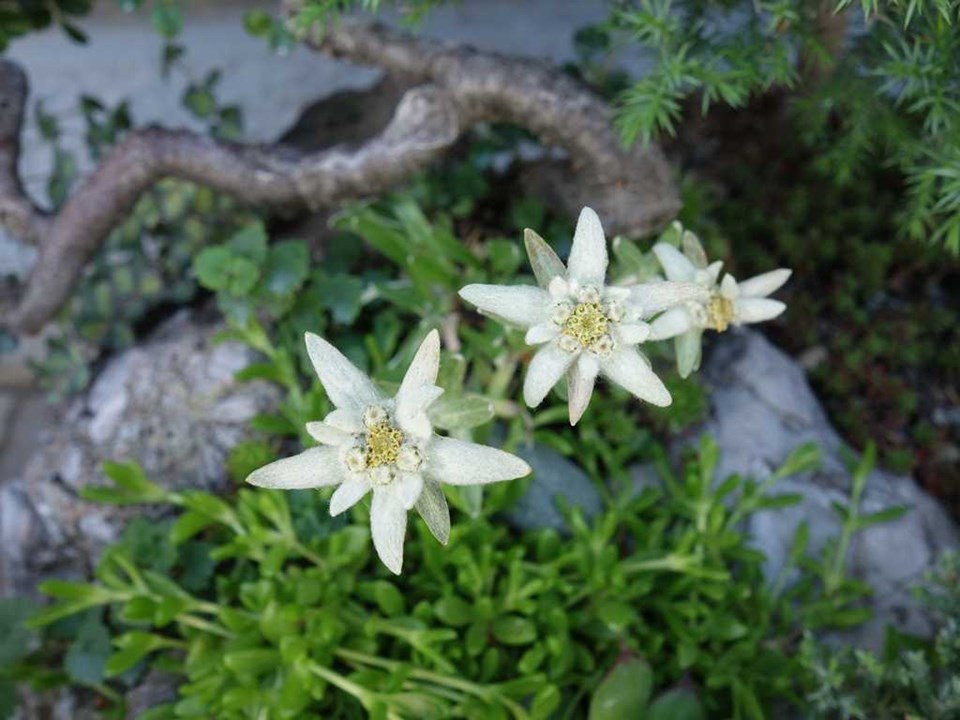
Perhaps best known from the iconic “Sound of Music” song bearing its name, edelweiss is a symbol of love and courage.
This alpine wildflower is the national flower of several countries, and has protected status in several of countries in its native range.
Small and white, clean and bright

Edelweiss, Leontopodium alpinum, is a woolly perennial wildflower in the daisy family. It blooms from July to September and grows up to 10 inches tall, slowly spreading to form colonies.
The plant’s common name combines the word German edel, meaning noble, and weiss, meaning white. The white fuzzy parts of plant, however, are actually its bracts that surround yellow disk flowers. The yellow flowers are said to resemble a lion’s paw.
Its genus combines the Greek leon, meaning lion, and podion, meaning foot, in a nod to its appearance.
Blossom of the snow

Edelweiss is native to rocky, limestone, alpine areas in Europe. Its distribution ranges from the Pyrenees to the Alps and eastwards over the peninsula of the Balkans to the central Balkans in Bulgaria, according to the International Union for Conservation of Nature.
Edelweiss is the national flower of Austria as well as Germany, Switzerland, and Italy.
Edelweiss has protected status in several European countries due to overcollection.
Bloom and Grow

Edelweiss is highly cultivated for its appearance and for some medical uses.
It grows best in cool summer climates. It prefers sandy to gritty, neutral to alkaline, sharply-drained soils and full sun. The plant is a great addition to rock gardens, raised beds, or border fronts.
The flower is used in teas and with milk and honey to treat coughs. It can also treat stomach aches and rheumatic pain.
You look happy to meet me


Alpine plants are often symbols of their resilience due to their ability to grow in rocky soil and cooler climates. Unfortunately that means many of them, including edelweiss, can’t survive the heat and humidity of Missouri summers.
Despite valiant attempts from the Missouri Botanical Garden’s horticulture team to add the iconic plant to the Strassenfest Garden and Bavarian Garden, none are currently growing at the Garden.
However, the Garden’s horticulture team recommends checking out these other interesting mountain blooms.
germander
Like edelweiss, Germander, or Teucrium montanum, is native to the alps although it is found farther south. It grows as small shrubs with yellowish white flowers.
Humans dating back to ancient Greece knew this plant. It has been used to treat digestive and respiratory problems.
The Garden currently has this species, wild-sourced from Conservatoire et Jardin Botanique de la Ville de Geneve, on display on the Bavarian Garden.
Catherine Martin
Senior Public Information Officer


Leave a Reply