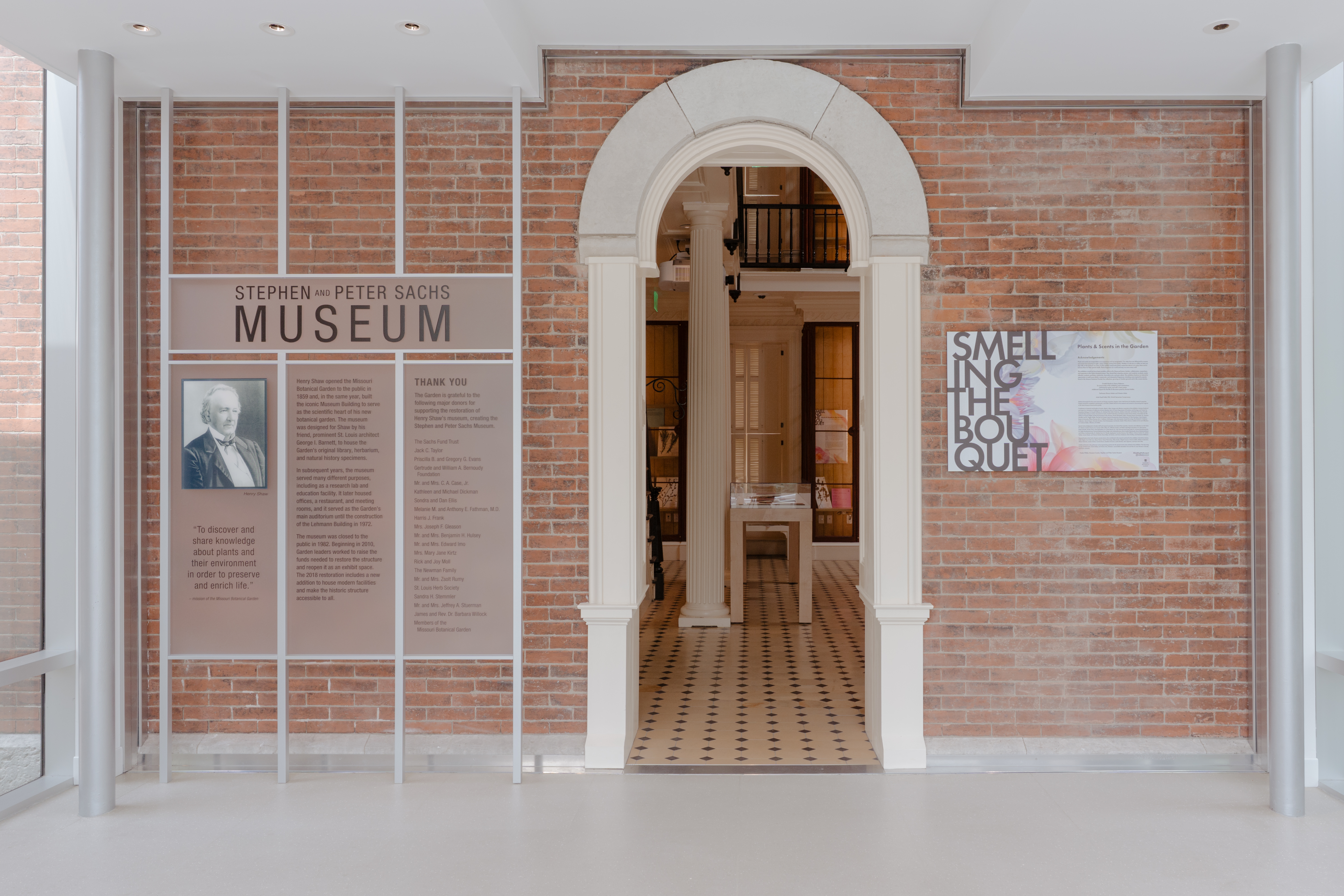
A new interdisciplinary exhibition at the Stephen and Peter Sachs Museum at the Missouri Botanical Garden explores the botanical, cultural, and olfactive history of the spectrum of scents created by plants – from floral to stinky.
Smelling the Bouquet: Plants & Scents in the Garden is open through March 2026.
Why Scent?

Scent is an essential part of life. It is especially important to plants, making it an ideal fit for the Missouri Botanical Garden’s Museum.
Plants use the chemistry of scent to communicate with the world around them. Plant’s scents attract pollinators with their intoxicating smells and repel herbivores with pungent odors. These different scents attract and repel humans as well, evidenced by the archaeological remains of plants and tools used for incense and perfume in ancient cultures.
Every part of a plant—from flower to root—contains compounds that can be harvested and extracted through different processes.
Volatile organic compounds or VOCs are plant compounds people extract for their scent.
The art and science of perfumery combining these elements in new and exciting compositions for our noses to enjoy.
the Exhibition

The Smelling the Bouquet exhibition explores the spectrum of scents plants create, inspired by the diverse live and scientific collections at the Missouri Botanical Garden.
The Garden’s conservatories protect and display unique and rare plants from around the globe. This provides new opportunities for Garden scientists to study and analyze their scents, what VOCS they create and emit, and to understand pollinator interactions. Garden botanists carry out scent research on plants in Madagascar, home of one of the world’s most identifiable scents—Madagascar vanilla.
Garden’s Herbarium specimens, together with scent-related objects, intersect the artistry and the botany behind the human culture of scent.

The highlight of the exhibition is the opportunity to sniff almost three dozen scents. Smells include several interpretive fragrances of the Garden’s live plants as well as botanical compounds renowned for use in perfumery. Each of the scents are in the small glass cloches (handled domes) on several sniffing tables in each gallery. All Artisan perfumers Shawn Maher and Weston Adam—both based in the St. Louis region—created these interpretive fragrances and provided these compounds in the Main and Lower Level galleries.


The Museum’s South gallery features olfactory artist Gayil Nalls’s botanical scent artwork, World Sensorium. This artwork, which can is only on display at the Garden, offers a unique sensory encounter with the importance of aromatic plants to the collective human experience.
Researching plant and scents at the Missouri Botanical Garden
Plants and Scents In the Living Collections

The Garden’s living collections offer myriad opportunities to learn more about plants. Garden scientist Mónica Carlsen shared her botanical scent research in the exhibition.
Carlsen conducted scent trapping to gather data about the wide variety of tropical plants in the Climatron and other conservatories.
To trap a plant’s scent, researchers cover the spadix with a plastic bag to let the scent accumulate. Then, a special carbon filament attached to an air pump captures the scent for analysis.
Several of these scents are interpreted as fragrances by the exhibition’s perfumers. The exhibition also features herbarium specimens of the plants.
in Madagascar

The Republic of Madagascar is a large island nation renowned as a globally significant biodiversity hotspot. It is home to many thousands of endemic plant and animal species.
Endemic species only occur in one geographic area.
Since the 1970s, the Garden has worked in Madagascar to explore, conserve, and restore this unique flora in collaboration with local communities and the national government. Today, the Garden manages 11 protected areas in Madagascar.
One of these protected areas is Ibity Massif. Less than half the size of St. Louis City, this rocky area is home to at least 304 plant species. In 2024, a Garden team conducted a field trip within Ibity Massif to locate and scent trap a dozen species of fragrant plants. This project was part of the research into plant scents for Smelling the Bouquet. The team had a list of plants to search for anduse scent trapping protocol set by Scientist Nisa Karimi.

Once completed, researchers refigerated the plant scent samples and eventually transported them to St. Louis. The Garden shared a sample from each species with Russell Williams, Director of Bioanalytical Chemistry Facility at the Donald Danforth Plant Science Center.
William’s research showed some of the volatile compounds present in each of the samples. For example, Ibityan everlasting, Helichyrsum ibityense, has a minty fragrance and is a natural inspect repellant. Its chromatogram, a chart showing the plants’ compounds, is on display in the exhibition. The tallest peaks illustrate the strongest volatiles in the plant.

Scent Traditions
Plants scents play an important role in cultural traditions around the world. Smelling the Bouquet explores banho de cheiro, a traditional Amazonia practice using aromatic herbs for physical and spiritual cleansing. Banho de cheirois Portuguese for “scented bath.”
In Brazil’s Amazon region, practitioners prepare banho de cheiro by steeping leaves, roots, and aromatic plants in water. This creates an infusion for cleansing baths and is either poured over the body or used for immersion.
Banho de cheiro‘s origins lie in Indigenous tradition, however the practice evolved and now appears in diverse contexts. Maria Luciene Gama Santos, from northern Brazil, is an erveira (herbalist) and madrinha (godmother) of carimbó, a traditional music and dance form.
In her interview, she opens the gates of her garden and shares her personal view on banho de cheiro. To her, it is not merely a ritual but as a living practice that involves asking permission from the plants and engaging in a collaborative, evolving dialogue with nature. Her account highlights how this knowledge is transmitted through experience and shared practices rather than fixed teachings.
Smelling the Bouquet features a banho de cheiro display. Artifacts include Herbarium specimens of three of the aromatic plants often used in the recipes and information about the plants often used in other recipes.
See Smelling the Bouquet
Visit the exhibition in person to experience all the scents. The Sachs Museum is open 11:30 a.m.–4:30 p.m. daily. Admission is included with regular Garden admission.
You can view the exhibition virtually:
Please check the Sachs Museum page or Linktree for updates and future events. For the latest updates on the Museum, follow the Sach’s Museum’s Instagram, Twitter/X, and Bluesky accounts.
Nezka Pfeifer, Museum Curator, Stephen and Peter Sachs Museum
Acknowledgments
Grateful thanks to Nancy Ridenour for sponsorship of the exhibition scent commissions, performance series, and sniff ‘n learn series.
Additional support for the film & discussion panel by Bonnie Koblitz.
Perfumers Shawn Maher and Weston Adam
Artist Gayil Nalls, PhD, World Sensorium Conservancy
Stefanie Hermsdorf for the scent research and design expertise, Rogério Victor Satil Neves for Brazilian research expertise, Virginia Harold for installation photography, and Sofia Collette Ehrich for the research and content in Uncovering the Fragrant in the Sachs Museum Mural activity guide.
Contributors of research and lenders of scents, objects, video, images and olfactory expertise to the exhibition: Marissa Sandoval and Jasen Liu, University of California at Davis, Ramírez Lab, UC Davis Department of Evolution and Ecology and Center for Population Biology; Dr. Russell Williams, Dr. Michael Wei, Katia Gutierrez, Melissa Jurkowski, and Kristina De Yong, Donald Danforth Plant Science Center; Fernanda do Canto, Tombô Productions and Maria Luciene Gama Santos, Association for the Defense of Human Rights and the Environment in the Amazon, Brazil; Elizabeth Collins, George Mason University; Dr. Vanessa Handley and Dr. Peggy Fiedler, The Red List Project; Spyros Drosopoulos, Baruti Perfumes; Dr. Eliot Gardiner, Case Western Reserve University; Éliane Thomas; Eric J. Hoffman; Ted Burger, Josh Johannpeter, Daniel Browning, The Richard H. Driehaus Collection. Marie Clapot; Miranda Gordon, Punk Champagne; Jas Brooks; Saskia Wilson-Brown, Institute of Art and Olfaction; Dr. Andreas Keller, Olfactory Art Keller.
Special acknowledgments to Garden staff and research associates who shared their expertise, research, and collections on view here: Dr. Mónica Carlsen-Krause, Dr. Carmen Ulloa Ulloa, Dr. Alfredo Fuentes, and Belen Alvestegui Montalvo; Dr. Nisa Karimi, Heidi Schmidt, Nicole Tineo, Chris Birkinshaw, Dr. Tariq Stevart; Dr. John Atwood and Doug Ladd; Dr. Armand Randrianasolo, Dr. Tabita Randrianarivony, Fortunat Rakotoarivony, Roger Lala Andriamiharisoa, Brice Funklee Rakotozafy, Bruno Rakotonindriana, and Wilson Andrianarivelo; Dr. Robbie Hart, Dr. Wendy Applequist, Carolina Romero, The William L. Brown Center; Dr. Jordan Teisher, Lauren Boyle, and Victoria Patrick; Dana Kelly, Jim Kuchar, and Anna Anderson; Chris Hartley; and Marianne Hoffmann.
Especial thanks to the Sachs Museum remote interns who contributed to the research and text for the exhibition: Merritt Dos Santos, Emily Tinglan Cai, Kristin Lee, Alyssa Hanna, Tianyi Frida Jiang, Abby Sucher, Abigail Cannon, Arianna Halle, Chelsea Zuckerman, Allison Fabrizio, Jordan Schein, Connie Brown, Emeline Swanson, Lydia Estrada, John Oganian, and Kyra Tani Little.
Additional thanks to the performers and programming partners for the special events series related to the exhibition: The Mourning Society of Saint Louis, Charis Railey and Amara Arts, Michael J. Leonardelli, Benedetta Orsi and The St. Louis Women’s Chorale, and Devin Johnston.
Leave a Reply