The Margaret Grigg Nanjing Friendship Garden, commonly called the Chinese Garden, is a hidden gem located in the center of the Missouri Botanical Garden. It contains a pergola, mosaics, ornamental stones, a water feature, and of course, a wide variety of plants native to China and eastern Asia.
Because of our shared, temperate climate, many beautiful ornamental plants that are native to China can be grown here in the St. Louis area. The plants featured here are good choices for our area. They are cold hardy, disease-resistant, have multiple ornamental features, and do not have aggressive or invasive tendencies.
They are also all planted in the Chinese Garden. Stop by on your next visit and see how many you can find.
Did you know? The Missouri Botanical Garden was at the forefront of an international project to publish the first modern English-language account of the 31,000 species of vascular plants of China. The Flora of China project made previously inaccessible information, like Chinese herbarium specimens, available to Western scientists, fostering collaborative research. Learn more about Flora of China >

Chinese Redbud (Cercis chinensis)
Endemic to China; Blooms in April

Unlike our native eastern redbud (Cercis canadensis) which can reach 30′ tall, the Chinese redbud will grow into a large to medium-sized (usually reaching around 10 feet tall, but 15 feet tall is possible), multistemmed shrub in the garden.

The spring blooms are pink in color and held in clusters along the stems. This species is endemic to eastern China, meaning that it is only found in the wild there.
Seven Son Flower (Heptacodium miconioides)
Endemic to China, Blooms in summer

This medium-sized tree is endemic to southeastern China where it is considered rare. The common name, seven-son flower, comes from the translation of the Chinese name for this plant. The name refers to the typically seven-part flower clusters that make up the inflorescence.
Clusters of fragrant, white flowers bloom in mid to late summer. The flowers are ringed by persistent bracts that turn bright pinkish red in fall, further adding to the beauty of this plant.

The tan, papery bark is exfoliating, revealing attractive, brown inner bark and providing good winter interest.
Chinese Sweetshrub (Calycanthus chinensis)
Endemic to China; Blooms early May

Plant this medium to large-sized shrub for its showy, late spring blooms and bright yellow fall color. At maturity, they can reach 5-10 feet tall and equally as wide. They are endemic to southeastern China.
Chinese Sweetshrub is related to the United States’ native Carolina allspice (Calycanthus floridus), but unlike Carolina allspice, its flowers have no fragrance.
Chinese Culture Days
May 3-4, 2025
Immerse yourself in awe-inspiring Chinese cultural performances, music, art, and history while enjoying authentic cuisine.

Plantain-leaf hosta (Hosta plantaginea)
Endemic to China; Blooms late summer and early fall

This hosta species forms medium-sized clumps of bright green leaves, reaching up to two feet across. From late summer into early fall, 2.5-feet tall scapes (leafless flowering stalks) bear large, white, trumpet-shaped blooms.

The flowers are fragrant and attractive to hummingbirds. In the wild, this species is only found in southeastern China, but it is widely available in cultivation.
Bishop’s Hat (Epimedium stellulatum)
Endemic to China; Blooms April-May

Renowned for their longevity and adaptability in the garden, this species of Epimedium features showy, star-shaped blooms in spring and semi-evergreen foliage.
Mature plants form tidy clumps reaching 1.5 feet tall with an equal spread. It is endemic to southeastern China where it grows on forested slopes. Its specific epithet comes from the Latin stellula , meaning small star.

Zawadzki Chrysanthemum (Chrysanthemum zawadskii)
Native to China; Blooms fall

This species of mum lights up the edge of the Chinese Garden when it blooms in fall.
Its native habitat includes stream sides, mountain slopes, and forested openings in northern China as well as eastern Europe, Siberia, and the Korean peninsula.
Did you know? The Genus name Chrysanthemum comes from the Greek words chrysos meaning gold and anthemon meaning flower.

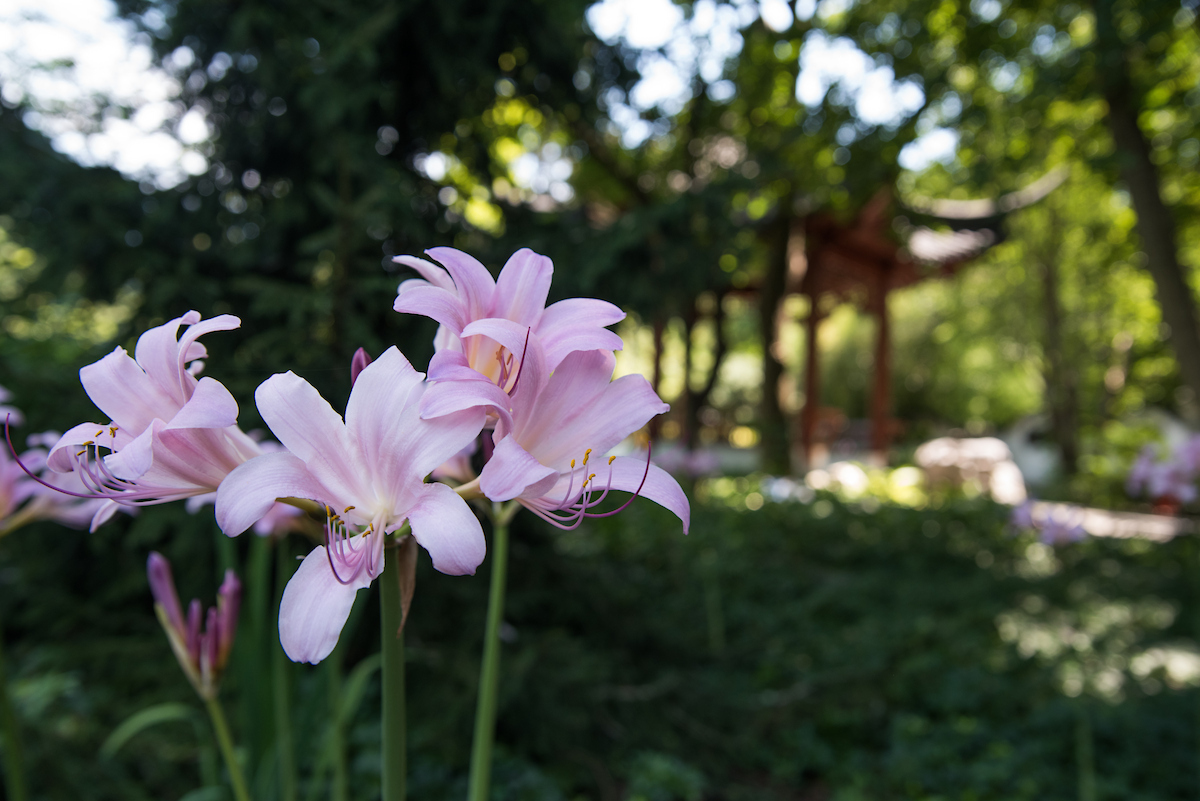
Surprise Lily (Lycoris squamigera)
Native to China; Blooms August-September

The clumps of strappy foliage of this species appear in the spring and disappear by summer. So when the 2-foot tall scapes bearing pink, trumpet-shaped flowers emerge in late summer after the foliage is long gone, it can be quite surprising, giving rise to some of this plant’s common names: surprise lily, Resurrection lily, and magic lily.
This plant can be found in the wild in southeastern China as well as the Korean Peninsula.

Justine Kandra | Horticulturist at the Missouri Botanical Garden’s William T. Kemper Center for Home Gardening.
Leave a Reply