The Missouri Botanical Garden is home to the largest nonprofit home gardening answer service in North America. The Garden’s expert staff and Master Gardener volunteers answer hundreds of questions each year with outdoor gardening tips and houseplant help.
The Garden’s Horticulture Answer service is available from 9 a.m. to noon Monday–Friday. Call 314-577-5143 to get answers to your gardening and houseplant questions!
You can also email questions to plantinformation@mobot.org
Home gardeners and houseplant consignors can call or email with questions, or visit our experts at the Plant Doctor Desk in person at the Center for Home Gardening. The Center also has a beautiful houseplant display and 23 demonstration gardens for inspiration.
Visit the Plant Doctor desk daily from 9 a.m.–3 p.m. April–October. November–March the Plant Doctor Desk is open Monday–Friday, 9 a.m.–3 p.m.
The following are the most common houseplant questions people ask our experts at the Kemper Center for Home Gardening.

What are these white, fluffy things that appeared on my Houseplant. Is it a fungus? How do I treat it?
Those are mealybugs. They are small, oval-shaped insects that produce a white, waxy coating giving them a cottony appearance. They move slowly and use their piercing-sucking mouth parts to feed on plant sap. You will most often see them singly or in groups clustered along leaf veins, on the underside of leaves, or hidden in hard-to-reach places like stem nodes.
They can be controlled using insecticidal soap sprays, neem oil sprays, or systemic insecticide applications. But as with all houseplant pest problems, an ounce of prevention is worth a pound of cure. Infestations of mealybugs often originate when a new plant from a grocery store, nursery, or friend is added to a houseplant collection.
We recommend quarantining newly acquired houseplants in a room separate from your main collection and monitoring the new plant for any pests for at least two weeks.
For more information on mealybugs and how to control them, check out our mealybug information page.

How do I know if my phalaenopsis orchid needs repotted?
While there is not a clear-cut answer since individual orchids and their growing conditions will differ, there are some general rules of thumb when it comes to orchid repotting.
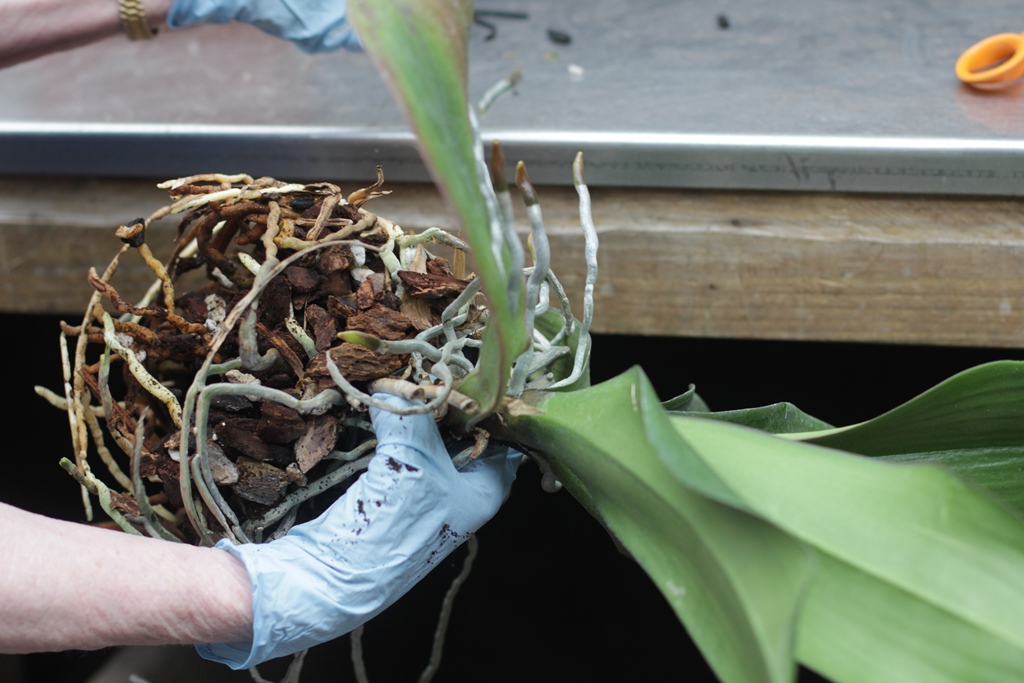
The average tropical houseplant will need repotted every few years to refresh the potting mix and give their roots more room to grow, and orchids are no different. After around two years the growing media surrounding the orchid roots will break down, causing the media’s water retention characteristics to change and leading to underwatering or overwatering.
Depending on how large the plant has gotten, the same container can be reused. But if there are lots of aerial roots starting to extend far beyond the edges of the pot, it might be time for a larger container.
For more information on repotting monopodial orchids like moth orchids, check out our handy Repotting Phalaenopsis Visual Guide.

The leaves on one of my Houseplant are constantly sticky and covered in a black film. Why?
This is called honeydew. It is the secretion of sapsucking insects such as mealybugs, aphids, and scale. An infestation of these insects can cause the leaves and anything surrounding an infected plant to be covered with a sticky residue.
An opportunistic fungus called sooty mold may start to grow on surfaces covered in honeydew, giving them a dirty, black appearance. Sooty mold is not harmful, and can be controlled by eliminating the cause of the honeydew.
Even if you don’t see any pests right away, keep looking. Scale can camouflage quite well, and mealybugs often hide on the underside of leaves or in stem nodes.
Want to see more photos of scale, honeydew, and sooty mold? Check out our scale and sooty mold information pages.

How can I get my amaryllis bulb to bloom again next year?
Once all the flowers have faded, cut the flowering stalk at the base near where it exits the bulb. Leaves will start to grow from the bulb, if they haven’t already. It is very important to not cut these leaves off.
Place your amaryllis in a warm, sunny location like a south-facing window so the leaves can start gathering energy for next year’s blooms. Water and fertilize as you would any other houseplant.
Once the danger of frost has passed in spring, you can move potted amaryllis bulbs outdoors to get extra sun and warmth. You can also keep your amaryllis indoors year-round as long as they get plenty of light.
In the fall, plants need to enter a dormant resting period. Stop watering and provide the plant with cooler temperatures. Amaryllis are not tolerant of freezing temperatures though, so make sure to bring them inside a garage or basement where they will not fully freeze.
After around two months, you can move the pot back into a warm, sunny location and resume watering to trigger blooming. If your amaryllis starts growing offsets, you can separate them and pot up in their own container in the spring.
For more information on amaryllis and how to get them to rebloom, check out our blog Your Amaryllis Can Bloom Again!

These little flies that live around my Houseplant keep bugging me. How can I get rid of them?
If you have small, black flies that sort of look like tiny mosquitoes buzzing around your plants and being a nuisance, they are definitely fungus gnats. Also sometimes called soil gnats, these flying insects require damp soil conditions to reproduce. If your plants can tolerate it, allowing the top inch or two of soil to dry out completely can help break the fungus gnat life cycle. Using a combination of sticky traps and biological or chemical control measures can also effectively control the population. Unfortunately household remedies such as sprinkling cinnamon, baking soda, coffee grounds, diatomaceous earth, or sand on the surface of the soil, or drenching the soil in hydrogen peroxide are not very effective and can harm your plants.
For more information on the life cycle of fungus gnats and how to control them, check out our fungus gnat information page.
For more houseplant help, or tips and information on home gardening, visit gardeninghelp.org.
Justine Kandra | Horticulturist with the William T. Kemper Center for Home Gardening
Leave a Reply