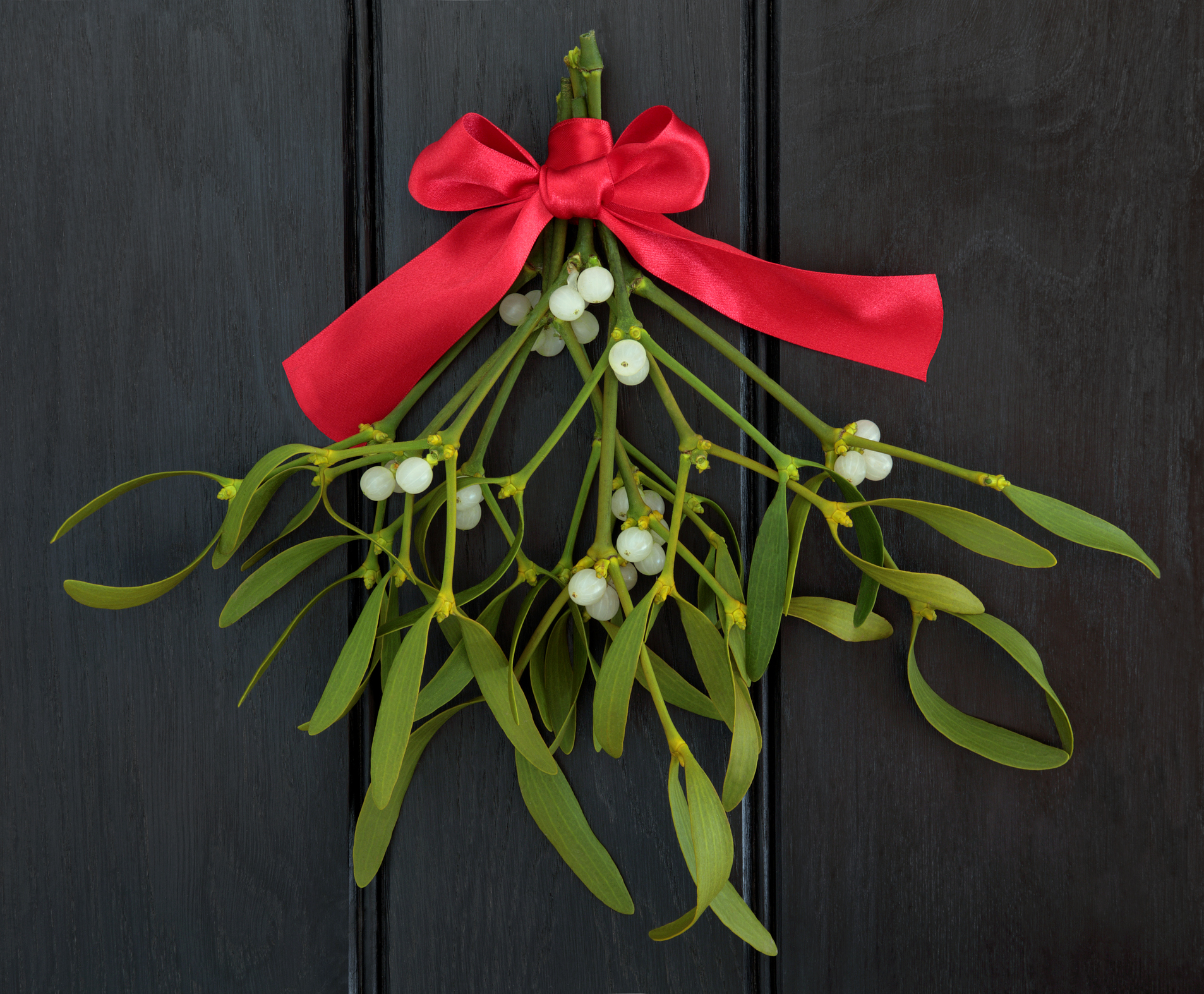

Perhaps second only to Christmas trees, mistletoe is a botanical holiday icon. But, in botanical terms, it is not actually one plant but a common name applied to a group of parasitic plants.
Learn more about these plants and where they come from in this information from the Missouri Botanical Garden’s Center for Home Gardening.
What is mistletoe?
Mistletoe is a common name applied to a group of evergreen, plants in the sandalwood family, Santalaceae. These plants are sometimes grouped together in their own family, Viscaceae.
European mistletoe, Viscum album, is the quintessential plant of European folklore and Christmas traditions. Its kissing cousin, American mistletoe, Phoradendron leucarpum, is in a different genus. But it shares many of the same physical characteristics as its European relative and has filled the same cultural niche. It is also the most common mistletoe species in North America.


Where is mistletoe from?
European mistletoe is native to a wide swath of Eurasia, from Europe into central and southern Asia. American mistletoe is native to temperate regions of North America including parts of the eastern and southern United States and northern Mexico.
Did you know Missouri has mistletoe? Phoradendron leucarpum can be found in the Ozarks of southern Missouri where it is somewhat rare.

How Does Mistletoe Grow?
Mistletoe plants are hemiparasite. This means they require a host plant to acquire water and mineral nutrients. They are evergreen subshrubs that grow on the branches or stems of other woody plants, forming dense, rounded clumps up to several feet across.

What Plants are hosts are for mistletoe?
Different species of mistletoe prefer different hosts. For example, European mistletoe has been recorded parasitizing on more than 400 different species of woody plants. However, it grows best on apple trees European lindens, poplars, hawthorns, and black locust. American mistletoe on the other hand has a host range of around 60 different tree species. Common hosts include maples, walnuts, oaks, elms, and tupelos.

What animals like mistletoe?
Mistletoe provides food and shelter for a range of animals.
In North America, plants in the genus Phoradendron including American mistletoe are larval host plants for the great purple hairstreak butterfly. Pollinators including small native bees, wasps, and flies visit the flowers for pollen and nectar. Birds such as cedar waxwings, robins, bluebirds, and chickadees and small mammals including squirrels and chipmunks eat the berries and rely on them as an important food source in winter. Deer and elk will readily browse on the plant’s foliage in the winter, usually from fallen branches. Clumps of mistletoe are also used as nesting habitat for wrens, mourning doves, and squirrels.

How about Humans?
Freshly cut branches of mistletoe are commonly used to decorate indoors during the winter. They have historically been associated with romance and vitality. Hanging a bough of mistletoe was said to protect a house from lightning strikes or fire.
Mistletoes have long been used as part of traditional medicine practices, and today active compounds produced by the plants are being studied for their ability to treat a range of issues including headaches, epilepsy, and even cancer. However, all parts of the plant are poisonous and can cause very serious side effects, so talk to your doctor before starting any herbal treatment.

Potential Pest?
While it a favorite for holiday decor, mistletoe can be problematic in the wild in certain situations.
Most healthy, mature trees can sustain a few mistletoe plants. But for a tree that is already weakened due to environmental stressors, insect pests, or disease, too many clumps parasitizing its branches could be detrimental. The fruits are also toxic to humans and pets if ingested in large enough quantities, so where kids or critters play the plant may be considered undesirable. Unfortunately, once mistletoe has been established, it is very difficult to control. Cutting the stems flush with the host tree will set the mistletoe back but not kill it. The only effective control measure is to prune out infect branches. Trees that are heavily infested may need to be removed entirely.
Leave a Reply