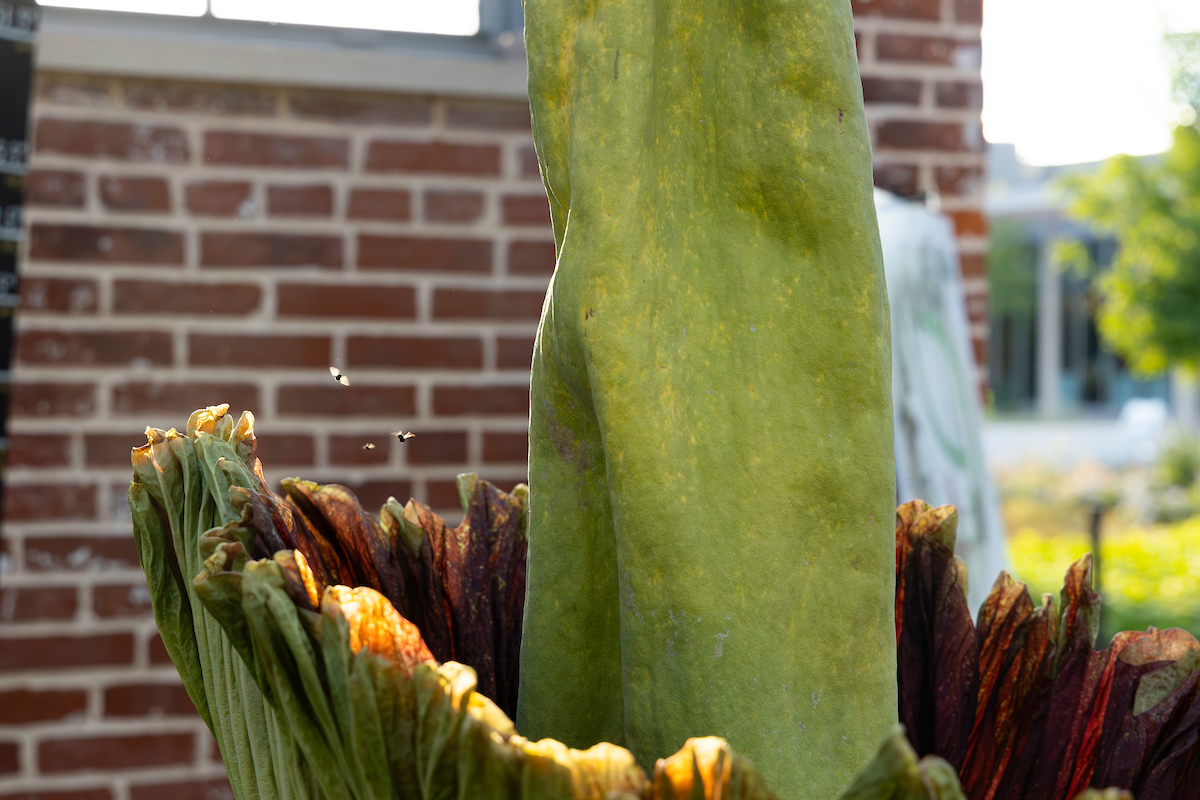
The corpse flower (Amorphophallus titanum) is one of nature’s more unusual plants, and that includes the way it is pollinated. While other plants use sweet fragrance and beautiful colors to attract pollinators, corpse flower pollination relies on insects that are more attracted to sights and smells we humans don’t find pleasant.

In this blog, we’ll take a look at some of the tricks the corpse flower plays to attract pollinators in the wild, common pollinators for the corpse flower, and how the Missouri Botanical Garden handles pollination for plants in or collection.
How the corpse flower attracts pollinators
If you’ve ever seen a corpse flower bloom, you probably know that one of the defining features of titan arum is its strong, offensive odor.
When the corpse flower blooms, it emits a smell that resembles decaying flesh. Unlike the sweet, flowery smell many plants use to attract bees and butterflies, titan arum uses its intense odor to attract flies and beetles known to feed on rotten meat.

Another trick the corpse flower uses for pollination is its color.
The vivid flowers we see in springtime attract bees and butterflies. Similarly, as the corpse flower unfolds its spathe (the leaf-like structure surrounding the tall, flesh spike), they reveal a deep red color which mimics exposed meat.
Blow Flies (Calliphoridae Family) as pollinators

If you were to encounter a blooming corpse flower in the wild, you would likely spot blow flies buzzing around the smelly plant.
Also known as carrion flies, blue bottles, and green bottles, these insects enjoy the strong scent of decay produced by the corpse flower. Blow flies can also be spotted buzzing aorund American pawpaws (Asimina triloba)1 and dead horse arums (Helicodiceros muscivorus)2, which produce similar rotting scents.
Did you know? Calli, the 16th corpse flower expected to bloom from the Garden’s collection and the first set to bloom at the Sophia M. Sachs Butterfly House, is named after this pollinator.
Because the corpse flower is monoecious (containing both male and female flowers), blow flies can pollinate titan arums simply by visiting multiple plants. When they land on the male flowers of one plant, they pick up pollen. That pollen can then be deposited on the female flowers over another corpse flower when the blow fly moves to the next smelly plant.
Some scientists have observed that a corpse flower can attract pollinators from as far as 1 mile away because there are usually no other flowering plants in the area.
Sap Beetles (Family Nitidulidae) and Carrion Beetles (Family Silphidae) As Pollinators
Sap beetles (Nitidulidae) and Carrion beetles (Silphidae) are also important corpse flower pollinators.
These beetles appreciate not only the rotting smell produced by Amorphopallus titanum, but they can also be lured in by the color of the corpse flower bloom. The distinct, vibrant burgundy color resembles rotting flesh, further enticing these beetles that feed on rotting meat.

When the corpse flower is blooming, these beetles will crawl onto the plant’s spadix (the long spike in the center), collecting pollen from the male flowers there. When they leave the plant, they may visit another nearby corpse flower, depositing the pollen onto its female flowers.
Did you know? A single corpse flower cannot pollinate itself because the male flowering stage occurs 24–36 hours after the female flowers are no longer receptive.
Manual corpse flower pollination at the Garden
Since botanical gardens rarely have multiple corpse flowers in bloom at once, they utilize manual pollination.
When a corpse flower blooms from the Garden’s collection, our horticulturists collect pollen from the male flowers, or applying stored pollen from another specimen to the female flowers.


The Garden also works with the Chicago Botanic Garden to share pollen samples in an attempt to nurture and grow more of these endangered plants.
Leave a Reply