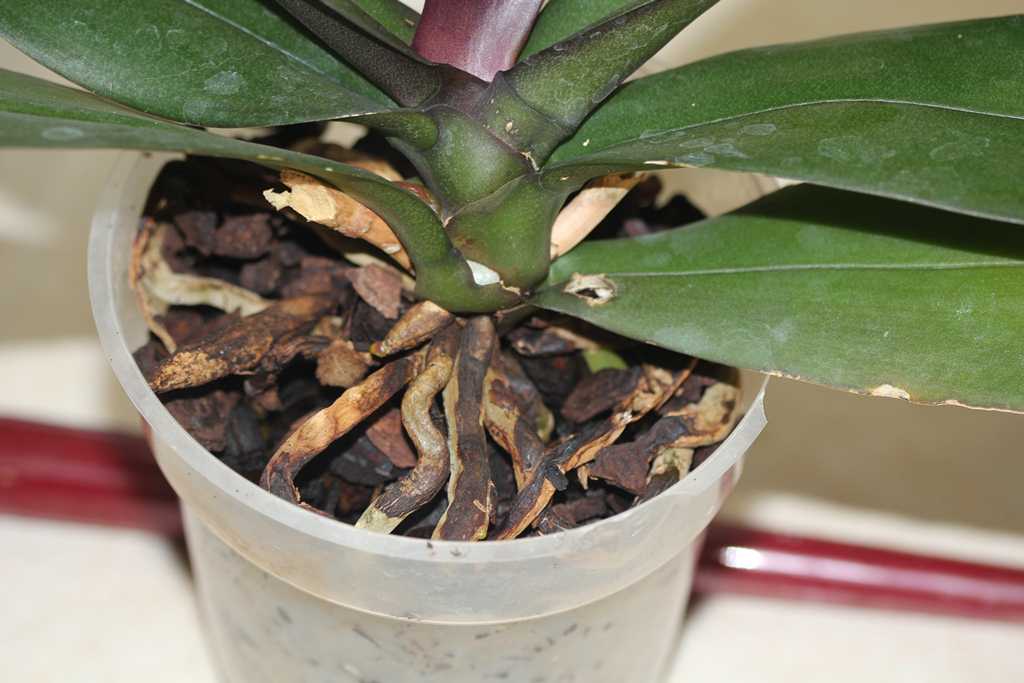
You don’t have to be a world-class horticulturist or blue-ribbon gardener to grow beautiful orchids at home. With the right care, these tropical flowers can become your most beloved houseplants.
Yet, many people swear off orchids after several unsuccessful attempts or avoid them altogether. If your orchid attempts have left you wondering where you went wrong, these popular orchid myths could be the real reason your orchids aren’t thriving at home.
1. You can Water Orchids by placing ice cubes in the pot

This houseplant “hack” is one of our least favorite orchid myths. Putting an ice cube in the orchid pot has been hailed as a way to prevent overwatering for decades, but in reality, the freezing temperature can shock the roots of these tropical plants.
Fortunately, as long as your orchid is in the correct growing media (not potting soil), and you don’t let it sit in water collected in the bottom of the pot or tray, you are unlikely to overwater it.

To properly water an orchid, take the plant to the sink (in the morning is best) and thoroughly rinse it with room-temperature water through the pot. Allow the water to fully drain before returning the pot to its usual location. Usually, you only need to do this once a week.
2. Orchids only bloom Only once, Then Die
People often believe orchids die after a single bloom, but some orchids can live up to 20 years.
This misconception comes from the rest period orchids sometimes enter. Flowers fade and fall off after they bloom, causing the plant to look a bit lifeless, though it is just resting.

Getting Your Orchid to Rebloom
Our Orchid Show features hundreds of vibrant, blooming orchids that provide a colorful…
Discover More >We encourage home growers to treat orchids as the perennials they are. Caring for these beautiful flowers year after year is not only rewarding, but also more sustainable than getting a new plant to enjoy each winter. Though, of course, you can always buy a new orchid to keep the old orchid company.
3. Orchids only flower every 3-5 years

Have you ever heard that orchids can’t flower every year?
This myth originates from some fact. When grown from seed, orchids usually take a few years to flower, but if you buy an already established plant, this is irrelevant.
Most orchids sold as houseplants will bloom annually, sometimes even more than once a year. Moth orchids (Phalaenopsis) are especially great houseplants since they are one of the longest blooming orchids, lasting 2-6 months from late winter to spring.
One thing to consider is that orchids sometimes hold off on new blooms during acclimation to a new environment, so it can take up to a year for the plant to feel comfortable enough to bloom again.
4. All orchids have the same care requirements
The most common orchid varieties sold as houseplants are Phalaenopsis, Cattleya, and Dendrobium. Each of these genera has many species, and needs vary within each major group.
Generally, here are the basic care requirements for each genus. For the best performance, adjust according to your specific variety.
Home Care for Phalaenopsis

Moth orchids prefer low light, with an east window being ideal. It likes temperatures in the 70s and 80s Fahrenheit during the day, and in the 60s at night. Keep humidity above 50%. Water mature plants weekly and fertilize on a different day from watering. Use a quarter to half the strength recommended on the label.
Home Care for Cattleya

Cattleya orchids require high light, but not direct sunlight. Temperatures should be 70–85 degrees Fahrenheit during the day and 55–60 degrees at night, with humidity above 50%. Water mature plants weekly and fertilize on a different day from watering.
Home Care for Dendrobium

Dendrobium is one of the largest and most diverse orchid genera, with over a thousand species and a great variety in flower appearance and color. Some prefer warm growing temperatures, while others prefer cool conditions. All require humidity above 50% and prefer high light.
To flower well, many species need a dormant rest period in late fall, during which water is withheld for several weeks; others need no such rest period. Water mature plants weekly, except during the dormant period, and fertilize on a different day from watering. Use a quarter to half the strength recommended on the label.
5. You can repot your orchid with regular
potting mix

Most orchids are epiphytes (Plants that grow on other plants without relying on soil) and need orchid-specific potting media that doesn’t hold onto much water.
As shared above, not all orchids require the same care, and this is true when it comes to what potting mix you should use.
- 5 parts fresh fir bark, medium grade (¼ to ½ inch chunks) – NOT landscape mulch!
- 1 part horticultural charcoal (not the same as charcoal for barbecues). Note: This ingredient is extremely important, as it neutralizes fertilizer salts.
- 1 part sponge rock (perlite)
- 5 parts fir bark, medium grade (¼ to ½ inch chunks) – NOT landscape mulch!
- 1 part horticultural charcoal (not the same as charcoal for barbecues). Note: This ingredient is extremely important as it neutralizes fertilizer salts.
- 5 parts fir bark, medium grade (¼ to ½ inch chunks), if your dendrobium has small delicate roots, use small grade bark (1/8 to ¼ inch chunks) – NOT landscape mulch!
- 1 part horticultural charcoal (not the same as charcoal for barbecues). Note: This ingredient is extremely important as it neutralizes fertilizer salts.
6. Orchids need constant misting or to sit in water/sit on a pebble tray of water

While most orchids grow in extremely humid environments, orchids grown as houseplants do not get the same airflow. Being constantly wet can actually lead to rot. Most orchid roots serve to stabilize and anchor the plant, and they need exposure to oxygen and some ventilation.
If your plant seems to benefit from more humidity, particularly in the winter when heaters dry out the air in our homes, you can place it in a small tray of standing water for about an hour. Allow the plant to soak up the water it needs, but make sure to drain the excess water afterwards.
Erin McCann | Interpretation Assistant with the Missouri Botanical Garden’s Education Department
Thanks to Garden horticulturists Justine Kandra, Brandon Ketcherside and Sophia Marsh for contributing their expertise.


Leave a Reply