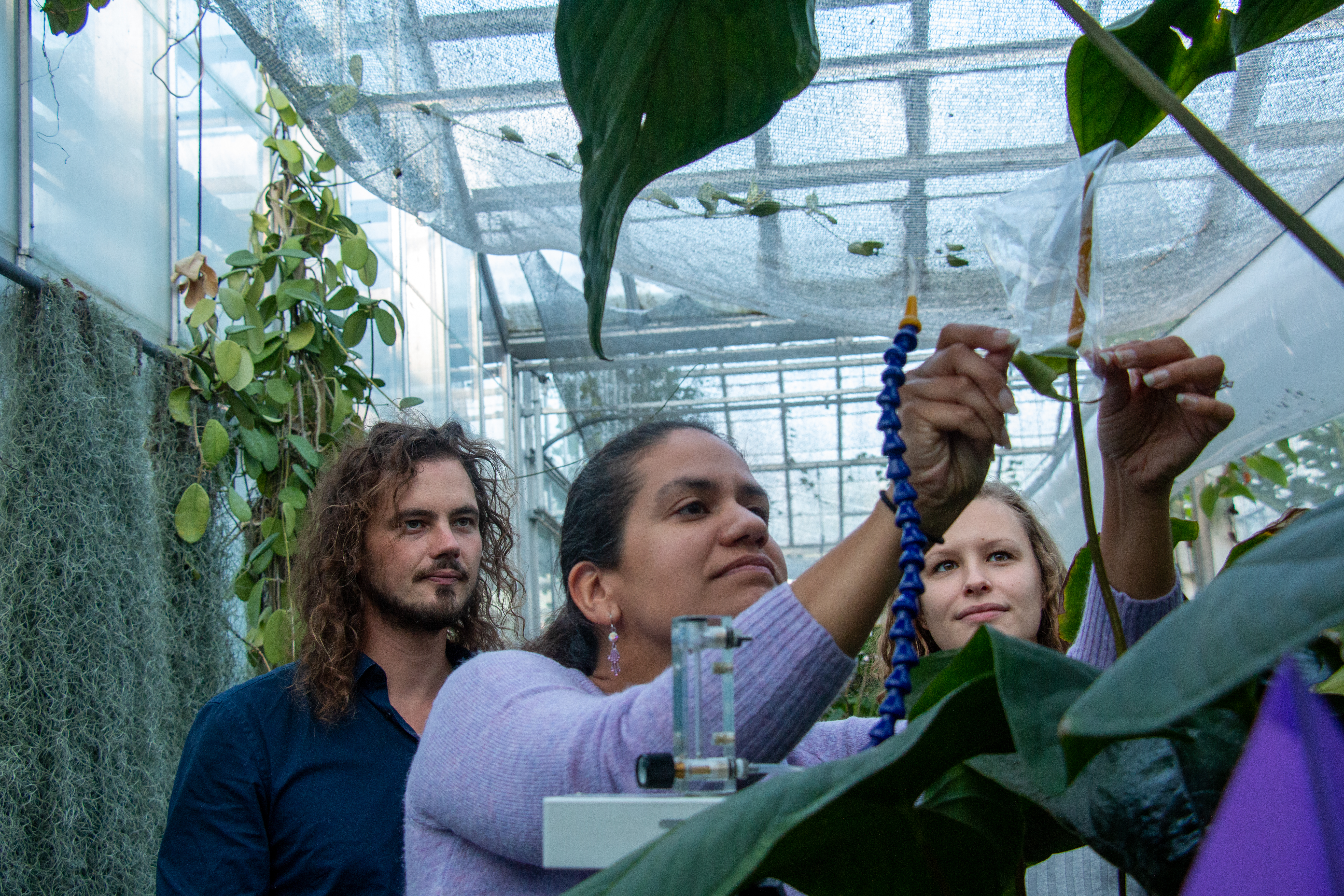
When scientists describe a new species, they often include a plethora of detail about its physical attributes — the size, shape, and color of its leaves, flowers, and fruits. But what about its smell?
Missouri Botanical Garden Scientist Mónica Carlsen is currently working on a project that will provide the first comprehensive characterization of floral scent across the genus Anthurium.
Why study smell?

Floral scent is the secret language of plant communication. It is especially important for plants communicating with insect pollinators. Some researchers theorize that unique pollinators attracted to specific floral scent profiles has led certain plant groups to evolve to include many diverse species. For example, the orchid family, Orchidaceae, includes nearly 30,000 known species. Almost every orchid genus has examples of strongly scented flowers.
What are Anthuriums?

Houseplant collectors may be familiar with Anthurium andraeanum, or the flamingo flower. Also called painter’s palette, it is a popular house plant known for being relatively low-maintenance and their vibrant red spathes.
Often mistaken for a flower, a spathe is s a large, often colorful, leaf-like bract that surrounds and protects a flower spike called a spadix.
But the flamingo flower is one of more than 1,000 species in the highly-diverse genus Anthurium. Anthurium belongs to the Araceae, or aroid, family that includes more than 100 genera comprising nearly 4,000 species.
The Anthurium genus is native to Latin America and is characterized by colorful, waxy spathes. Garden Scientist Tom Croat has described more than half of the species in this genus, including several Carlsen co-authored.
Why study Anthuriums?

In their native habitat, 10-15 species Anthurium often flower at the same time in the same forest. A variety of insects pollinate these flowers, including weevils, gall midges, fruit flies, and many types of bees. Scientist still don’t know what clues Anthurium flowers use to attract such a variety of pollinators and maintain their fidelity when encountering several species in the forest.
One possible answer is scent. While the anthuriums commonly cultivated as houseplants are largely odorless, Anthurium scents in wild Anthurium species run the spectrum from sweet like marzipan, mango, and blueberry—to more unpleasant smells like old shoes, wet dog, even vomit.
How do you trap a scent?

Researchers trap a plant’s scent by covering its spadix with a plastic bag to let the scent accumulate. Then, a special glass tube, containing a mix of absorbent resins, attached to an air vacuum pump captures the scent for analysis.
What Information can scientists collect from scent trapping?
When scent trapping, scientists collect the air surrounding the sample. This contains all the volatile organic compounds (VOCs) that make up a certain floral bouquet.
Scent trapping anthuriums at the Garden

Carlsen first started her research on Anthurium scent using the Missouri Botanical Garden’s living collection. The goal is to better understand the role of scent in attracting insects and understand patterns in floral scent evolution within the genus Anthurium.
To date, the team has collected scents from 132 species all from plants in the Garden’s aroid greenhouse.
Wild Anthuriums

In 2025, Carlsen and her collaborators received funding from the National Science Foundation to expand the project, “Understanding pollinator-mediated diversification in Neotropical plants.”
The program is led by Carlsen, along with Garden Curator Julian Aguirre-Santoro and Elliot Gardner, Case Western Reserve University. The project aims to provide a high-quality international collaborative research experience in Colombia to six U.S. students each year, over the course of three years. Students will receive in-depth mentorship and training from our Colombian collaborators while conducting individual research projects that address key questions regarding the pollination biology and evolutionary ecology of Anthurium.
The first field season is planned for June 2026 and will include scent trapping.
What can this research be used for?

Scent research could help those in the floral industry identify fragrant Anthurium species for commercial varieties and could support innovation in the perfume industry.
Carlsen’s research also has the potential to discover new chemical compounds in Anthurium floral scents, which could open new research avenues for chemists and biochemists. Identifying chemical compounds that attract certain pollinators could help researchers understand insect behavioral responses. It could also potentially be used in agriculture to develop chemical attractants for orchards and plantations to increase yield by attracting specific pollinators.
How can this help conservation?

Based on preliminary research conducted by Carlsen’s undergraduate student from Washington University, Jacob Cummings, around 400 species of Anthurium face the threat of extinction due to habitat loss. Additionally, many species of Anthurium have one specific insect pollinator, many of which are at risk of extinction. Better understanding the unique relationship between Anthurium and its pollinators can support conservation efforts.
Where can I learn more about plant scents?

“Smelling the Bouquet: Plants & Scents in the Garden” explores the spectrum of scents plants create, inspired by the diverse live and scientific collections at the Garden. The highlight of the exhibition is the opportunity to sniff over two dozen scents, including some considered unpleasant.
The Stephen and Peter Sachs Museum is open from 11:30 a.m. to 4:30 p.m. daily and included with Garden admission.
Catherine Martin
Senior Public Information Officer
Many thanks to Garden Scientist Mònica Carlsen for providing information used in this piece.
Leave a Reply