A look at the Missouri Botanical Garden’s Corpse Flower Collection
Several times a year, news media share that a rare corpse flower is in bloom. But if we’re hearing about it several times a year, how rare is it?
In the wild, the plants are still threatened with extinction. But they are becoming more common in cultivation as horticulturists better understand how to grow the plants and get them to bloom. And, many corpse flowers distributed from the same source are all blooming at the same time.
What is a corpse flower?

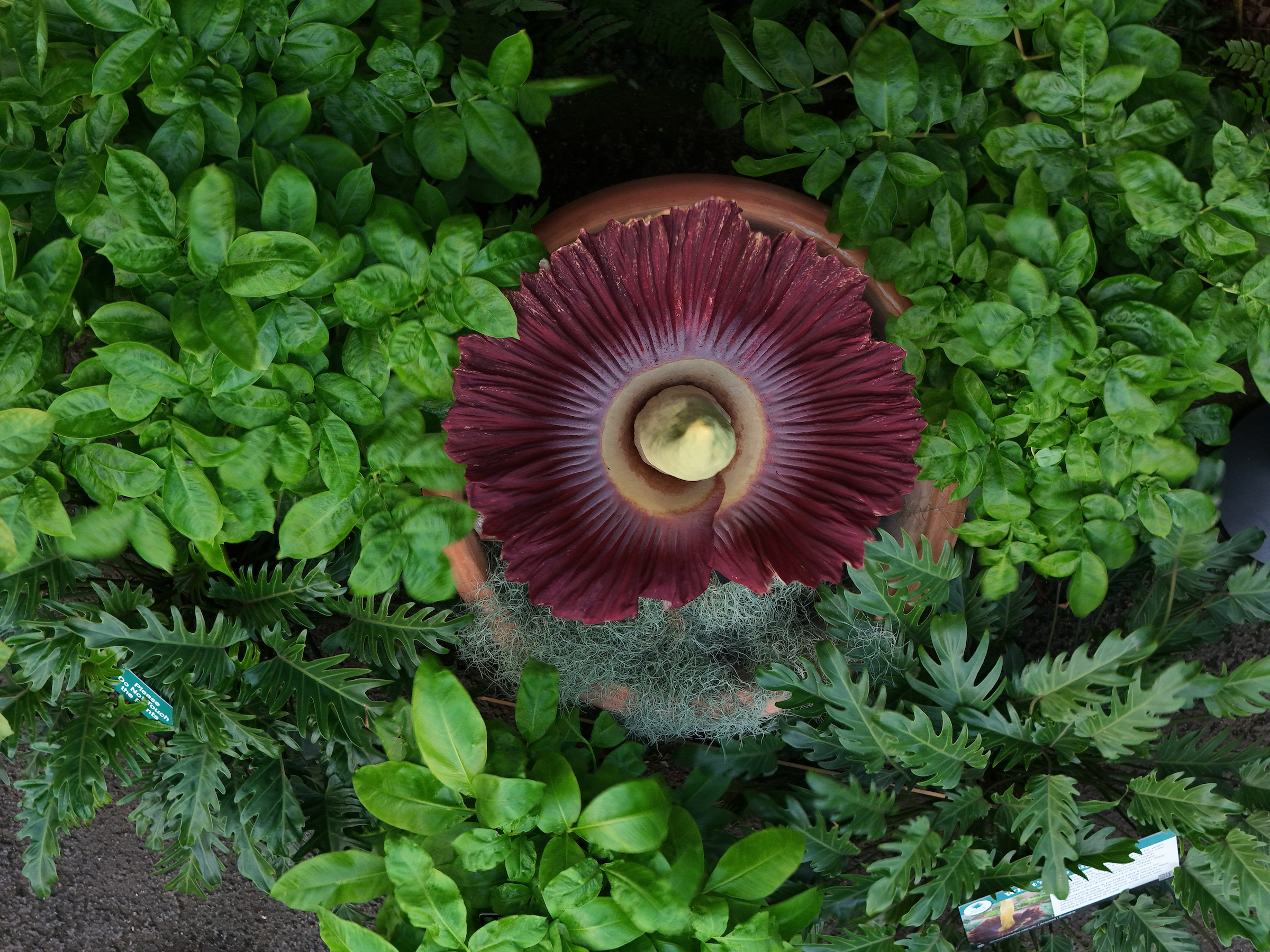
Amorphophallus titanum, commonly known as a titan arum, or “corpse flower,” is a large, fast-growing plant in the Aroid family. The plant, native to Sumatra, Indonesia, is known for its intense, foul odor emitted from a tall spike of small flowers, often lasting just 24 hours.
The titan arum’s smell and coloration mimic rotting flesh to attract its pollinators—flies and carrion beetles.

Does it really take a corpse flower 10 years to bloom?
Yes, it takes a titan arum roughly ten years to bloom from seed for the first time. After that, subsequent blooms occur much more frequently. Some corpse flowers bloom every two years, swapping between the reproductive and vegetative stages.
At the Missouri Botanical Garden, horticulturist Emily Colletti oversees the titan arum collection. Colletti has seen some plants bloom just one time, while others—we’re looking at you, Octavia—have bloomed up to five times.
What does a corpse flower look like when it’s not blooming?

In the vegetative stage, the tuber sends up one long, gigantic,
rolled-up leaf that unfurls an umbrella-like blade. The leaf can live for nine months to up to two years before the plant goes into a dormant period. The dormant period lasts anywhere from a couple of months to a year.
When in the reproductive stage, the tuber sends up an
inflorescence.
An inflorescence is a giant flowering structure that takes about a
month to develop.
The plant blooms at night, and without much warning. Once a bloom starts, it takes four to six hours to completely open. As it opens, the bloom heats up to help it emit its famous foul-smelling odor. The bloom maintains its full form from one to 36 hours after peak bloom.
Corpse Flowers in the Wild

The IUCN Red List lists titan arums as “endangered.” Experts estimate fewer than 1,000 mature corpse flowers exist in the wild. The population continues to decline with about 50% of the wild population lost in the past 150 years.
Did you know the Missouri Botanical Garden is a Red List partner? It is the only botanical garden partner in North America.
Why are so many corpse flowers blooming?

While threatened in the wild, the number of corpse flowers in cultivation is growing. This is due to shared pollen for seed production and the success of propagation through leaf cuttings. Some institutions have as many as 100 titan arums in their living collection.
Many of the corpse flowers in cultivation are also about the same age. Colletti likens it to a group of friends all having babies around the same time.
Corpse Flowers at the Missouri Botanical Garden
The Missouri Botanical Garden currently has more than 20 corpse flowers in its Living Collection. Several institutions gifted the Garden tubers over the years including The Huntington Library, Art Museum, and Botanical Gardens; Des Moines Botanical Garden; the U.S. Botanical Gardens; and the University of Missouri St. Louis. Garden horticulturist Emily Colletti oversees the Garden’s collection.
Meet the Garden’s Corpse Flower Collection
To date, the Missouri Botanical Garden has had 19 corpse flower blooms and counting. Each bloom offers something unique. Get to know the Garden’s stinky stars!
Tommy

Date of first (and only) bloom: May 19, 2012
Number of Blooms: One
Height: 58 inches (weight unknown)
Namesake: Tommy is named for Senior Curator Tom Croat, a world-renowned aroid expert who has worked at the Garden for more than 50 years.
More about Tommy: Tommy was the Garden’s first recorded corpse flower bloom.
Izzy

Date of first Bloom: June 19, 2012
Number of blooms to date: Three
Largest height/weight: 64.5 inches | 110 pounds
Namesake: Izzy ( Isabel ) is named after Emily Colletti’s paternal grandmother who was an avid gardener.
More about Izzy: Izzy’s first bloom correlated with Coletti’s 10-year anniversary with the Garden. After Izzy reached peak bloom, she started to close up immediately and was all but closed the following morning.
Jack

Date of first bloom: October 17, 2013
Number of blooms to date: Two
Largest height/weight: 66 inches | 110 pounds
Namesake: Named for Emily Colletti‘s father.
More about Jack: Jack’s first bloom in 2013 was the Garden’s latest bloom, happening in mid-October. Jack was from wild collected seed received from plant enthusiast Dr. James Symon who actually visited Sumatra with David Attenborough in hopes to see the corpse flower.
Hunter

Date of first (and only) bloom: July 30, 2014
Number of Blooms: One
Largest height/weight: 59.5 inches | 42 pounds
Namesake: Named to honor the Huntington Botanical Garden, which gifted five tubers to Garden President Peter Raven in 2008.
Octavia

Date of first bloom: July 9, 2017
Number of blooms to date: Four attempts, fifth bloom expected August 2025
Largest height/weight: 96 inches | 119 pounds
Namesake: The Latin word for eighth, Octavia was the Garden’s eighth corpse flower to bloom.
More about Octavia: Octavia is the largest corpse flower in the Garden’s collection. In 2019, Octavia grew to a whopping 96 inches but didn’t have enough energy to bloom. Colletti believes nighttime lighting affected Octavia’s ability to bloom.
Nona

Date of first bloom: October 4, 2018
Number of blooms to date: One
Largest height/weight: 65 inches, 81 pounds
Namesake: Continuing with the Latin theme, Nona is Latin for “ninth.”
More about Nona: Nona is a clone of Octavia. Nona split from Octavia in 2013.
Plant clones are genetically identical. Titan arum produce clones by splitting into two distinct tubers. Horticulturists separate the tubers into different pots and each tuber can produce its own bloom.

Date of first bloom: July 12, 2022
Number of blooms to date: Two
Largest height/weight: 88 inches | 33 pounds
Namesake: The Garden’s twelfth corpse flower bloom display, “Luna” is a nod to the twelve cycles of the moon. Luna bloomed just one night ahead of the full moon.
More about Luna: A gift from Chicago Botanical Garden, Luna’s parentage is a cross between Chicago’s “Alice” and Denver’s “Stinky.”
Augie

Date of first bloom: Aug. 5, 2023
Number of blooms to date: One
Height/weight: 80 inches| 107 pounds
Namesake: Another clone of Octavia, Augie is short for Augustus, the Roman emperor and brother to Octavia the Younger. Coincidentally, Augie also bloomed in August.

More about Augie: Augie’s first bloom was less than a week after Octavia’s third bloom. The Garden displayed the two side-by-side in the Linnean House. This was the first time the Garden displayed two corpse flowers at the same time.
Millie

Date of first bloom: June 10, 2024
Height/weight: 64 inches, 37 pounds.
Number of blooms to date: One
Namesake: A nickname for Emily, Nursery Senior Manager Derek Lyle suggested the name “Millie” to honor Emily Colletti.
Calli

Date of first bloom: Aug. 3, 2024
Height/weight: 50.5 inches, 30.5 pounds
Number of blooms to date: One
Namesake: Calli is named after the Calliphoridae family, blow flies, which are the main pollinator for corpse flowers. Its highlights the importance of pollinators.
More about Calli: Calli was the first Garden corpse flower to be displayed at the Sophia M. Sachs Butterfly House in Chesterfield.
Lucy

Date of first bloom: May 31, 2025
Height/Weight: 46.5 inches, 22.5 pounds
Number of blooms to date: One
Namesake: Lucy honors Garden President Dr. Lúcia G. Lohmann. Lohmann, the Garden’s eighth president and the first woman to hold the position.
More about Lucy:
Desi

Date of first bloom:– July 7, 2025
Height/Weight: 37 inches/30.5 pounds
Number of blooms to date: One
Namesake: Desi is named for Greater Des Moines Botanical Garden. In 2019, Des Moines Botanical Garden gifted the Missouri Botanical Garden eight tubers, including Desi.
More about Desi: Desi is the Garden’s shortest corpse flower to date.
Corpse Flowers in the Garden’s herbarium

The Garden not only has a large living collection of titan arums, the Garden’s Herbarium has its own corpse flower collection! The Herbarium has 12 titan arum specimens. This includes one specimen Croat collected in the wild, as well as 11 specimens from cultivated corpse flowers.
An herbarium is a collection of preserved plant specimens that can be used for a variety of research and conservation purposes. The Missouri Botanical Garden is home to one of the largest herbaria in the world with 7.5 million specimens. Scientists are currently working to digitize these specimens through the Revolutionizing Species Identification Project.
To create a titan arum herbarium specimen, scientists wait until the plant goes dormant, the leaf goes away, or the inflorescence stops producing an odor. Due to its size, scientists don’t press the whole inflorescence. Rather, they take photos and press certain parts of the plant. For the inflorescence, they make sure to include the red skirt, spathe, and samples of male and female flowers. For the leaf, they use several Herbarium sheets to accommodate the entire leaf.
Catherine Martin
Senior Public Information Officer

Leave a Reply