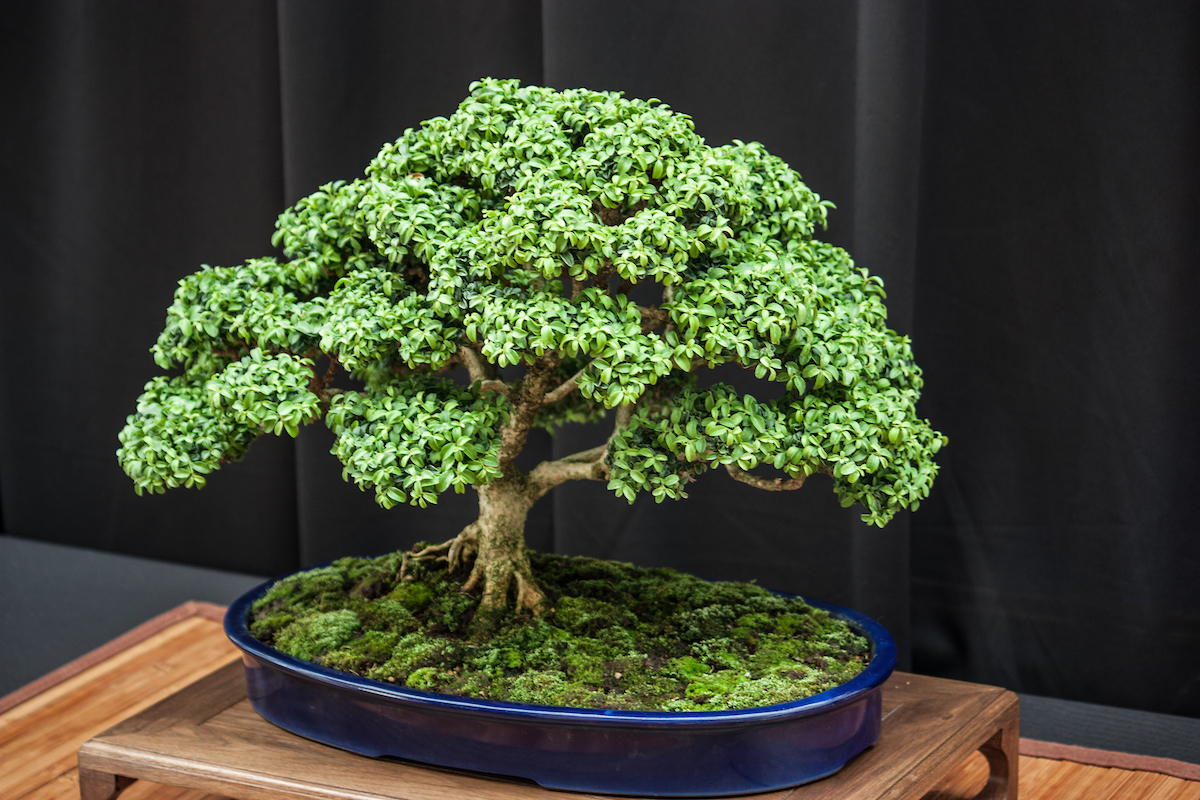
Bonsai, the art of growing miniaturized trees in shallow pots, has enchanted plant lovers for centuries, creating both whimsical tiny trees and a unique meditative practice.
Today, tending to bonsai is a hobby that anyone can try their hand at. All that is needed is a few simple tools and a lot of patience.
What is bonsai?

Though you may hear someone call these tiny trees bonsai trees, there is actually no specific species of tree called “bonsai”.
Bonsai instead is the art and practice of caring for and training these small trees. You could also think of bonsai as a description of the tree, even when it is used as a noun.
Bonsai are classified by the general shape of their trunks (formal upright, slanting, and cascading), as well as by size. Some are so large they require two to three people to move them, and others are so tiny they can be balanced, pot and all, on a fingertip.
Where did Bonsai come from?
Bonsai originated in ancient China and is believed to have been brought to Japan at least 1,200 years ago. During the 19thcentury, Japanese artisans fine-tuned their techniques, combining a deep understanding of plant physiology with new materials and methods.
The word bonsai is Japanese, meaning “tree in a pot.” . According to Diane Relf, Extension Specialist, Horticulture at Virginia Tech, in the 13th century, the Japanese collected and potted wild trees that had been dwarfed by nature. These naturally formed miniatures were some of the first bonsai.

Two Japanese women examine a bonsai, called a “dwarf tree” at the time, in the Japanese garden of the 1904 World’s Fair in St. Louis. Photos from the St. Louis Public Library digital collection.
Dr. Thomas Elias writes in his article History of the Introduction
and Establishment of Bonsai in the Western World that bonsai was shared through international trade, scientific research, and events like the World’s Fair during the 17th-19th centuries.
Discover More: The Creation of the Japanese Garden
What are the benefits of growing bonsai?
In 2023, Journal of Therapeutic Horticulture published an article on some of the benefits of bonsai.
In a 2017 study involving male patients with spinal cord injury, patients reported feeling more relaxed and comfortable just when viewing bonsai. Tension/anxiety, anger/hostility, depression, and fatigue were also all significantly lower.

A 2021 study found that for skilled bonsai practitioners, their practice provided meaningful healing qualities and promoted integral health. They also experience improvements in creativity, resilience, adaptability, and social, physical, and personal health.
In summary, viewing or practicing bonsai can have the following benefits:
- Lowers anxiety and increases relaxation
- Lowers depression and fatigue
- Increases creativity, resilience and adaptability
- Improvements to social, physical and personal health
Discover More: Therapeutic Horticulture at Home
Beginner friendly bonsai species
The first step in growing bonsai is to pick the right species for your situation. Some species do better as indoor bonsai, while others will need to overwinter.
best for indoor bonsai

Some of the most beginner friendly bonsai are tropical plants that can be grown indoors as houseplants.
Ficus are perhaps the easiest to care for and the most commonly available. Two species make up the majority of ficus bonsai available for sale: Ficus retusa and Ficus microcarpa. These names are often used interchangeably, though the species do differ slightly in the size of their leaves. Common names include Indian laurel, Chinese banyan, and ginseng ficus.
Portulacaria afra (elephant’s bush), Schefflera sp. (umbrella plant), and Crassula ovata (jade plant) are also commonly used for bonsai and are relatively easy to train and care for.
Best for outdoor bonsai

Plants adapted to temperate climates are also commonly used for bonsai but have different winter care requirements than tropical plants. These plants cannot be kept indoors as a houseplant and instead require a cool, dormant period in winter.
This can be provided in a few ways, including burying pots outdoors in a sheltered location, or placing bonsai in a cold frame, enclosed porch, unheated garage or shed. Ideally temperatures will be maintained between 34-40°F; cool enough to keep plants dormant but still above freezing.
Juniperus sp. (junipers), Acer palmatum (Japanese maples), and Ulmus parvifolia (Chinese elm) are a few of the species recommended for beginners who want to grow bonsai that require winter dormancy. Be sure to provide juniper bonsai at least some light while overwintering because they are evergreen and require light year-round.
Caring for your first bonsai

Taking care of a bonsai is different from just about any other potted plant, and though some bonsai are easier to take care of than others, all require dedication and time to maintain.
Because their root systems are shallow, they may require watering as often as every day during the growing season. Regular potting mix that would be fine for most other plants is not suitable for bonsai. The potting media must be very well-draining and have good aeration, but still retain some soil moisture.
Most bonsai will need to be root pruned and repotted every few years, and the branches will need to be trained and pruned regularly. Despite these challenges, training a bonsai is a rewarding experience.
Resources for bonsai beginners

Growing bonsai has long been an artform passed down from mentor to apprentice. Today there are a wide range of different resources available to learn more about taking care of bonsai plants.
- Get involved in your local bonsai society or club. In the St. Louis area, the Bonsai Society of Greater St. Louis offers workshops and other events for everyone from beginners to experts. They also put together the bonsai display on view at the Missouri Botanical Garden during the Japanese Festival.
- Many books have been written about bonsai. Some good books for beginners include The Little Book of Bonsai by Jonas Dupuich and The Complete Book of Bonsai by Harry Tomlinson.
- Other sources of information about bonsai include blogs, YouTube videos, and podcasts.
Justine Kandra | Horticulturist
Jessika Eidson | Public Information Officer
Leave a Reply