If seeing all of the Olympics coverage from Paris has you wishing you could hop on a transatlantic flight and experience the botanical wonders of France, you are in luck!

You can find many beautiful plants native to France right here in St. Louis at the Missouri Botanical Garden. The Garden houses a large collection of plants native to France and southern Europe in general.  See how many you can find during your next visit.

A screenshot of the Living Collections Management System shows Acer monspesslum marked in two places on a map of the Missouri Botanical Garden.

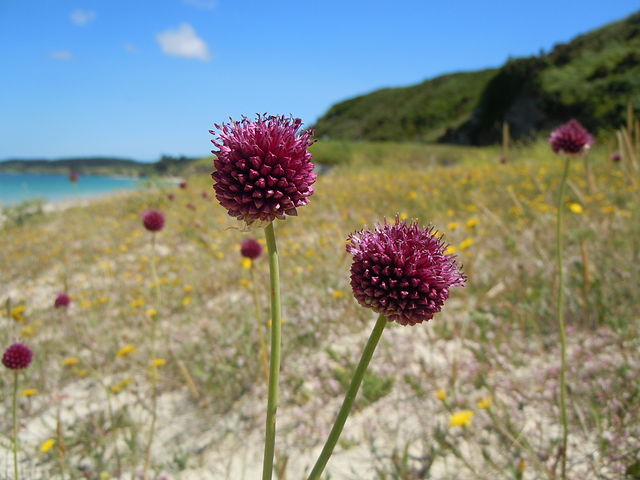
round-headed leek (Allium sphaerocephalon)

Round-headed leek is a ball of clustered pointy, magenta flowers.
 Round-headed leek at Dunes of Belle-Île-en-Mer, a nature reserve in Sauzon, France. Wikcommons

Also commonly called drumstick allium, this ornamental bulb produces showy, purple pom-pom inflorescences in summer. It is native to rocky, open habitats from western Europe to the Caucasus.

Plant in groups among other perennials in mixed borders or rock gardens. They make excellent fresh cut or dried flowers.

Round-headed leek is a ball of clustered pointy, magenta flowers.
Round-headed leek (Allium sphaerocephalon). Photo by Erik S. Anderson/Missouri Botanical Garden.
A view of the bulb garden at the Missouri Botanical Garden.
The Samuels Bulb Garden where round-headed leek can be found. Photo by Sundos Schneider/Missouri Botanical Garden.

Find it at the Garden: Find round-headed leeks blooming in the Samuels Bulb Garden.


Montpellier maple (Acer monspessulanum)

A tree with bright yellow leaves
Foliage of a Montpellier maple in a valley of Cuges-les-Pins in Southern France. Wikicommons.

Named for Montpellier, a city in southern France on the Mediterranean coast, this compact tree can reach up to 30′ tall with an equally wide, rounded, densely branched canopy.

A photo of dried Montpellier maple leaves and seeds.
An herbarium specimen show the unique shape of the Montpellier maple leaves. Missouri Botanical Garden Herbarium.
A waterfall is surrounded by orange and green trees on an autumn day. Overhead, storm clouds.
The waterfall in the Japanese Garden is home to a Montpellier. Photo by Kent Burgess / Missouri Botanical Garden.

Find it at the Garden: Look at the top of the waterfall in the Japanese Garden to spot a Montpellier maple.


French tarragon (Artemisia dracunculus ‘Sativa’)

Stringy clusters of French Tarragon.
French tarragon (Artemisia dracunculus ‘Sativa’). Missouri Botanical Garden.

This selection of wild tarragon is commonly used as a culinary herb. Its aromatic leaves have a slightly sweet, licorice or anise-like flavor with additional notes of herbal freshness and peppery spice.

A scanned image of a book gives culinary benefits of French tarragon.
A passage from “Meals Medicinal: With Herbal Simples”, c. 1905, shares the culinary benefits of French tarragon. Peter H. Raven Library/Missouri Botanical Garden.
An aerial view of the Tower Grove House with a the herb garden behind it. Within a gated area, diamond shaped areas contain plants.
A view of the Herb Garden where gardeners grow French Tarragon. Photo by Cassidy Moody/Missouri Botanical Garden.

It is a perennial subshrub with spreading rhizomes that can be grown successfully in sunny, St. Louis herb gardens as long as the soil is very well-draining.

Find it at the Garden: Find French tarragon growing in the Herb Garden behind Tower Grove House.


Scotch pine (Pinus sylvestris)

A black and white image of officials in military uniform surveying forests of Scotch pine.
Forests of young Scotch pines in France supplied lumber to American, British and French troops during World War 1 according to an article in Natural History, The Journal of the American Museum, c. 1919.

Scotch pine is a medium-to-large pine species native to northern Eurasia including France where it is grown both ornamentally and commercially for timber harvest.

A close-up image of needles on a scotch pine.
A closer view of scotch pine (Pinus sylvestris). Photo by Nathan Kwarta/Missouri Botanical Garden.
A landscape view of Crane Island at the Japanese Garden. In the foreground, a Scotch pine.
Scotch pine (Pinus sylvestris) on the left and Crane Island on an early October morning in the Japanese Garden. Photo by Tom Incrocci/Missouri Botanical Garden.

It has a picturesque, cone-shaped to rounded crown with showy, exfoliating reddish-orange bark. In the U.S. it is a popular Christmas tree.

Find it at the Garden: Many Scotch pines can be found growing throughout the Japanese Garden.


moss stonecrop (Sedum acre)

A cluster of greenish yellowish star-shaped flowers.
Moss stonecrop growing in Celles, Hérault, France. Wikicommons.

Moss stonecrop is a good ground cover plant for sunny areas of the garden with rocky or shallow soil. This perennial sedum only reaches 3″ tall, but will spread readily with the proper growing conditions.

Stonecrop  is as tiny, rhizomatous, tuberous-rooted, carpet-forming, evergreen succulent perennial which typically grows to only 3” tall but spreads in a moss-like fashion along the ground to 24” or more to form an interesting and often impressive ground cover.
A closer view of Moss stonecrop (Sedum acre). Missouri Botanical Garden.
A wooden pergola and fence separate the sidewalk from a garden area. In front of the pergola are containers of multicolored flowering plants.
Pergola and Summer plantings above the Fragrant Garden in the Kemper Center. Tom Incrocci / Missouri Botanical Garden

Find it at the Garden: Look for this plant growing at the edge of the main path by the tram pickup location just outside of the Kemper Center for Home Gardening.


Justine Kendra | Horticulturist with the William T. Kemper Center for Home Gardening

Leave a Reply

Discover more from Discover + Share

Subscribe now to keep reading and get access to the full archive.

Continue reading