Each year, the Missouri Botanical Garden’s Science and Conservation staff discover and name about 200 plant species new to science. That’s roughly 10 percent of all plant species discovered by scientists worldwide annually.
Discovery is the first crucial step in plant conservation. Until a species is described, we cannot think about conservation status or ensure its survival. Many plants described by scientists are critically endangered and at risk of disappearing. Once the species has a name, plans to try to ensure its survival can begin.
We’re still counting the number of new species discovered by the Garden this year, but here are a few highlights so far.

New species: Heisteria austroecuadorica
Type of plant: Distant relative of the sandalwood
Where it’s from: Ecuador
Describers: Garden Scientist Carmen Ulloa and colleagues Xavier Cornejo and Jürgen Homeier.
Preliminary conservation status: Endangered
More: This small tree endemic to the foothills of the Andes in southern Ecuador features fruits with a bright orange-red expanded calyx, like ballerina skirts. These miniature ballerina skirts are characteristic of this genus and perhaps attract Andean birds like toucans or parrots that eat the fruits and disperse the seeds. It took almost 25 years since first collected to study, compare, and gather additional material needed to describe this plant as new.

New species: Anthurium huaytae
Type of plant: Anthurium
Where it’s from: Peru
Describers: Garden Scientist Tom Croat and collaborator Carlos Martel
Preliminary conservation status: Unknown
More: Scientists analyzed the chemical compounds responsible for this plant’s scent to find its likely pollinator: euglossine bees, or orchid bees. These insects gather the perfume to attract female bees. The plant is known from only one location, but given similar environments nearby other populations may exist. It is one of an extensive list of aroids described by Garden Scientist Tom Croat.

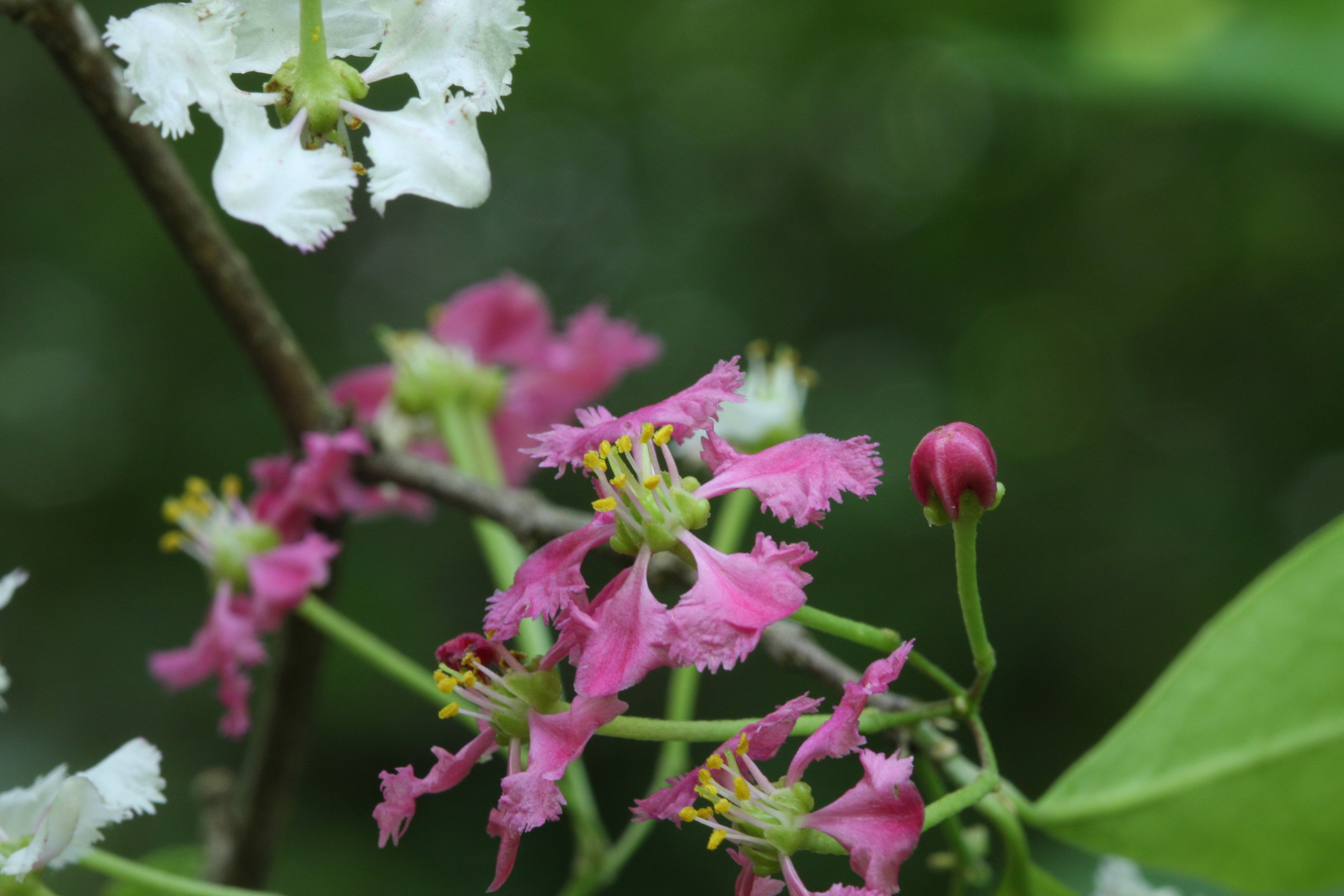
New species: Malpighia inclinata
Type of plant: Barbados cherry
Where it is from: Nicaragua
Describer: Garden Scientist Amy Pool
Conservation status: Unknown, but plant is considered rare
More: This shrub produces flowers that open pink and quickly fade to white, meaning both pink and white flowers can be seen on it simultaneously. It is probably quite rare as it has only been collected three times, all in a small area in Nicaragua. Like most Neotropical members of the Malpighiaceae family, this species is likely pollinated by female oil-gathering bees. These bees in the process of gathering oil from the plant’s oil-producing sepals to feed to their young and transfer pollen from the flowers of one plant to another.

New species: Dalbergia rakotovaoi
Type of plant: Rosewood
Where it is from: Madagascar
Describers: Garden Scientists Pete Phillipson, Nic WIlding, and colleague Simon Crameri
Conservation status: Endangered
Collected by recently retired botanist Charles Rakotovao, one the Garden’s most prolific plant collectors in Madagascar, this species is one of at least nine rosewood species described in 2023 as the Garden continues work on the Madagascar Precious Wood Project.
This project, started in 2019, aims to gather information on all species of rosewood, in the genus Dalbergia, and ebony, in the genus Diospyros, in Madagascar so that the Malagasy government will have the necessary information to sustainably manage this valuable resource. One of the main goals of the project was to develop a practical set of tools to facilitate field identification of rosewood and ebony species, even in the absence of flowers and fruits, which is often the case when conducting forest inventories.
New species of both Diospyros and Dalbergia continue to be discovered as taxonomic work advances. The most recently describes species brings the total number of accepted species in the genus Dalbergia in Madagascar to 64, all of which occur nowhere else in the world.

New species: Campomanesia madidiensis
Type of plant: Myrtle
Where it’s from: Bolivia
Describers: Garden Scientist Alfredo Fuentes, Missouri Botanical Garden, and collaborator Daniel Villarroel
Conservation status: Endangered
More: This new species is restricted to one of the most extensive, and until recently, best preserved Andean dry forests in the Madidi National Park. Its name celebrates and honors Madidi, one of the most biodiverse places on the planet. The species is threatened due to illegal mining that has recently been established and expanded in Madidi Park, particularly in these dry valley ecosystems. Mining threatens several other endemic species that were also discovered by the Garden’s Bolivia program.
Published in Revista de la Sociedad Boliviana de Botánica.

New species: Rustia ucayalina
Type of plant: False Quinine Tree
Where it’s from: Peru
Describers: Garden Scientist Charlotte Taylor
Preliminary conservation status: Endangered
More: This tree known from Amazonian Peru has unusual flowers. The flower’s anthers open by pores instead of slits and when an insect or hummingbird bumps them, they release a cloud of pollen that covers the insect or bird.
Most of the specimens of Rustia ucayalina were collected in the Oxapampa province, home of the Garden’s Peru project. Collections date back to the 1980s, and all but one of the scientists who have documented this tree have been Garden scientists.

New species: Polygonatum bifolium
Type of plant: Solomon’s seal
Where it’s from: Myanmar
Describers: Garden Scientist Aaron Floden and collaborator Kate E. Armstrong
Preliminary conservation status: Vulnerable
More: The smallest known species of Polygonatum, Polygonatum bifolium, grows only to 3-12 inches in height with only 2-3 leaves and 1-2 flowers. It has only been found in one small area near the border with India, where it grows as a perennial evergreen epiphyte—a plant that grows on another plant. It produces red-orange fruit, which scientists think is likely consumed by native birds.

New species: Anoectangium radulans
Type of plant: Moss
Where it is from: Mexico
Describer: Garden Scientist Richard H. Zander
Preliminary conservation status: Vulnerable
More: Mosses usually have smooth leaves or occasionally have tiny bumps over the leaf cells that are thought to enhance absorption of water after a long dry spell. Some species have very odd outgrowths that have no apparent immediate value for survival. It may involve some great leap in imagination to explain some moss features as adaptations.
Anoectangium radulans is named for the lines of ridges crossing the leaves, giving them the appearance of a tiny file. No suggestion, even for fun, was made in the published article of any possible value in species survival for this unusual feature. What do you think?

New species: Polystichum xuansonense
Type of plant: Fern
Where it is from: Vietnam
Conservation status: Unknown, but plant is considered rare
Describers: Garden Scientist Li Bing Zhang and collaborators Ngan Thi Lu and Liang Zhang
More: Garden Scientist Li Bing Zhang is a specialist in ferns that dwell in the odd habitat of caves and sinkholes but this species grows in the open open on limestone in dry forests. It was collected by Zhang and his co-describers during fieldwork in a national park in Vietnam in 2013. It is named for the national park.

New species: Brymela antioquiana
Type of plant: Moss
Where it is from: Colombia
Conservation status: Unknown
Describers: Garden Scientists John J. Atwood and Steven P. Churchill
More: The distinguishing features of this new species were first noted by Garden bryologist Steve Churchill in 1995, but the species was not formally described at that time and the specimens were then forgotten about among the backlog of Neotropical bryophytes waiting to be studied in the Garden’s herbarium. The second author re-discovered the specimens while working on the backlog.
The genus, Brymela, was described in 1985 by two Garden bryologists, Marshall Crosby and Bruce Allen, who were then also naming specimens from the extensive herbarium backlog at MO. The name ‘Brymela’ is an anagram based on the name of Garden Scientist Barry Hammel, who made the first collection of this genus in 1978 while doing fieldwork in Panama.
Steve Churchill, a longtime Garden scientist, passed away earlier this year. Through his work, he heavily contributed to knowledge of the mosses of the Andean countries of Colombia, Venezuela, Peru and Bolivia, and to building capacity for the study of mosses in those countries.
Published in Acta Biologica Plantarum Agriensis.

New species: Desmopsis terriflora
Type of plant: Custard apple
Where it is from: Mexico
Conservation status: Unknown
Describer: Garden Scientist George E. Schatz and collaborators María Fernanda Martínez-Velarde, Andrés Ernesto Ortiz-Rodriguez, and Thomas Wendt
More: This rare tree flowers in a most extraordinary way. Long whip-like branches extend from the lower trunk and are then buried in the leaf litter just below the surface before sending up erect inflorescences. This type of flowering, called flagelliflory, is a very rare phenomenon in nature and has been documented in only 20 tree species. Observations suggest Desmopsis terriflora is mainly pollinated by flies and ants.
Published in PhytoKeys.


New and Resurrected Genera
Genus is a taxonomic rank above species. Calea is a genus of flowering plants in the aster family originally described by Carl Linnaeus in 1763. The genus has grown to more than 100 species and the plants are common throughout tropical America, yet poorly known and often misclassified.
“Over the centuries Calea has become a trash dump (so-to-speak) of unrelated species that are artificially similar,” said Garden Scientist John Pruski, who has studied the genus since 1983.
In 2023, Pruski published a 170-page paper on Calea that described three new genera and resurrected three others.
A resurrected genus is one that was described, but then ceased to be used as its plants were classified into another existing genus or other genera. For instance, the genus “Lemmatium” was named as a new genus in 1836 but decades later, scientists decided it was synonymous with “Calea.” Pruski deemed Lemmatium to be distinct from Calea due to its narrowly-stalked four-angled fruits compared to Calea’s flat-based round fruits.
In total, the newly-described and newly-resurrected genera comprise 67 species.
Catherine Martin
Senior Public Information Officer
Leave a Reply